What Size Furnace Do I Need? Free Calculator and Sizing Guide
Ask five sizing websites about the same 2,000 square foot house and you can get five answers. One says 48,000 BTU. Another says 120,000. Both sound sure of themselves, and a contractor quote may land anywhere in between.
This guide answers what size furnace do I need with math you can check yourself. You will learn to read the rating plate on your current furnace and size a new one from last winter’s gas bill. You will also see why most charts aim too high.
Start with the furnace size calculator below. The gas bill tab gives the most realistic answer for an existing home, and the square-foot tab shows the rule-of-thumb number most sites use.
Furnace Size Calculator
Enter one winter gas bill, one summer bill and your design temperature. The tool estimates your home’s real heat loss and shows which common furnace sizes fit. Add your current furnace’s input rating to see how close the old one was.
The square-foot rule is the method most sites use. It tends to run high, so treat this answer as a ceiling and check it with the gas bill method.
The Short Answer
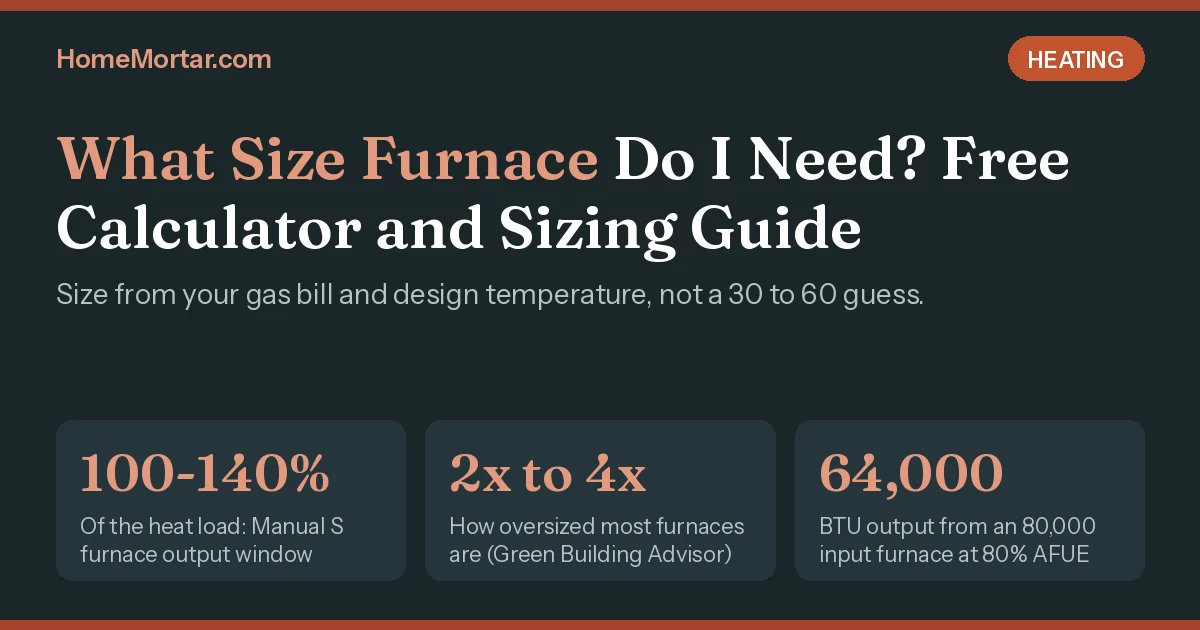
Here is the short answer to what size furnace do I need. Pick one whose output covers roughly 100% to 140% of your home’s heat loss on a design day. That window comes from ACCA Manual S, the industry method contractors use to pick equipment after a Manual J load calculation.
Square footage alone cannot tell you that heat loss. Two houses of the same size can need furnaces that differ by half. Insulation, air leaks, windows and your local winter temperature all move the number.
For a fast ceiling, many sites multiply square feet by 30 to 60 BTU. Read the rest of this guide before you trust that figure. Studies keep finding that installed furnaces are far bigger than the homes need.
Input vs Output BTU: Read the Rating Plate First
Every gas furnace has two BTU numbers. Input is the fuel it burns per hour. Output is the heat that actually reaches your ducts. Most furnaces are sold and labeled by input, which is why so many sizing conversations go wrong.
Find the size of your current furnace
Open the burner door or look on the side of the cabinet for the rating plate. It lists the model number, the input BTU per hour and often the output. The yellow EnergyGuide label, if it is still there, shows the AFUE.
The model number usually hides the input size too. A string with “080” or “100” in it often means 80,000 or 100,000 BTU input. Brands differ, so confirm it on the plate. Our guides to Lennox furnace age, Carrier age by serial number and Goodman age by serial number show where those labels sit.
The AFUE math
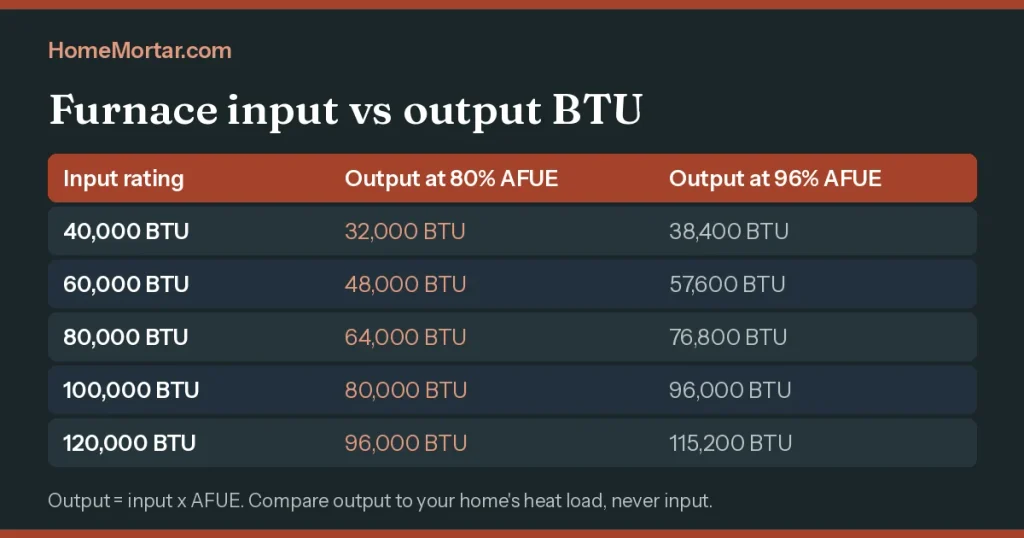
AFUE is Annual Fuel Utilization Efficiency. Output equals input times AFUE. The U.S. Department of Energy covers this in its Energy Saver guide to furnaces and boilers. It puts older systems at 56% to 70% AFUE, mid-efficiency at 80% to 83% and high-efficiency at 90% to 98.5%.
| Input rating | Output at 80% AFUE | Output at 96% AFUE |
|---|---|---|
| 40,000 BTU | 32,000 BTU | 38,400 BTU |
| 60,000 BTU | 48,000 BTU | 57,600 BTU |
| 80,000 BTU | 64,000 BTU | 76,800 BTU |
| 100,000 BTU | 80,000 BTU | 96,000 BTU |
| 120,000 BTU | 96,000 BTU | 115,200 BTU |
So an 80,000 BTU furnace at 80% AFUE delivers about 64,000 BTU. The same box at 96% delivers about 76,800 BTU. Compare output to your heat load, never input.
Real rating plates can differ a little from this math, because AFUE is a seasonal rating. Lennox, for example, lists its EL296UH070XV36B at 66,000 BTU input and 62,000 output at 96% AFUE. When your plate lists an output figure, use that number.
A higher AFUE does not mean your house needs fewer BTUs. It means you burn less gas to deliver the same heat. That point trips up a lot of buyers.
Furnace Size Chart by Square Footage
This furnace size chart uses the five-band rule of thumb that AC Direct, IWAE and Advantage Heating all publish. Each band lists BTU of required output per square foot. Use the low end for a tight, well insulated house and the high end for an older, drafty one.
| Heated sq ft | Band 1, hot (30-35) | Band 2, warm (35-40) | Band 3, mixed (40-45) | Band 4, cool (45-50) | Band 5, cold (50-60) |
|---|---|---|---|---|---|
| 1,000 | 30,000 to 35,000 | 35,000 to 40,000 | 40,000 to 45,000 | 45,000 to 50,000 | 50,000 to 60,000 |
| 1,200 | 36,000 to 42,000 | 42,000 to 48,000 | 48,000 to 54,000 | 54,000 to 60,000 | 60,000 to 72,000 |
| 1,500 | 45,000 to 52,500 | 52,500 to 60,000 | 60,000 to 67,500 | 67,500 to 75,000 | 75,000 to 90,000 |
| 1,800 | 54,000 to 63,000 | 63,000 to 72,000 | 72,000 to 81,000 | 81,000 to 90,000 | 90,000 to 108,000 |
| 2,000 | 60,000 to 70,000 | 70,000 to 80,000 | 80,000 to 90,000 | 90,000 to 100,000 | 100,000 to 120,000 |
| 2,500 | 75,000 to 87,500 | 87,500 to 100,000 | 100,000 to 112,500 | 112,500 to 125,000 | 125,000 to 150,000 |
| 3,000 | 90,000 to 105,000 | 105,000 to 120,000 | 120,000 to 135,000 | 135,000 to 150,000 | 150,000 to 180,000 |
Treat every number in this table as an upper limit, not a target. The bands are not official climate zones either. Each site draws its own map, and a city can fall in band 3 on one site and band 4 on another.
What each furnace size can heat by the rule
People often ask the question backward: how big a house will a 60,000 or 80,000 BTU furnace heat? Here is the same rule run in reverse, using output at 96% AFUE and the 30 to 60 range.
| Input rating | Output at 96% AFUE | Square feet by the 30 to 60 rule |
|---|---|---|
| 40,000 BTU | 38,400 BTU | about 640 to 1,280 |
| 60,000 BTU | 57,600 BTU | about 960 to 1,920 |
| 80,000 BTU | 76,800 BTU | about 1,280 to 2,560 |
| 100,000 BTU | 96,000 BTU | about 1,600 to 3,200 |
| 120,000 BTU | 115,200 BTU | about 1,920 to 3,840 |
At 80% AFUE each furnace covers about one fifth less. A tight modern house can often go well past the top of these ranges, because its real heat loss sits below the rule.
Why Every Furnace Size Chart Disagrees
We read 20 of the top sizing pages for this topic. For a 2,000 square foot home, Trane’s BTU glossary works out to 48,000 BTU. The cold column of Bryant’s table says 100,000 to 120,000 BTU. Some pages even contradict themselves between the main text and the FAQ.
Four habits explain most of the spread:
- Input and output get mixed up. One chart means fuel burned, the next means heat delivered, and few of them say which.
- Climate zones are homemade. Sites use five, six, seven, eight or nine zones with different borders.
- Cooling tables sneak in. At least one popular guide prints an air conditioner table in tons and calls it furnace sizing.
- The rule bakes in a cushion. A rule that must cover a drafty 1950s house will oversize a tight new one.
Field data backs this up. Fine Homebuilding cites studies showing that heating and cooling equipment is “almost always oversize, sometimes by as much as 200%.” Dana Dorsett, writing for Green Building Advisor, says most equipment puts out 2 to 4 times the heating load. A 2002 DOE fact sheet noted that nearly 40% of surveyed contractors oversized on purpose.
How to Size a Furnace, Step by Step
Here is how to size a furnace for a house without guessing. The first three steps are the heart of a Manual J. The last two are Manual S.
- Find your 99% design temperature. This is the outdoor temperature your area stays above for 99% of the hours in a year.
- Find the heat loss per degree. A Manual J does this room by room from walls, windows, ceilings and air leaks. The gas bill method below gets close for an existing home.
- Multiply. Heat loss per degree times the gap between indoors and the design temperature gives the design heat load in BTU per hour.
- Pick output inside the window. Choose a furnace whose output lands at 100% to 140% of that load.
- Convert to input and check the ducts. Divide output by AFUE to get the input size, and make sure the ducts can move the air a bigger blower needs.
What design temperature means
Energy Vanguard’s Allison Bailes explains it with Fort Collins, Colorado, where the 99% design temperature is 0°F. The thermometer drops below that for only about 88 hours in an average year. Sizing for the record low instead would oversize the furnace for every other night.
Design temperature sets furnace size. Heating degree days, a measure of how cold a whole season runs, set the gas bill. Seattle and Atlanta show the difference. Their design temperatures are similar, so a house in each would need about the same size furnace. Seattle racks up more degree days, so its bills run higher.
| County (city) | 99% heating design temperature |
|---|---|
| Fairbanks North Star, AK | -40°F |
| Anchorage, AK | -14°F |
| Cook, IL (Chicago) | 2°F |
| Denver, CO | 3°F |
| Hartford, CT | 8°F |
| Ada, ID (Boise) | 11°F |
| District of Columbia | 21°F |
| Fulton, GA (Atlanta) | 25°F |
| Sacramento, CA | 31°F |
| Miami-Dade, FL | 48°F |
These values come from ENERGY STAR’s Design Temperature Limit Reference Guide, which is built on ASHRAE weather data. Ask your contractor for your own county’s number before you run the calculator.
Size It From Your Own Gas Bill
Your house has already run a heat-loss test every winter. The gas meter recorded the result. This method turns one cold-month bill into a design heat load. Dana Dorsett describes it in detail at Green Building Advisor. For an existing home, it is the closest you can get to answering what size furnace do I need without hiring anyone.
- Take a January or February bill and note the gas used and the billing days.
- Subtract the gas your water heater, stove and dryer use. A summer bill shows that baseline.
- Multiply the heating gas by 100,000 BTU per therm and by the old furnace’s AFUE. That is the heat delivered.
- Divide by the heating degree days for those exact dates, then by 24. You now have BTU per hour for each degree below 65°F.
- Multiply by 65 minus your design temperature. That is your design heat load.
The U.S. Energy Information Administration lists 1 therm at 100,000 BTU and 1 cubic foot of gas at 1,036 BTU. Some bills show Ccf, which is 100 cubic feet, or about 103,600 BTU. Free sites such as DegreeDays.net give heating degree days for any weather station and date range.
A worked example (hypothetical numbers)
Take a 2,000 square foot house near Chicago with an 80% AFUE furnace rated at 100,000 BTU input. Its January bill shows 210 therms over 31 days. Its summer bill shows 18 therms over 30 days, and the billing period logged 1,150 heating degree days.
| Step | Math | Result |
|---|---|---|
| Baseline gas for 31 days | 18 / 30 x 31 | 18.6 therms |
| Gas used for heat | 210 minus 18.6 | 191.4 therms |
| Heat delivered | 191.4 x 100,000 x 0.80 | 15,312,000 BTU |
| Per degree-day | 15,312,000 / 1,150 | about 13,315 BTU |
| Per degree-hour | 13,315 / 24 | about 555 BTU |
| Design load at 2°F | 555 x (65 minus 2) | about 35,000 BTU/h |
The Manual S window for this house runs from about 35,000 to 49,000 BTU of output. A 40,000 BTU input furnace at 96% AFUE puts out 38,400 BTU, or 110% of the load. That fits.
The square-foot rule for the same house in a cold band says 100,000 to 120,000 BTU. The existing furnace puts out about 80,000 BTU, roughly 229% of the real load. That is the pattern Green Building Advisor describes, and it explains why the house never ran out of heat.
Where the bill method goes wrong
- Sunny weeks hide some heat loss. Free solar gain through windows lowers the gas used, so the result can read a little low.
- A fireplace, space heater or wood stove skews it. Any heat that did not come from the furnace makes the house look tighter than it is.
- A changed house needs a new number. New windows, an addition or a finished basement all change the load.
- Thermostat habits matter. Deep night setbacks cut gas use. Our guide on whether 72 is a good temperature for heat in the winter covers setpoints.
Run two different winter bills if you can. If both answers land close together, you can trust the range.

What Changes the Number
Insulation and air sealing
Heat leaks out through every surface and every gap. The DOE Energy Saver guide makes a simple point: efficiency upgrades let you buy a smaller furnace. If you plan to add attic insulation or seal air leaks, do it first and size after.
Windows
Single-pane glass loses heat much faster than modern double-pane windows. A wall of old glass can push a room’s load well above its neighbors. A room-by-room Manual J catches that. A whole-house rule cannot.
Ceiling height and volume
Most charts assume 8-foot ceilings. A 10 or 12-foot ceiling adds wall area and air volume, so it raises the load. No reliable source we found gives one fixed percentage, which is another reason a load calculation beats a chart.
Basements and finished spaces
A finished basement or a new bonus room adds heated area. A heated basement with exposed walls also loses heat to cold soil. Count only spaces you actually heat.
Ductwork
AC Direct points out that existing ducts can cap the furnace size you can install. A bigger furnace pushes more air. Small or leaky ducts turn that extra air into noise and wasted heat. Ducts in a cold attic or crawlspace lose heat before it reaches the rooms.
Altitude
Air holds less oxygen at elevation, so gas furnaces are derated. ACHR News quotes Rheem: most furnaces need a 4% input reduction per 1,000 feet when installed above 2,000 feet. Some condensing models use 2%. By that 4% rule, an 80,000 BTU furnace at 5,000 feet acts like a 64,000 BTU input unit. Always follow your model’s installation manual.
Oversized vs Undersized: Signs and Fixes
| Too big | Too small | |
|---|---|---|
| How it runs | Short bursts, frequent starts | Runs almost nonstop in a cold snap |
| Comfort | Hot blasts, then cool rooms | House drifts below the setpoint |
| Wear | More starts on igniter, blower and controls | Long hours on every part |
| Noise | Loud starts, high airflow in small ducts | Steady but constant |
| Efficiency | Each short cycle wastes some heat | Fine until the coldest days |
For a heat-only furnace, a modest oversize is less harmful than an oversized air conditioner. A furnace does not need long runs to pull humidity out of the air. Big oversizing still costs you, though. You pay more up front, and the house gets uneven heat.
If the right size falls between two models, look at two-stage or modulating furnaces. A two-stage unit runs on a low fire most of the time and uses high fire only on the coldest days. A modulating unit adjusts in small steps. Either one softens the effect of a little extra capacity.
An undersized furnace is rarer, but it happens after additions or when someone downsizes on a guess. If yours runs constantly and the house still falls behind on a design day, the furnace may be too small. Leaky ducts and a dirty filter cause the same symptoms, so rule those out first.
Choosing between one and two flame sizes? Our guide to the two stage furnace shows real low-fire numbers from Carrier and Goodman spec sheets.
Manual J: What It Is and How to Get One
Manual J is the ANSI-recognized ACCA method for residential heating and cooling loads. It works room by room from your walls, windows, insulation, air leakage, ducts and local design temperatures. Manual S then picks the equipment. Manual D sizes the ducts.
The International Residential Code requires equipment to be sized from Manual J or an approved method under section M1401.3. Fine Homebuilding notes that the rule is often ignored. Its editor Martin Holladay even warned that contractor load calculations “should be looked at with suspicion” if the inputs are padded.
To get a real one, you have a few options:
- Ask each bidding contractor for a printed Manual J and Manual S summary, not just a size.
- Hire a HERS rater or an energy auditor. Many also run a blower door test that measures air leakage.
- Check with your gas or electric utility. Some offer home energy audits that include a load calculation.
Compare the contractor’s design load with your gas bill estimate. If the Manual J says 90,000 BTU and your bill says 35,000, ask which inputs explain the gap.
Electric Furnaces and Heat Pumps
Electric furnaces are sized the same way, but in kilowatts. The EIA lists 1 kilowatt-hour at 3,412 BTU. Divide the BTU load by 3,412 to get kilowatts. A 20 kW electric furnace makes about 68,240 BTU per hour, and electric heat delivers nearly all of it.
The hypothetical Chicago house above, at 35,000 BTU per hour, would need about 10.3 kW at design conditions. Element sizes and circuits vary by model, so your electrician and the installation manual set the final choice.
Heat pumps follow a different rule set because their capacity drops as it gets colder. Google Trends lists “what size heat pump do i need” as a rising search. Many homeowners now compare a furnace with a heat pump or a dual-fuel setup. Our comparison of heat pump vs mini split systems is a good place to start.
Pricing a mini split for one room instead? Our mini split sizing calculator starts from the ENERGY STAR room chart.
What Changed in 2025 and 2026
- The 95% furnace rule is back in court. DOE’s rule requires non-weatherized gas furnaces made after December 18, 2028 to reach 95% AFUE. That effectively ends new 80% models. On June 8, 2026, the U.S. Supreme Court vacated an appeals court ruling that had upheld it and sent the case back.
- A delay is under review. DOE is weighing an industry petition to push compliance to at least January 1, 2030. As of late October 2026 we found no final decision.
- Today’s floor is still 80%. The current federal minimum for most gas furnaces has been 80% AFUE since 2015.
- ENERGY STAR sets the high bar. Gas furnaces need 95% AFUE or better in the U.S. South and 97% or better in the U.S. North to earn the label.
- Search interest jumped. Google Trends shows U.S. searches for “furnace size” hit a five-year high in winter 2025-26, and interest is climbing again this fall.
The size math does not change with any of these rules. Only the AFUE you plug in does.
Furnace Sizing in Canada, the UK and Australia
Canada. Natural Resources Canada sets a 95% AFUE minimum for gas furnaces up to 225,000 BTU per hour. It applies to furnaces made on or after July 3, 2019. Sizing follows CSA F280-12, “Determining the required capacity of residential space heating and cooling appliances,” reaffirmed in 2025. Ask your contractor for an F280 report the same way a U.S. buyer asks for a Manual J.
United Kingdom. Google Trends shows almost no UK searches for furnace sizing. If you heat with a gas boiler, the same idea applies: a heat-loss calculation in kilowatts sets its size.
Australia. Search interest is also very low. Whatever the heater type, a heat-load calculation at your local design temperature is the right starting point.
The core idea travels well. Measure the heat loss at your local design temperature, then pick equipment that covers it without a big cushion.
Questions to Ask a Contractor
- What design temperature did you use for my address?
- What is my design heat load in BTU per hour?
- Is the furnace size you quoted input or output?
- What percentage of my load does its output cover?
- Did you include my ducts, and can they handle the airflow?
- Would a two-stage or modulating model fit my load better?
- Do you need to derate it for my elevation?
- Can I see the Manual J and Manual S summary?
If the answer to the last question is no, keep shopping. A contractor who wants to replace the same size “because it worked” is skipping the most important step.
When two quotes disagree
Different quotes for the same house are common, and the gap can be large. One Ontario homeowner on Home Improvement Stack Exchange ran an online calculator for a 1,040 square foot house. It said about 62,000 BTU, while the furnace already installed was 80,000. Another commenter in the same thread heats more than 2,000 square feet with under 30,000 BTU in a very cold climate, thanks to heavy insulation.
That spread is normal when people size by rule or by habit. Put each quote’s size into the calculator above and look at the output column. The quote closest to your measured load, with a written load calculation behind it, usually deserves the most weight.
Safety note: gas line work, venting changes and furnace installation need a licensed HVAC contractor and usually a permit. A wrong vent or gas connection can leak carbon monoxide. Keep working CO alarms on every level of your home.
The Bottom Line
The honest answer to what size furnace do I need is a number in BTU per hour of output, measured at your design temperature. Square-foot charts give a ceiling, not an answer. Your gas bill gets you close, and a real Manual J settles it.
Pick a furnace whose output covers 100% to 140% of that load. If your old furnace sits far above it, smaller and staged may be the better buy. If you are deciding whether to replace at all, our repair or replace calculator weighs the age and the repair quote. Our guide on how long a furnace should last shows when replacement starts to make sense.
A new furnace still needs yearly care to reach its rated output. Our furnace tune-up cost guide lists what a good service visit covers.
Frequently Asked Questions
How many BTU furnace do I need for a 2,000 sq ft house?
By the 30 to 60 rule, 60,000 to 120,000 BTU of output, depending on climate. A well insulated 2,000 square foot home often needs far less. Our hypothetical Chicago house measured about 35,000 BTU per hour from its gas bill.
How big a house will a 60,000 BTU furnace heat?
At 96% AFUE it puts out about 57,600 BTU, which the square-foot rule spreads over roughly 960 to 1,920 square feet. In a tight house it can heat more.
How many square feet will an 80,000 BTU furnace heat?
At 96% AFUE it delivers about 76,800 BTU, or roughly 1,280 to 2,560 square feet by the rule. At 80% AFUE it delivers about 64,000 BTU.
How many square feet will a 100,000 BTU furnace cover?
At 96% AFUE it delivers about 96,000 BTU, roughly 1,600 to 3,200 square feet by the rule. Many homes with a 100,000 BTU furnace need much less than that.
Is it better to oversize or undersize a furnace?
Neither. Aim for output at 100% to 140% of the design load. If you must choose, a little extra capacity in a two-stage furnace is safer than running short on the coldest night.
Should I replace my furnace with the same size?
Not without checking. Your old furnace may have been oversized from day one, and your house may be tighter now. Run the gas bill method or ask for a Manual J before you buy.
Does a high-efficiency furnace need fewer BTUs?
Your house needs the same heat either way. A 96% furnace just delivers more of its input as heat, so it needs a smaller input rating to hit the same output.
What size furnace do I need for a 1,500 square foot house?
The rule says 45,000 to 90,000 BTU of output, from hot to cold climates. Use the furnace BTU calculator above with your gas bill to narrow it down for your home.