Water Heater Element: How to Test, Replace, and Choose the Right One
A dead heating element is one of the cheapest repairs an electric tank can need. The part itself can cost less than a pizza. The hard part is knowing for sure that the element is the problem, and buying the one that actually fits.
This guide covers the whole job. You will learn what a water heater element does and which symptoms point to the upper or lower one. You will also learn to read a multimeter without guessing. It also covers matching the replacement to your tank, swapping it safely, and what the repair costs in the U.S., Canada, the UK, and Australia. Every resistance number here comes from a manufacturer’s formula, not a rough range.
Quick Answer
- What it is: a metal rod that screws or bolts into the side of an electric tank and heats the water by electrical resistance. Most home tanks have two: an upper and a lower.
- Most common signs: no hot water at all, hot water that runs out fast, lukewarm water, or a breaker or reset button that keeps tripping.
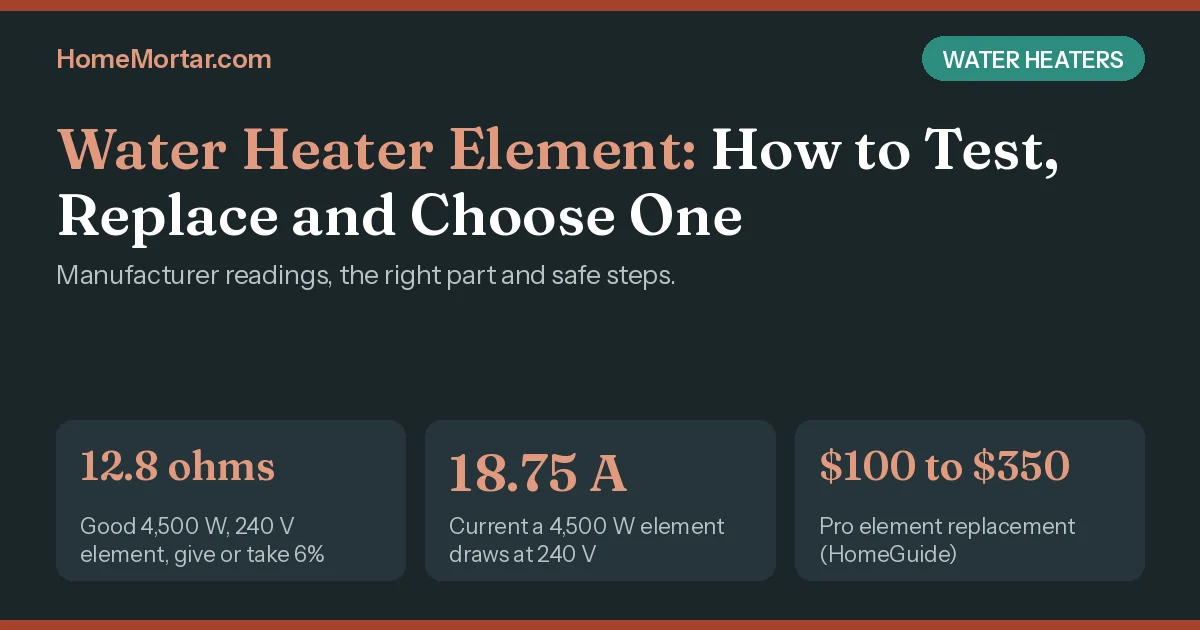
- How to test: power off, confirm it is dead, disconnect a wire, and measure ohms across the two screws. A 4,500 W, 240 V element should read about 12.8 ohms. Then check each screw against the tank. Any reading there means the element is grounded.
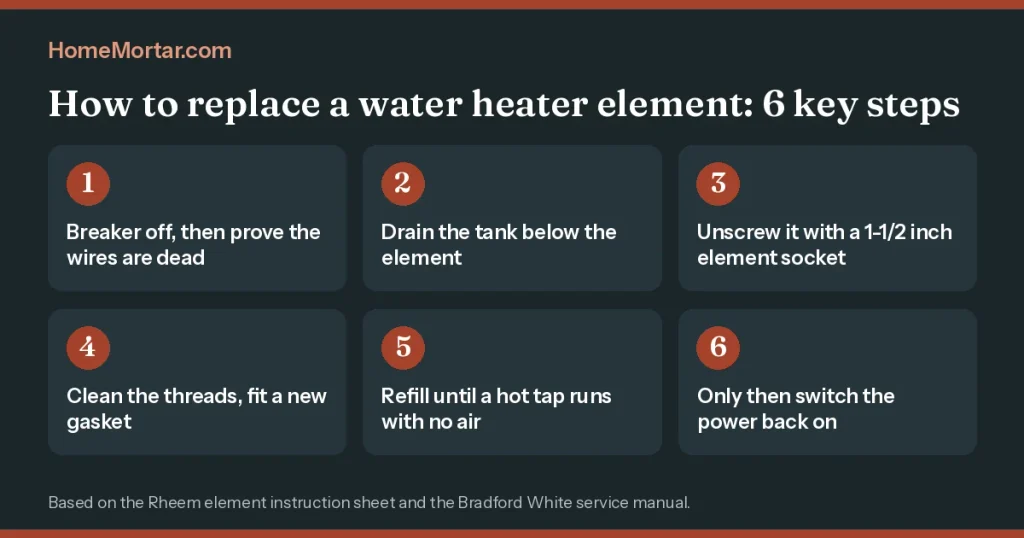
- How to replace: drain the tank below the element and unscrew it with a 1-1/2 inch element socket. Fit a new gasket, then refill until no air comes out before restoring power.
- Cost: a common Rheem 4,500 W element listed at $8.99 at Home Depot on 10 November 2026. HomeGuide puts a pro replacement at $100 to $350.
What a Water Heater Element Does
An electric water heater has no flame. Inside the tank, one or two metal rods carry current through a resistance wire packed inside a sealed sheath. The wire gets hot, and the sheath passes that heat into the water. Each element has its own thermostat on the outside of the tank, under an access panel.
The element head sits flush against the tank wall. You will see two screw terminals on its face, with a wire on each. The rod itself reaches into the water, where you cannot see it until you pull it out.
Upper vs lower element: which one runs first
In a standard two-element tank, both elements never run at the same time. Rheem’s wiring diagrams call this layout “double element non-simultaneous.” Bradford White’s service manual explains the order: “when the tank is cold, the upper element is energized first, heating the top of the tank.”
Once the top reaches its set temperature, the upper thermostat passes power down to the lower thermostat. The lower element then heats the rest of the tank. It usually does most of the daily work, because cold water enters near the bottom every time someone runs a tap.
That order explains the symptoms. If the upper element dies, power never moves down, so you get no hot water at all. If the lower one dies, the top still heats, so you get a short burst of hot water and then cold.
Gas water heaters do not have one
Plenty of people search for a gas heater element, but a gas tank heats with a burner under the tank. If a gas unit stops making hot water, look at the pilot, burner, or gas control instead. Heat pump (hybrid) water heaters are different again. They use a compressor most of the time and carry electric backup elements. You can read about them in our guide to what a hybrid water heater is.
Signs of a Bad Heating Element
Symptoms point you to the right side of the tank before you pick up a tool. This table pairs what you notice with the part most likely to blame.
| What you notice | Most likely cause | What to check first |
|---|---|---|
| No hot water at all | Upper element, upper thermostat, or a tripped high-limit (reset) switch | Breaker, then the red reset button, then test the upper element |
| Hot water for a few minutes, then cold | Lower element or lower thermostat | Test the lower element |
| Lukewarm water that never gets hot | One weak or failed element, scale on the element, or a thermostat set low | Test both elements, then check the dial |
| Breaker trips when the heater calls for heat | Element shorted to the tank, or damaged wiring | Ground test on each element |
| Red reset button keeps popping | Bradford White says repeated trips are “usually the result of a grounded element” | Ground test, then thermostats |
| Rumbling or popping noises | Sediment on the tank floor around the lower element | Flush the tank |
| Water far too hot | A thermostat stuck closed, not the element | Have the thermostats checked |
No hot water at all
Start with the breaker and the reset button before blaming any part. The high-limit switch, often called the ECO, sits above the upper thermostat. Rheem’s manual says once it opens, “it must be reset manually.” If it trips again soon after, something is overheating. A grounded element is the usual suspect.
Hot water runs out fast
A short shower followed by cold water is the classic lower element failure. Before you test, think about the season. Incoming water is much colder in winter, so a healthy tank delivers less hot water in January than in July. A sudden change in the same month is the stronger clue.
Breaker trips or the element looks burned
A shorted element can pull current to the tank body and trip the breaker. You may also find a cracked sheath, a burned terminal or crusty scale when you pull one out. Popular Mechanics shows a removed element with mineral deposits bridging the coil, which is a sign to replace it even if it still reads correctly.
Safety Before You Open the Panels
Most electric water heaters in the U.S. and Canada run on 240 volts. That is twice a normal outlet and enough to kill. Treat every step below as required, not optional.
- Switch off the breaker. It is usually a double-pole breaker. Mislabeled panels are common, so do not trust the label alone.
- Prove it is dead. Test your voltage tester on a live outlet first, then check every wire at the thermostat and element. No beep, no reading.
- Let the water cool. The element and tank stay hot after power is off. The Spruce suggests waiting two hours or more before testing.
- Keep the plastic covers. They protect the terminals, and they go back on before power is restored.
- Know your limit. Any test with the power on, such as a live voltage or amp reading, is a job for an electrician or plumber.
If the tank is rented, which is common in Ontario, call the rental company first. Enercare, for example, says its rental plan includes “coverage for repairs over the life of your equipment,” subject to the rental agreement.
How to Test a Heating Element With a Multimeter
Learning how to test water heater element resistance takes about ten minutes, and a cheap digital multimeter is all you need. The reading tells you exactly which part to buy. Bradford White’s service manual gives the method most competitor guides skip: work out the correct reading from the element’s own rating.
- Turn off power and confirm it is dead with a tester, as described above.
- Remove the access panels for both elements, fold back the insulation, and unclip the plastic covers.
- Photograph the wiring. It saves guesswork when you put things back.
- Disconnect one wire from the element. Testing with both wires on can read through the thermostat and give a false result.
- Set the meter to the lowest ohms (Ω) range and touch the probes together. The display should read close to zero.
- Measure across the two element screws. Compare the number with the chart below.
- Do the ground test. Put one probe on an element screw and the other on bare tank metal or the element’s mounting flange. Repeat for the second screw.
- Repeat on the other element, then reconnect the wires, covers, insulation, and panels.
Resistance chart by wattage and voltage
The rule is Ohm’s law. Resistance equals the rated voltage squared, divided by the rated watts. Bradford White’s example is a 240 V, 4,500 W element, which should read 12.8 ohms, give or take 6%. A reading outside that band means the element should be replaced.
| Element rating | Expected reading | Acceptable range (±6%) | Current draw |
|---|---|---|---|
| 1,500 W at 120 V | 9.6 ohms | 9.0 to 10.2 | 12.5 A |
| 2,000 W at 120 V | 7.2 ohms | 6.8 to 7.6 | 16.7 A |
| 3,500 W at 240 V | 16.5 ohms | 15.5 to 17.5 | 14.6 A |
| 3,800 W at 240 V | 15.2 ohms | 14.3 to 16.1 | 15.8 A |
| 4,500 W at 240 V | 12.8 ohms | 12.0 to 13.6 | 18.75 A |
| 5,500 W at 240 V | 10.5 ohms | 9.8 to 11.1 | 22.9 A |
| 3,500 W at 208 V | 12.4 ohms | 11.6 to 13.1 | 16.8 A |
| 4,500 W at 208 V | 9.6 ohms | 9.0 to 10.2 | 21.6 A |
Use the voltage and wattage stamped on the element head or printed on the tank’s rating plate. The 208 V rows only apply to elements rated for 208 V.
Here is a hypothetical example. Your meter shows 12.4 ohms on a 4,500 W, 240 V element. That sits inside 12.0 to 13.6, so the element is fine. A reading of 15.1 ohms on the same element is outside the band, so replace it.
What OL, 0, and a ground reading mean
Several top-ranking guides mix these up, so here they are in plain words.
- OL, “1” or infinity across the screws: the coil inside has broken. The element is open and cannot heat. Replace it.
- 0 or close to 0 across the screws: the coil has shorted. Replace it.
- The chart value across the screws: the coil is fine. Now do the ground test before you trust it.
- Any reading from a screw to the tank: the element is grounded. Bradford White is blunt: “Any reading indicates a grounded element and the element must be replaced.” A good element shows OL here.
If both elements pass both tests, the fault is probably a thermostat, the high-limit switch or the wiring. Our guide on how to test a water heater thermostat covers those parts step by step.

Testing without a multimeter
You cannot confirm a bad element without a meter, but you can narrow it down. Home inspectors on the InterNACHI forum describe running a hot tap and checking the temperature at five and ten minutes. Hot water that turns cold early points to the lower element. No heat at all points to the upper side.
Some pros also use a clamp meter on a live element wire to see whether current is flowing. That is a power-on test, so leave it to an electrician. For a homeowner, a basic multimeter costs less than one service call.
How to Find the Right Replacement Element
Element shelves look alike, but the wrong part can leak, overheat or fail early. Rheem’s instruction sheet says to use “the same element flange, gasket type, wattage and voltage as on the unit being replaced.” Bradford White and U.S. Water Heating Solutions add length to that list.
Look in two places for the details:
- The rating plate on the side of the tank lists voltage and wattage. Some tanks list a different wattage for the upper and lower element.
- The element head usually has the voltage, wattage and part number stamped on it. You may need to pull the element to read it.
The fastest route is the tank’s model and serial number. Parts sites and the manufacturer can match the exact part from those. Need help with the label? Our guides to Rheem water heater age and Bradford White water heater age show where the plate sits.
Screw-in vs flange (bolt-in)
Most modern home tanks use a screw-in element. Rheem lists a 1-1/2 inch socket for screw-in elements and a 3/8 inch socket for the older four-bolt flange type. Popular Mechanics agrees that most elements need a 1-1/2 inch socket. Flange elements are harder to find today, and stores sell adapter kits for some older tanks.
Watt density and sheath material
Rheem’s own part names show how many versions of the “same” 4,500 W element exist. Its list includes copper and stainless steel elements, high, medium and low watt density, and a stainless “Dry Fire Resistant” low watt density model.
| Element type | What it means | When it fits |
|---|---|---|
| Copper | Grainger notes copper’s high thermal conductivity; it is the common, low-cost original part | Soft or average water, like-for-like replacement |
| Stainless steel or nickel alloy (such as Incoloy) | Grainger says these resist corrosion | Hard water and high mineral content |
| Low watt density (LWD) | Heat spread over a larger surface, which Grainger says causes less wear | Hard water, scale problems, repeated burnouts |
| High watt density (HWD) | More heat from a smaller surface | Matches many standard original parts |
| Dry fire resistant | A stainless LWD design Rheem sells for extra protection | Extra insurance, but still fill the tank first |
Keep the voltage, wattage and length the same as the original. Within that rating, Grainger points to stainless or low-density elements as the long-lasting choice for very hard water. U.S. Water Heating Solutions notes you can use copper in place of stainless, though matching the original material is best.
Are upper and lower elements the same?
Often, yes, but not always. Plenty of tanks use the same element top and bottom. Others pair different wattages, and A. O. Smith sells a two-element kit rated at 3,500 W and 4,500 W. Check the rating plate rather than assuming, then buy each element to match its own spot.
How to Replace the Element, Step by Step
Here is how to replace water heater element parts the way the manufacturers describe it. The steps below follow the Rheem element instruction sheet and the Bradford White service manual. Sears PartsDirect rates the swap itself at 30 minutes or less. Draining and refilling add more time, depending on tank size and how fast the drain valve flows.
Tools and parts
- Multimeter and non-contact voltage tester
- 1-1/2 inch deep element socket or element wrench (3/8 inch socket for a four-bolt flange)
- Screwdrivers, garden hose, towels, and gloves
- The new element with a new gasket
- A small wire brush or rag to clean the threads
Step-by-step replacement
- Shut off power at the breaker and confirm the wires are dead.
- Test the drain valve first. Open it briefly with a hose attached, then close it. Plumbers on ElectricianTalk describe old tanks as so full of sediment that they would not drain, so find out before you loosen anything.
- Close the cold water supply and open a hot tap in the house to let air in.
- Drain the tank below the element. Rheem and Bradford White both say to drain to a point below the element you are replacing. For the lower element, that means nearly the whole tank. The water can scald, so route the hose to a floor drain or outside.
- Remove the panel, insulation, and plastic cover, then note which wire goes where and disconnect both.
- Unscrew the old element counterclockwise with the element socket. Pull out the old gasket too. Bradford White says it is “not recommended to be reused.”
- Clean the threads and the gasket seat in the tank opening. Old scale and sediment here cause leaks.
- Fit the new gasket on the new element and thread it in by hand, then tighten with the socket. Bradford White warns: “Do not over tighten, over tightening may damage element gasket.”
- Reconnect the wires firmly. Loose terminals can overheat. If a wire end is corroded, plumbingsupply.com suggests trimming and stripping it if there is enough slack, or calling an electrician if not.
- Close the drain valve and refill with the hot tap open. Wait until water flows from that tap with no spitting air.
- Check the element for leaks, then refit the cover, insulation, and panel.
- Restore power and give the tank a couple of hours to heat before you judge the repair.
Can you replace it without draining?
Some plumbers and electricians do it. On the Appliantology and ElectricianTalk forums, pros describe the method. They shut off the cold supply, open a hot tap to drop the pressure, close it again, then swap the element fast. One tech compared it to putting a finger over the end of a straw. The water stays in because air cannot get in.
It works best when you are experienced, the new element is ready in your hand, and towels or a wet vacuum are close by. The risks are real, though. A corroded gasket can stick, the old element can hang up, and the water may still be very hot. The manufacturer’s sheets we checked tell you to drain below the element first. If this is your first time, drain it.
Refill before power: avoid dry fire
This is the step that destroys new elements. A dry element overheats almost at once because there is no water to carry the heat away. Rheem’s manual is direct: “Heating element(s) WILL BE DAMAGED if energized for even a short time while tank is dry.”
A. O. Smith’s installation manual gives a clear test. Run a hot tap at full stream for a full three minutes before switching on the breaker. Rheem’s warranty also excludes failures caused by operating with an empty or partially empty tank. So one rushed minute can cost you both the element and the coverage.
Why a New Element Burns Out Again
If you are on your second or third element in a year, the element is rarely the real problem. Look for the cause before you buy another one.
- Dry fire. Power came on before the tank was full, or air was still trapped at the top. This kills the upper element first.
- Scale and sediment. U.S. Water Heating Solutions names mineral build-up as the most common cause of element failure. Crust insulates the element, so it runs hotter. A low-watt density or stainless element and regular flushing of the water heater both help.
- A grounded element tripping the ECO. Bradford White links repeated reset trips to a grounded element. Replace the element, then make sure nothing else is shorted.
- Loose or corroded wires. A loose terminal heats up and can burn the element head. Clean, tight connections matter as much as the part.
- A thermostat stuck closed. If a thermostat never switches off, the element runs nonstop. Test the thermostats too.
- The wrong use. A heating help forum user ran a small 4,500 W tank as a floor-heating boiler and burned out elements every couple of weeks. Tank heaters are built for domestic hot water.
Water Heater Element Replacement Cost
Water heater element replacement is cheap in parts. Labor is what moves the total. Here is what the sources we checked show in the U.S.
| Item | Typical price | Source |
|---|---|---|
| Rheem 4,500 W, 240 V copper element (SP10552MH) | $8.99 | Home Depot listing, checked 10 Nov 2026 |
| DIY total with basic tools | $10 to $60 | The Spruce |
| Both elements, DIY | $40 to $50 | Popular Mechanics |
| Element replaced by a pro | $100 to $350 | HomeGuide, 349 reported projects |
| Plumber hourly rate for water heater work | $45 to $150 an hour | HomeGuide |
| Thermostat replaced by a pro | $100 to $350 | HomeGuide |
Service call minimums, which HomeGuide lists at $50 to $200, can apply even for a short job. If both an element and a thermostat have failed, replacing them in one visit avoids paying that fee twice.
Canada, UK and Australia
Canada: Canadian electric tanks use the same 240 V elements and the same test. The big difference is ownership. Many Ontario homes rent their water heater, and rental plans such as Enercare’s include repairs. Check your gas or utility bill for a rental charge before buying parts.
United Kingdom: the same part is called an immersion heater, and it sits in a hot water cylinder. The DIYFAQ wiki says 27-inch elements are the most common, while 11-inch elements heat only the top. UK supply is 230 V, so a 3 kW element works out to about 17.6 ohms. MyJobQuote’s September 2026 figures put a fitted copper immersion heater at £150 to £240. It recommends a qualified electrician or heating engineer.
Australia: electric storage systems often use a 3.6 kW element. Genuine parts are listed for Rheem, Dux, Rinnai and Apricus tanks. At 230 V, a 3.6 kW element works out to about 14.7 ohms. Australian parts sellers state that electrical components must be fitted by a qualified electrician, so this is not a DIY job there.
Repair or Replace the Whole Water Heater?
An element swap makes sense on a tank that is otherwise healthy. It makes less sense when the tank itself is near the end. Rheem says most conventional tanks last around 10 years and recommends you start planning a replacement around that age. You can read more in Rheem’s guide to the signs a water heater is going bad.
| Situation | Usual call |
|---|---|
| Tank well under 10 years old, one failed element, no leaks | Replace the element |
| Both elements failed from heavy scale | Replace both, flush the tank, consider low-watt-density parts |
| Water pooling around the tank body | Replace the water heater; leaks from the tank itself are not repairable |
| Rusty hot water plus an old tank | Get a pro opinion; the tank may be near the end |
| Tank around 10 years or older with repeat repairs | Price a new heater before spending more |
Not sure where your tank stands? Our repair or replace calculator weighs age, repair cost, and replacement cost for you. If you are already pricing a new heater, our comparison of the pros and cons of a tankless water heater is a good next read.
Conclusion
A failed water heater element is usually a small, fixable problem, but only if you prove it first. Read the symptoms, kill and confirm the power, and measure the element against its own rating. Then do the ground test, which is where many guides go quiet.
When you buy the part, match voltage, wattage, length, and fitting. Choose low watt density or stainless if hard water keeps winning. Drain below the element, use a new gasket, and never switch the power back on until a hot tap has run steady and air-free. Do those things, and a cheap part buys an old tank more years of hot showers.
Frequently Asked Questions
How many ohms should a 4,500-watt element read?
A 4,500 W element rated for 240 V should read about 12.8 ohms. Bradford White allows 6% either way, so roughly 12.0 to 13.6 ohms is normal. If the element is rated for 208 V, expect about 9.6 ohms instead.
How long does a water heater element last?
No manufacturer we checked publishes a lifespan for the element alone. Water hardness, sediment, dry firing, and loose wiring decide most failures. For the tank as a whole, Rheem points to around 10 years.
Can you replace the element without draining the tank?
Experienced plumbers often do, by holding the water in with a vacuum and swapping the element quickly. The Rheem and Bradford White instructions say to drain below the element first. For a first attempt, draining is the safer choice.
Will a water heater work with only one element?
Partly. With a dead lower element, the upper one still heats the top of the tank, so you get a short supply of hot water. With a dead upper element, power never reaches the lower one, so you usually get no hot water.
Which element usually fails first?
Many plumbers report that the lower element fails more often, because it sits closest to sediment on the tank floor. The upper element is the one most often ruined by dry firing. It is the first to sit in air if the tank is not full.
How do I know which element I need?
Match the voltage, wattage, length, and fitting type of the old one. Find them on the tank’s rating plate or stamped on the element head. When in doubt, give the model and serial number to a parts counter.
How many amps does a 4,500-watt element draw?
Divide watts by volts. At 240 V, a 4,500 W element draws 18.75 amps, the same example Bradford White uses. The correct breaker and wire size for your heater are listed on its rating plate and in its manual.
How long does it take to replace a hot water heater element?
The swap itself can take 30 minutes or less, according to Sears PartsDirect. Draining and refilling usually take longer than the swap. A bottom element takes longer because the tank must drain almost completely.
Do I need a plumber or an electrician?
Plumbers and electricians both do this repair, and many homeowners do it themselves where local rules allow. In Australia, electrical parts must be fitted by a qualified electrician. Call a pro for any live voltage testing, damaged wiring, or a reset button that keeps tripping after the element is replaced.