Furnace Tune Up Cost: What You Should Pay and What You Should Get
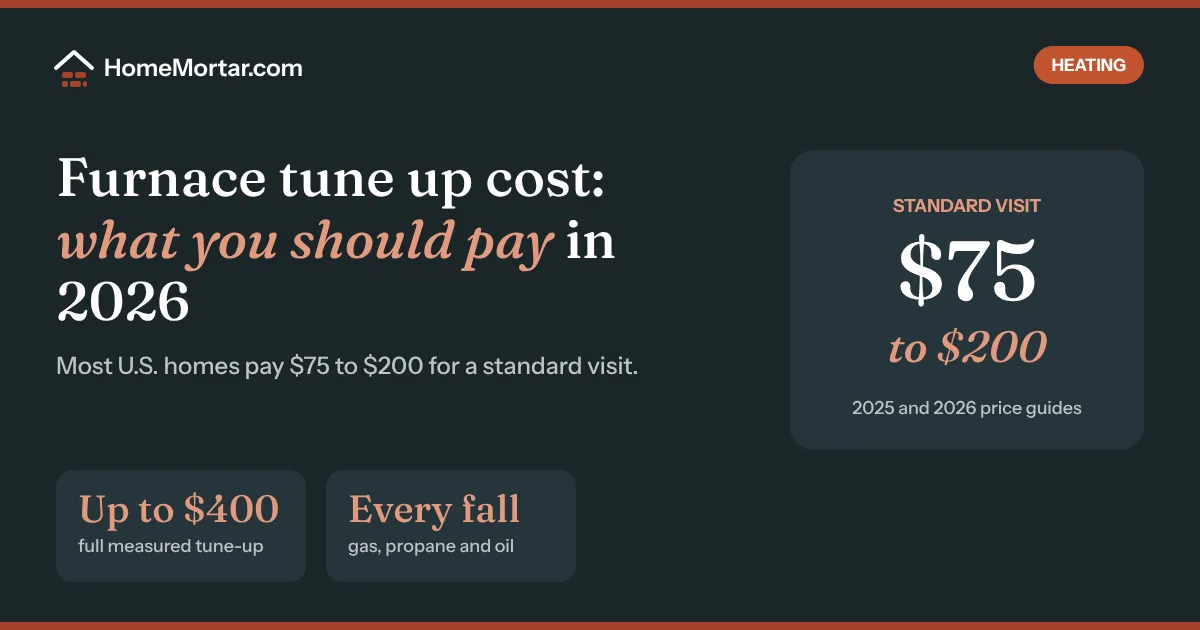
Most homeowners in the U.S. pay about $75 to $200 for a standard furnace tune-up. Full, instrument-based visits run higher, and fall promotions can drop below $70. Those are the figures that show up again and again in current HVAC price guides.
The price alone tells you very little, though. A $59 visit and a $250 visit can both be called a tune-up, and they may not include the same work. This guide covers the real furnace tune up cost in 2026 and what each price level should buy. It also compares maintenance plans and shows how to tell a thorough visit from a sales call.
The Short Version
- Typical range: about $75 to $200 for a standard gas furnace tune-up, based on 2025 and 2026 price guides.
- Full instrument-based service: often $150 to $400, with combustion analysis, static pressure and temperature rise measured.
- Promotions: $29 to $90 offers are common in late summer and fall. Expect a shorter checklist and, often, a sales pitch.
- Maintenance plans: usually $150 to $500 a year, often with two visits (heating and cooling) and repair discounts.
- Repairs are extra. A tune-up price covers inspection, cleaning and adjustment, not parts.
- Timing: ENERGY STAR advises checking the heating system in the fall, before you need it.
Furnace Tune-Up Prices in 2026, Compared
We read the current cost guides that rank in Google for this question and compared their numbers side by side. They do not agree perfectly, which is useful in itself, because it shows how much the scope of a tune-up varies.
| Source (date) | Standard tune-up | Full or premium tune-up | Maintenance plan |
|---|---|---|---|
| HomeGuide (Aug 2025) | $70 to $200 | Not separated | $150 to $450 a year |
| Summers Plumbing Heating and Cooling (Aug 2026) | $75 to $200; $100 to $150 most common | Not separated | Members often pay nothing extra |
| AC Direct (Aug 2026) | $80 to $200 | $150 to $400 | Not priced |
| Triple-O (updated Jun 2026) | $100 to $200 | $150 to $300 | $150 to $500 a year |
| Logan Services (updated Oct 2026) | $75 to $150 | Not separated | 10 to 20 percent off tune-ups |
| Gene May Heating and Cooling (Sep 2025) | $175 to $350 | Not separated | $150 to $500 a year |
| Bob Vila (2023, citing HomeAdvisor) | $100 to $200 | $130 to $200 for an advanced inspection | $150 to $500 a year |
Read the table as a range of the market, not a quote. Most sources cluster between $75 and $200 for a standard visit. The higher numbers usually describe a longer visit with measurements, or a region with higher labor rates. One local contractor page quotes $200 to $700, which almost certainly blends repairs into the figure, so we left it out of the comparison.

What Each Price Level Usually Buys
The same phrase covers very different visits. Here is how the work typically scales with the price.
| Price level | What is usually included | What is often missing |
|---|---|---|
| Promotional ($29 to $90) | Filter check, visual inspection, basic burner and flame check, a short report | Measurements, deep cleaning, written findings; time pressure is common |
| Standard ($75 to $200) | Burner and flame sensor cleaning, ignition test, safety switch checks, blower inspection, filter service, carbon monoxide check | Full combustion analysis and static pressure, depending on the company |
| Full or instrument-based ($150 to $400) | Everything above plus combustion analysis, gas pressure, temperature rise and static pressure, with a written report | Repairs and parts, which are billed separately |
| Maintenance plan ($150 to $500 a year) | Usually one heating and one cooling visit, priority booking, repair discounts | Plans vary widely, so read what is actually covered |
AC Direct, an equipment seller, makes a point worth repeating. A real tune-up is defined by measurements you cannot see, like combustion readings and static pressure. Time spent standing in the basement proves nothing.
What Changes the Price
Several factors push a quote up or down. Knowing them helps you compare two quotes fairly.
Fuel type
Gas furnaces are the most common and set the baseline. Oil furnaces usually cost more to service, because the nozzle, filter and combustion setup need more attention. Electric furnaces have no burner or flue, so a basic check can cost less. The section below breaks this down.
Scope of the visit
This is the biggest factor. A 30-minute look and a 90-minute visit with instruments are not the same product, even if both are called a tune-up.
Where you live
Labor rates differ by region and city. Busy northern markets in the fall, when every company is booked, can also price higher than a slow spring week.
Timing and promotions
Many companies advertise low fall specials to fill their schedule. Booking early in the season usually gives you more choice of appointment times.
Furnace age and condition
An older or neglected furnace may need extra cleaning or a part, such as a flame sensor or igniter. The tune-up price may be the same, but the final bill may not.
Number of systems
Pricing is usually per unit. A home with two furnaces, or a furnace plus a separate boiler, pays for each one.
Furnace Tune Up Cost by Furnace Type
Fuel type changes both the work and the price. The most detailed public breakdown we found is in Bob Vila’s guide, which cites HomeAdvisor data from 2022 and 2023. Prices have risen since, so treat these as a floor rather than today’s going rate.
| Furnace type | Typical tune-up range (2023 data) | Extra work compared with gas |
|---|---|---|
| Natural gas | $80 to $170 | Baseline: burners, flame sensor, gas pressure, carbon monoxide test |
| Oil | $100 to $200 | Nozzle and oil filter changes, combustion tuning, tank and fuel line check |
| Electric | $70 to $130 | No burner or flue; heating elements, sequencers and wiring are checked instead |
| Propane | Usually close to natural gas | Gas pressure is set for propane; the tank is the supplier’s job |
| Heat pump with backup heat | Often priced as a heating and cooling visit | Refrigerant system plus electric backup strips |
Propane and heat pump rows are general guidance, not figures from a price survey. Ask your local company how it prices them.
Furnace Maintenance Checklist: What a Good Tune-Up Should Cover
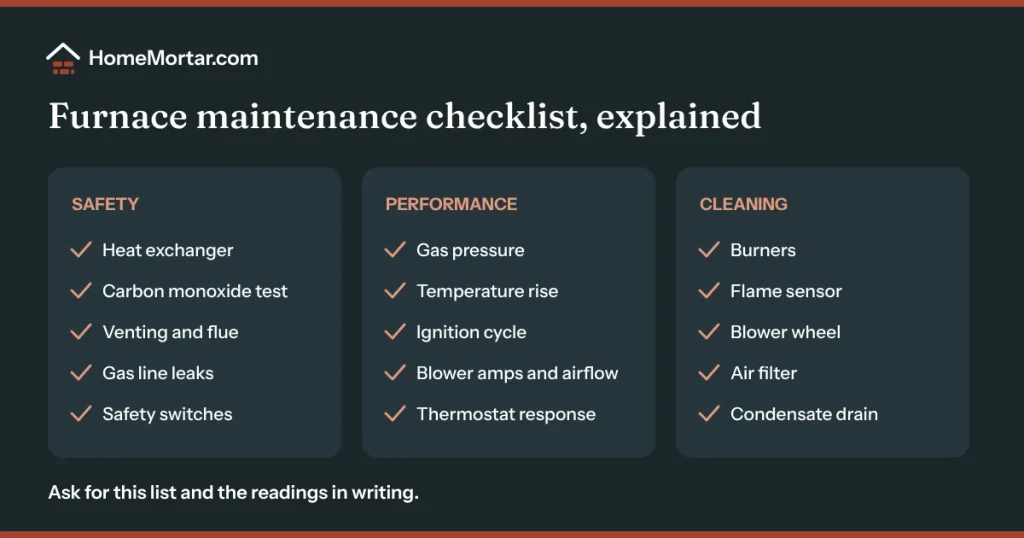
ENERGY STAR’s maintenance checklist says a contractor should check all gas or oil connections, gas pressure, burner combustion and the heat exchanger. The Heating, Refrigeration and Air Conditioning Institute of Canada (HRAI) lists similar items for a heating check-up. A thorough visit usually includes the following.
Safety checks
- Inspect the heat exchanger for cracks, rust or signs of overheating.
- Test for carbon monoxide around the furnace and in the flue gases.
- Check the venting, flue and chimney connection for blockages and leaks.
- Check gas line connections for leaks.
- Test the high-limit, rollout and pressure safety switches.
Performance checks
- Measure gas pressure and adjust it to the manufacturer’s setting.
- Check the temperature rise across the heat exchanger.
- Test the ignition sequence and watch a full heating cycle.
- Measure blower amp draw and, on a full visit, static pressure.
- Confirm the thermostat is calling for heat and shutting off correctly.
Cleaning and wear
- Clean the burners and the flame sensor.
- Clean or inspect the blower wheel and motor.
- Check or replace the air filter.
- Clear the condensate drain and trap on high-efficiency furnaces.
- Tighten electrical connections and check the capacitor where fitted.
Ask for this list in writing before the visit. A company that cannot tell you what it checks is a company to skip.
Is a Furnace Tune-Up Worth the Money?
Opinions run hot on this question. Homeowner discussions show up right in Google’s results for this question. Some people there call cheap tune-ups little more than a way to get a salesperson into the house. Others point out that a furnace burning fuel in your home deserves a yearly safety check.
Both views have a point. Here is a balanced way to think about it.
- Safety is the strongest reason. The U.S. Consumer Product Safety Commission urges a yearly professional inspection of all fuel-burning home heating systems. It also reports that more than 200 people die each year from unintentional non-fire carbon monoxide poisoning linked to consumer products.
- Small fixes prevent bigger ones. A dirty flame sensor or clogged drain can shut a furnace down on the coldest night. A tune-up often catches those for the price of the visit.
- Warranty terms can depend on it. Some manufacturer warranties require proof of regular professional maintenance. Read yours, and keep every receipt.
- A cheap visit is not always cheap. If a $49 visit ends with a high-pressure replacement pitch, it was a sales call. Get a second opinion before you agree to major work.
For a gas, propane or oil furnace, a yearly check by a qualified technician is the safe default. For a newer electric furnace with no combustion, some guides suggest every one to two years under light use.
Not sure how old your furnace is? If it is a Carrier, Bryant or Payne, our Carrier serial number guide dates it in about a minute. For a Lennox, use our Lennox furnace age decoder. Then compare the age with how long a furnace should last.
Maintenance Plan vs Paying per Visit
Most HVAC companies offer an annual plan. Whether it pays off depends on what you would buy anyway.
Here is a hypothetical comparison. Assume a plan costs $220 a year and includes one furnace visit, one AC visit and 15 percent off repairs. Without the plan, the same company charges $140 for each tune-up.
| Hypothetical year | Without a plan | With a plan |
|---|---|---|
| Furnace tune-up | $140 | Included |
| AC tune-up | $140 | Included |
| Plan fee | $0 | $220 |
| $300 repair | $300 | $255 after 15 percent off |
| Total | $580 | $475 |
In this example, the plan saves $105. Without the repair, the plan still costs $60 less than two separate tune-ups ($280 vs $220). If you only want a furnace visit and no AC service, paying per visit is likely cheaper. Run the numbers with your own local prices.
Plans also differ in the fine print. Check whether parts are discounted or only labor, whether the discount applies to emergency calls and how many systems are covered.
What You Can Do Yourself, and What You Should Not
Homeowners can handle a few simple jobs between professional visits. ENERGY STAR advises inspecting, cleaning or changing filters once a month in a furnace or heat pump, and replacing them as needed.
| Safe for most homeowners | Leave to a licensed technician |
|---|---|
| Check and change the air filter | Gas pressure and combustion adjustment |
| Keep supply and return vents clear | Heat exchanger inspection |
| Keep the area around the furnace clear of storage | Gas line and venting work |
| Check that the condensate drain line is not visibly blocked | Electrical testing inside the cabinet |
| Test carbon monoxide alarms and replace batteries | Burner and flame sensor removal |
| Watch for a yellow, lazy or noisy burner flame and call if you see one | Anything that needs the furnace panels removed while the gas is on |
Safety note: if you smell gas, leave the house and call your gas utility from outside. Do not switch lights or appliances on or off. If a carbon monoxide alarm sounds, get everyone outside and call 911 or your local emergency number.
How to Lower Your Furnace Maintenance Cost
You do not need the cheapest visit to save money. You need the right visit, at the right time, with nothing wasted.
- Book before the rush. Late summer and early fall appointments are easier to get, and that is when most companies run their specials. Confirm the checklist before you accept a low price.
- Bundle heating and cooling. If you service both systems every year, a plan or a two-visit package often costs less than two separate calls. Use the plan math above with your own quotes.
- Do the easy jobs yourself. Changing filters on schedule keeps the blower and heat exchanger cleaner, which can shorten the technician’s cleaning time.
- Clear the area first. Move boxes away from the furnace and make sure the attic or crawlspace access is open. Paid time spent moving storage is wasted money.
- Ask about extra systems. Some companies discount a second furnace or a water heater check on the same visit.
- Ask your utility. Some gas and electric utilities run safety check, rebate or efficiency programs. Rules change often, so check their website before you book.
- Keep records. A folder of receipts and reports helps with warranty claims and shows a buyer the furnace was cared for if you sell the home.
Red Flags During a Tune-Up
Homeowner complaints about tune-ups follow a familiar pattern. Watch for these signs.
- No checklist and no report. You should get written findings, ideally with measured readings.
- A visit under 30 minutes for a full tune-up. Real cleaning and testing take time.
- “Your heat exchanger is cracked” with no proof. Ask to see photos or a camera image, and get a second opinion before replacing a furnace.
- Pressure to decide today. A safe system can wait a day for a second quote. An unsafe one should be shut off, not sold on the spot.
- Charges that were not in the quote. Ask what the tune-up price covers and what triggers extra charges before the technician starts.
Questions to Ask Before You Book
A few questions on the phone save a lot of frustration later. Good companies answer them without hesitation.
- What exactly is on your tune-up checklist, and can you send it to me?
- Do you measure combustion, gas pressure, temperature rise and static pressure on this visit?
- Will I get a written report with the readings?
- Is a standard filter included, or do I supply my own?
- What happens if you find a problem? Do you quote before doing any repair?
- Is your technician licensed for gas work where I live?
- Is there an extra charge for a second furnace, a high-efficiency model or a hard-to-reach attic unit?
Write the answers down. When two companies quote different prices, these answers usually explain why.
When to Book, and How Often
ENERGY STAR suggests checking the heating system in the fall and the cooling system in the spring. Some homeowners tie it to the clock change as a reminder. Booking in late summer or early fall also avoids the rush when the first cold night hits.
Interest in the topic is growing fast. On Google Trends, average U.S. interest in “furnace tune up” in 2026 is more than six times its 2022 to 2024 level. Minnesota, Utah, Delaware, Illinois and North Dakota show the highest interest relative to their total searches. In our keyword research from October 2026, searches for this exact cost question were up 134 percent over the previous 12 months.
| Furnace type | Suggested service interval |
|---|---|
| Gas or propane furnace | Every year, before the heating season |
| Oil furnace | Every year; oil systems tend to need more cleaning |
| Electric furnace | Every 1 to 2 years under light use, per some HVAC guides |
| Heat pump with backup heat | Every year, ideally checking both heating modes |
If you heat with a heat pump, ask the technician to check the backup heat too. Our guide to what EM heat on a thermostat means explains why backup heat that runs too often costs so much.
How Furnace Service Works in Canada, the UK and Australia
The idea of a yearly heating check is shared across Tier-1 countries, but the rules and equipment differ.
| Country | Official advice | Who does the work |
|---|---|---|
| United States | CPSC urges a yearly professional inspection of fuel-burning heating systems | Licensed HVAC contractor; licensing rules vary by state |
| Canada | Technical Safety BC recommends having all home heating devices serviced annually, regardless of fuel | A certified gas fitter for gas appliances, per Technical Safety BC |
| United Kingdom | Gas Safe Register advises a safety check and service every year | A Gas Safe registered engineer; most UK homes use boilers, not furnaces |
| Australia | Energy Safe Victoria advises servicing gas heaters at least every two years | A licensed gasfitter |
Prices in Canada, the UK and Australia are quoted in local currency and depend heavily on region, so get two local quotes. In the UK, ask for a “boiler service”. In Australia, ask for a “gas heater service” or “ducted heating service”.
Repair, Tune Up or Replace?
A tune-up sometimes ends with bad news. Use these points to keep the decision calm.
- Age matters. Many guides put a well-maintained gas furnace’s life at around 15 to 20 years. These are industry estimates, not a guarantee. Check your unit’s age before you approve a large repair. Our guide to reading a Goodman serial number shows how to date one common brand.
- Compare repair cost to replacement. Some contractors use a rule of thumb: if a repair costs more than about a third of a new furnace, replacement is worth pricing.
- Safety findings come first. A confirmed cracked heat exchanger or a carbon monoxide problem means the furnace should stay off until it is fixed or replaced.
- Get it in writing. Ask for the readings and photos that support any major recommendation.
The Bottom Line on Price
A fair furnace tune up cost for most U.S. homes in 2026 is about $75 to $200 for a standard visit. A full, measured service costs more. The best value is not the lowest price. It is a clear checklist, real measurements and a written report. The technician should not be in a hurry to sell you a new system.
Book in early fall, change your filter between visits and keep your carbon monoxide alarms working. For more guides on keeping your home warm, browse our heating guides or try our free HVAC tools. ENERGY STAR’s maintenance checklist is a handy reference to bring to your next appointment.
Frequently Asked Questions
How much does a furnace tune-up cost on average?
Most current U.S. price guides put a standard visit at about $75 to $200. One 2026 guide names $100 to $150 as the most common range. Full, instrument-based visits often run $150 to $400.
What is the average furnace service cost for a repair visit?
Repairs are priced separately from tune-ups. HomeGuide lists service calls at about $75 to $150 per hour, plus parts, and $140 to $210 per hour for after-hours or emergency service.
What is included in a furnace tune-up?
A good visit covers safety checks, performance tests and cleaning. That means the heat exchanger, carbon monoxide, venting, gas pressure, ignition and safety switches, plus burners, flame sensor, blower, filter and condensate drain.
How long does a furnace tune-up take?
A standard visit often takes 60 to 90 minutes. A quick inspection may take 30 to 60 minutes, while a full instrument-based service can take two hours or more.
How often should a furnace be serviced?
Gas, propane and oil furnaces should be checked every year before the heating season. Some guides allow every one to two years for electric furnaces with light use.
Is the furnace maintenance cost worth it for a new furnace?
Usually, yes. Many warranties expect regular professional maintenance, and early visits catch installation problems. Keep every receipt in case you need to make a warranty claim.
Can I tune up my furnace myself?
You can change filters, clear vents and test carbon monoxide alarms. Gas, combustion and electrical work inside the furnace should be left to a licensed technician.
Why are some furnace tune-ups so cheap?
Low-priced specials help companies fill their fall schedules and meet new customers. Some include a shorter checklist, and some are used to pitch repairs or new equipment. Ask what is included before you book.
What is the best time of year to tune up a furnace?
Early fall, before the first cold snap. ENERGY STAR suggests checking heating systems in the fall and cooling systems in the spring.
What happens if I skip furnace maintenance?
A furnace can run for years without service, but dirt, worn parts and blocked drains raise the risk of breakdowns and safety problems. A yearly check lowers those risks.
Does a furnace tune up cost include a new filter?
Often, yes, for a standard 1-inch filter. HomeGuide notes that new filters are typically part of an annual tune-up. Thicker media filters and special sizes are often billed extra, so ask when you book.
Do maintenance plans include repairs?
Most plans include tune-ups and a discount on repairs, not free repairs. Read the plan terms to see what is covered, including parts, labor and emergency calls.