Two Stage Furnace: How It Works, What It Really Saves, and Who Should Buy One
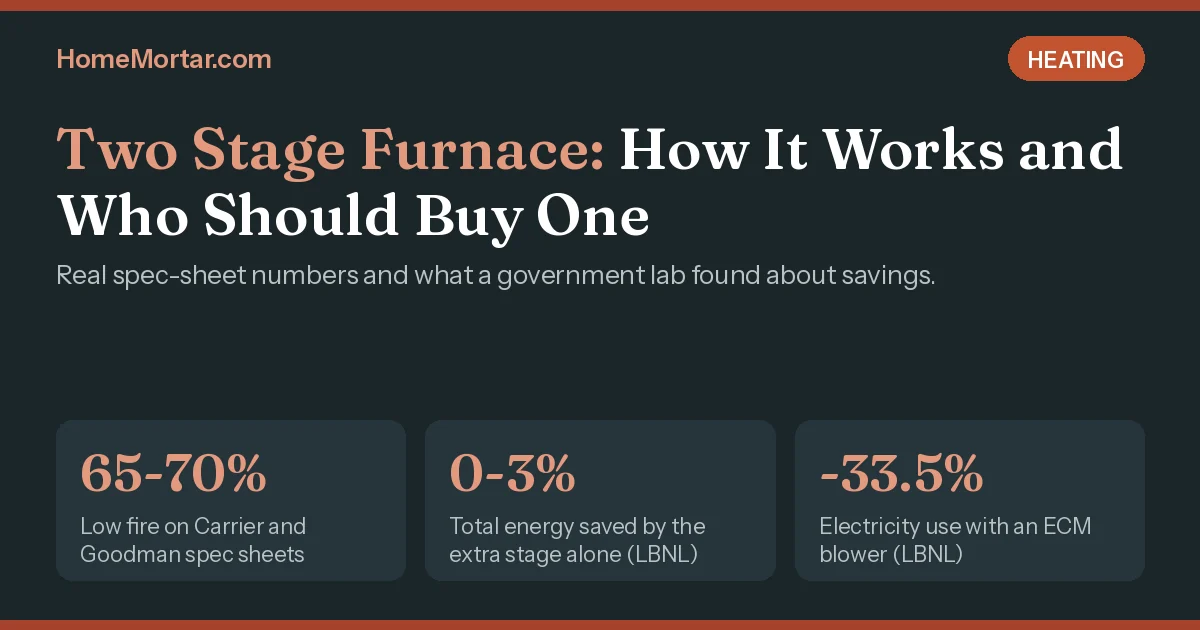
Open the product data for an 80,000 BTU Carrier Performance furnace and you will find a second number beside the first. On its low setting, that furnace burns 52,000 BTU an hour. That smaller number is the whole idea behind a two stage furnace.
Most guides stop at “it has a low and a high setting.” This one goes further. You will see real low-fire numbers from manufacturer spec sheets and what a government lab found about energy savings. You will also learn which thermostat you need, how to tell if you already own one, and when a single-stage model is the smarter buy.
The Short Answer
A two-stage gas furnace can burn at two levels instead of one. On mild days it runs on low fire, roughly 60% to 70% of full output depending on the model. On cold days, or when the house falls far behind, it switches to high fire.
The payoff is mostly comfort. Longer, gentler cycles mean steadier room temperatures and a quieter system. Real fuel savings from the extra stage alone are small, according to Lawrence Berkeley National Laboratory. The bigger savings come from a high AFUE rating and an efficient variable-speed blower.
A two-stage model makes the most sense in three cases. You keep your furnace for years, some rooms run hot and cold, or noise bothers you. A single-stage furnace still fits small, tight homes, mild climates and strict budgets.
What Is a Two Stage Furnace?
What is a two stage furnace in plain terms? It is a gas furnace with a gas valve that opens to two positions instead of one. Carrier describes its two-stage models as using a two-stage gas valve to give “a lower and higher level of heat output.”
A single-stage furnace works like a light switch. It is either off or burning at 100%. A two-stage model adds one more step in between, more like a light with a low and a high bulb.
Low fire and high fire
Low fire is the first stage. It burns less gas, and on most models the inducer and blower slow down to match. Carrier says its two-stage furnaces can run in low stage up to 90% of the time.
High fire is the second stage. It delivers the furnace’s full rated input, just like a single-stage unit. You get it on the coldest nights or when the house needs to recover quickly.
The furnace does not change shape or size between stages. Inside, the gas valve changes position, and the combustion air inducer and blower follow. Carrier’s product data, for example, lists a two-stage gas valve paired with a two-speed inducer motor.
Who decides when to switch
There are two common setups, and the difference matters.
- A two-stage thermostat makes the call. The thermostat has separate W1 and W2 terminals. It asks for low fire first and calls for high fire when the room falls behind.
- The furnace makes the call. Many two-stage furnaces accept an ordinary single-stage thermostat. Goodman’s installation manual covers this case. It allows a single-stage thermostat “in conjunction with timed transition to high fire,” in the manual’s words. The furnace starts on low and moves to high after a set time.
Lennox builds the choice into its control board. Its EL296V guide specs list a setting to “Select Thermostat used: Single-Stage or Two-Stage.” The installer sets it once during setup.
Real Low-Fire Numbers From Manufacturer Spec Sheets
Competing guides quote anything from 60% to 75% for low fire. The real answer depends on the model, so we went to the documents.
| Brand and model | High fire input | Low fire input | Low fire share | Source |
|---|---|---|---|---|
| Carrier Performance 59TP6C, 80,000 size | 80,000 BTU/h | 52,000 BTU/h | 65% | Carrier product data, 2025 |
| Carrier Performance 59TP6C, 100,000 size | 100,000 BTU/h | 65,000 BTU/h | 65% | Carrier product data, 2025 |
| Goodman MEC96, 80,000 size | 80,000 BTU/h | 56,000 BTU/h | 70% | Goodman technical manual, 2014 |
| Goodman MEC96, 100,000 size | 100,000 BTU/h | 70,000 BTU/h | 70% | Goodman technical manual, 2014 |
| Bryant two-stage gas valve | 100% | about 60% to 65% | 60% to 65% | Bryant two-stage furnace guide |
| LBNL study model | 75,000 BTU/h | 68% of maximum | 68% | LBNL, ACEEE 2006 |
Every Carrier 59TP6C size we checked follows the same 65% ratio, from 26,000 over 40,000 up to 78,000 over 120,000. Every Goodman MEC96 size in its heating table sits at 70%.
What does that mean for your house? Take a hypothetical home that needs 40,000 BTU an hour on a normal January day. An 80,000 BTU Carrier on low fire delivers 52,000 input. A single-stage 80,000 unit has only one choice, so it blasts at 80,000 and shuts off sooner.

Single Stage vs Two Stage Furnace
The single stage vs two stage furnace question comes down to how each one behaves on the many days that are cold but not brutal.
| Feature | Single-stage | Two-stage | Modulating |
|---|---|---|---|
| Burner levels | One, 100% | Two, low and 100% | Many small steps |
| Typical low setting | None | About 60% to 70% | Varies by model |
| Run cycles on mild days | Short and frequent | Longer and gentler | Longest |
| Temperature swings | Most noticeable | Smaller | Smallest |
| Noise at start-up | Loudest | Softer on low | Soft |
| Upfront price | Lowest | Middle | Highest |
| Controls | Simplest | More complex, per Bryant | Most complex |
| Best fit | Small, tight homes, mild climates, tight budgets | Most homes with real winters | Comfort-first buyers, long stays |
Where single-stage still wins
Single-stage furnaces have fewer parts and cost less to buy. Carrier lists their lowest upfront cost and simpler technology. It also calls them “highly reliable due to fewer internal components,” since there is less to fail. Carrier also says they suit homeowners on a strict budget or in very mild climates.
They also make sense when the existing furnace failed in January and money is tight. A properly sized single-stage furnace still keeps a house warm and safe.
Two-Stage, Variable-Speed or Modulating?
These three terms get mixed up constantly. Carrier itself notes that many people say “variable-speed” when they really mean two-stage. Here is the plain difference.
| Term | What it controls | What it means for you |
|---|---|---|
| Single-stage | The gas valve | One flame size, on or off |
| Two-stage | The gas valve | A low flame and a high flame |
| Modulating | The gas valve | Many small flame sizes to match the load |
| Variable-speed or ECM blower | The blower motor | Fan speed that adjusts smoothly, using less electricity |
| PSC blower | The blower motor | An older motor style with a few fixed speeds |
| Two-stage AC or heat pump | The outdoor compressor | Cooling stages, a separate feature from furnace stages |
| Dual fuel | A heat pump plus a gas furnace | The heat pump handles mild days and the furnace takes over in the cold |
So a “two-stage, variable-speed furnace” has two flame sizes and an efficient blower. If you are not sure whether you already have a heat pump outside, our guide to what a heat pump looks like helps. A two-stage furnace with a PSC blower has the same flame sizes but an older, thirstier fan. That difference shows up on the electric bill, as the next section explains.
Does a Two-Stage Furnace Save Money?
This is where most sales pages overreach. Several of the top results promise 10% to 20% fuel savings without naming any source. The best research we found tells a more careful story.
Lawrence Berkeley National Laboratory studied the question in a 2006 paper for ACEEE, Residential Two-Stage Gas Furnaces: Do They Save Energy? The authors compared single-stage and two-stage designs at the same AFUE rating. Their conclusion was blunt: “two-stage technology by itself does not save energy.”
| Finding (same AFUE) | DOE test method | 2006 ASHRAE method |
|---|---|---|
| Total site energy, two-stage vs single-stage | About 3% lower | Almost no difference |
| Fuel use, two-stage with PSC blower | 3.4% lower | 0.4% lower |
| Electricity, two-stage with PSC blower | 2.0% higher | 11.4% higher |
| Electricity, two-stage with ECM blower | 39.8% lower | 33.5% lower |
The researchers added that the ASHRAE results “seem to be confirmed by field studies.” The study dates from 2006. Treat the exact percentages as a guide to the physics, not a bill forecast.
The blower matters more than the stage
Look at the last two rows of that table. A two-stage burner paired with an old PSC blower can actually raise electricity use, because the fan runs longer. Pair the same burner with an ECM blower and electricity use drops sharply.
So if savings matter to you, ask one question before anything else. Does this two-stage model have a variable-speed ECM blower?
What that looks like in dollars (hypothetical)
Take a home that spends $1,000 a year on furnace gas with an old 80% AFUE single-stage unit. Here is how the two upgrades compare, using simple math.
| Upgrade | How the saving is worked out | Rough yearly gas saving |
|---|---|---|
| Add a second stage only, same 80% AFUE | LBNL: about 0% to 3% less total energy | About $0 to $30 |
| Move from 80% to 96% AFUE | 1 minus 80/96 = about 16.7% less gas | About $167 |
The gap is the point. The AFUE jump does the heavy lifting on fuel, while the second stage mostly buys comfort and quiet. Your real numbers depend on gas prices, climate and how the furnace is set up.
AFUE is a separate choice
People often search “2 stage furnace vs high efficiency” as if they were rivals. They are not. AFUE measures how much of the gas becomes heat. Staging measures how many flame sizes the burner has.
A single-stage furnace can be 96% AFUE. A two-stage furnace can be 80% AFUE. The AFUE number comes mostly from the heat exchanger design, not from the stage count. Going from 80% to 96% AFUE is where the big fuel savings live, because the furnace wastes far less heat up the vent. Staging then adds comfort on top.
Pros and Cons of Two-Stage Heat
Pros
- Steadier temperatures. Longer low-fire cycles keep rooms closer to the setpoint, which helps two-story homes and rooms far from the thermostat.
- Quieter running. On most models the burner, inducer and blower run softer on low fire.
- More filtering. Longer blower run time sends more air through the filter each day.
- More forgiving of tight ducts. Less airflow on low fire puts less strain on small or restrictive ductwork.
- Lower electric use with an ECM blower, according to the LBNL comparison above.
Cons
- Higher price. You pay for the extra valve, controls and usually a better blower.
- Slightly costlier repairs. Bryant says the controls are more complex, so repairs can cost a little more.
- Small fuel savings on their own. The extra stage alone saves little gas at the same AFUE.
- Best results need the right setup. A two-stage thermostat, sound ductwork and correct sizing all matter.
Is a Two Stage Furnace Worth It?
There is no single answer, so use this checklist. If most of the left column describes you, a two-stage model is usually worth the extra cost.
| Usually worth it | Usually not worth it |
|---|---|
| Real winters with many mild and cold days | Short, mild winters with few heating hours |
| Two-story home, finished basement or rooms that run cold | Small, open, well-insulated home |
| You plan to stay many years | You may sell or rent it out soon |
| Noise or drafts bother you | Budget is the top concern |
| The model comes with an ECM blower | The only two-stage option uses a PSC blower |
| Ducts are small or a bit restrictive | Ducts are fine and the old furnace was quiet |
A note on mild climates
Some homeowners in places like California ask whether a two-stage model is worth it there. In a mild climate the heating season is short, so there are fewer hours for any benefit to add up. Carrier says single-stage furnaces suit “very mild climates where the heating system is rarely used.” Comfort can still improve, but the payback math gets weaker.
A note on very cold climates
In a deep-cold place, the furnace spends more hours on high fire. You still get gentler cycles in fall and spring and on milder winter days. Correct sizing matters even more here, because an oversized furnace short-cycles on either stage.
The Worries Homeowners Raise, Answered
We read homeowner threads on Houzz and HVAC-Talk, plus the “People also ask” questions on Google. The same concerns come up again and again.
“They break down sooner and repairs cost more.” One Chicago homeowner on Houzz worried about exactly this before replacing a 30-year-old furnace. A contractor who replied said both gas valves have similar lifespans, and a two-stage valve costs only marginally more to replace. Bryant says repairs can be “slightly more expensive” and puts the life of a two-stage model at 15 to 20 years, similar to standard models.
“The savings are minor, if they exist at all.” That instinct lines up with the LBNL research for the extra stage alone. Real savings come from the AFUE tier and an ECM blower, so judge the whole package.
“I’m worried about the noise of an always-running furnace.” A two-stage model runs longer, but it runs softer. Bryant says it “doesn’t run constantly” but runs longer at a lower speed. Another reader on the same thread added that constant noise usually points to restrictive ducts or a setup problem.
“Is it better to let the thermostat control the staging?” A buyer asked this on HVAC-Talk about a new Goodman two-stage unit. The furnace can stage itself on a timer, but the pros who answered preferred a two-stage thermostat. The catch was wiring, covered below.
“The price difference was small, so is there a catch?” Quotes vary a lot by brand and installer. The Houzz homeowner found the gap “negligible.” Other sources report a premium of $500 up to $2,500. Ask each installer to price both options on the same AFUE tier.
What You Will Pay for Two-Stage Heat
Bryant puts installed costs for its two-stage furnaces at $4,000 to $12,000, depending on brand and efficiency. Carrier, citing Today’s Homeowner, says two-stage models average $1,000 to $2,500 more upfront than a comparable single-stage furnace. Treat both as ranges, not quotes.
The final price moves with these factors:
- AFUE tier. An 80% non-condensing model costs less than a 96% condensing one, which also needs a condensate drain and different venting.
- Blower type. An ECM variable-speed blower adds cost but cuts electricity use.
- Size. Bigger BTU ratings cost more.
- Install work. New venting, gas line changes, duct repairs and a new thermostat cable all add labor.
- Fuel. Bryant notes its 927T and 926T can switch from natural gas to propane with an accessory kit.
Rebates and tax credits
The federal 25C tax credit is gone for this purchase. The IRS says it does not apply to property placed in service after December 31, 2025. Some pages still promise it, so check the date before you count on one. Many gas utilities still offer rebates, usually tied to AFUE rather than staging, so check your utility’s site.
Features worth paying for
If a two-stage model fits your home, these features decide whether you get the full benefit:
- A variable-speed ECM blower. This is where the electricity savings come from.
- A two-stage thermostat with W1 and W2. It lets the thermostat choose the stage from room temperature, not only a timer.
- The right AFUE tier. Condensing models at 95% AFUE and up cut fuel waste the most. ENERGY STAR requires 95% or better in the U.S. South and 97% or better in the North.
- Correct size. Low fire should cover most of your winter hours without overheating the house.
- Registered warranty. Many brands need online registration within a set time to give you the full parts warranty, so check your model’s terms.
Current two-stage examples by brand
These are examples from manufacturer documents, not a ranking. Prices and availability change by dealer and region.
| Model | Type | Efficiency | Notes from the maker |
|---|---|---|---|
| Bryant Preferred 97 (927T) | Two-stage, variable-speed ECM blower | Up to 97% AFUE | 60,000 to 120,000 BTU/h |
| Bryant Preferred 96 (926T) | Two-stage | Up to 96.7% AFUE | Gas to propane kit available |
| Carrier Performance 96 (59TP6) | Two-stage, variable-speed blower | Up to 96.7% AFUE | Low fire 65% of high |
| Carrier Infinity 96 (59TN6) | Two-stage, variable-speed blower | Up to 96.7% AFUE | Low stage up to 90% of the time |
| Goodman MEC96 | Two-stage | 96% AFUE | Low fire 70% of high |
| Lennox EL296V | Two-stage, variable-speed blower | 96% AFUE | Board setting for single or two-stage thermostat |
Two Stage Furnace Thermostat: Do You Need a New One?
Not always. Bryant says a compatible two-stage thermostat “is recommended to fully control both stages,” but some models can self-adjust with your existing thermostat. Goodman’s timed transition is one example.
Here is how to choose:
- Keep your single-stage thermostat if the wiring is limited and your installer sets the furnace to stage itself.
- Upgrade to a two-stage thermostat if you want the thermostat to pick low or high from the actual room temperature. Installers on HVAC-Talk favored this option.
- Check smart thermostats carefully. Make sure the model lists two heat stages, often shown as W1 and W2.
Wiring: W1 and W2
A two-stage furnace board has two heat inputs. Goodman’s manual lists “two heating inputs (W1 & W2).” Honeywell’s wiring guide labels W2 as heat stage 2.
That means a two-stage thermostat needs one more conductor than a basic one. If the cable in your wall has no spare wire, an installer may need to run a new cable. Many modern thermostats also want a C wire for steady power.
Replacing the thermostat
Turn off power to the furnace before you remove the old thermostat. Take a photo of the wires and their letters before disconnecting anything. If the labels at the furnace board do not match what you see on the wall, stop and call a licensed HVAC technician. A wrong connection can damage the control board.

How to Tell If Your Furnace Is Two-Stage
“How do I know if my furnace is two-stage?” shows up on almost every search for this topic. These checks take a few minutes:
- Read the rating plate and model number. Look up the model’s product data. Two-stage models list both a high and a low input, like Carrier’s 52,000 and 80,000.
- Look at the thermostat wires at the furnace board. Two wires on W1 and W2 point to two-stage control. A single wire on W can still mean a two-stage furnace running on timed staging.
- Check the status light. On Goodman MEC96 boards, one LED flash means a first-stage heat call and two flashes mean second stage.
- Listen at start-up. A two-stage unit often starts softer, then the inducer and blower speed up when it moves to high fire.
- Check the gas valve. Two-stage models use a two-stage gas valve. The valve label or the parts list in your manual shows which type you have.
The same plate tells you the furnace’s age. Our guides to Carrier age by serial number, Goodman age by serial number and Lennox furnace age show how to read it.
Sizing Still Comes First
Staging cannot rescue a furnace that is far too big. An oversized unit satisfies the thermostat in a few minutes even on low fire, then shuts off. You end up with the same short cycles you were trying to escape.
Before you choose single or two-stage, size the furnace for your home. A room-by-room Manual J load calculation is the professional standard. Our furnace size calculator estimates your heat load from last winter’s gas bill. Ideally, the low-fire output covers most of your normal winter days.
Two-Stage Furnaces in Canada, the UK and Australia
Canada. Google Trends shows Canada searching for this topic about twice as much as the U.S., relative to population. Natural Resources Canada already requires 95% AFUE for gas furnaces made on or after July 3, 2019. Sizing follows CSA F280, so ask your contractor for an F280 report.
In Ontario, the Technical Standards and Safety Authority (TSSA) sets the gas safety rules. It says any fuel-fired appliance “should be installed, serviced and inspected by a TSSA-registered contractor,” so check registration first. Other provinces have their own gas safety rules. For rebates, Natural Resources Canada keeps a finder of incentives by province and territory, including programs from gas and electric utilities. Amounts change often, so check it before you sign.
United Kingdom and Australia. Search interest is too low to measure in Google Trends. Ducted gas furnaces are far less common there, and many homes use boilers, heat pumps or reverse cycle air conditioners instead. The same idea still applies: a heater that can turn down runs longer and more evenly.
What Changed in 2025 and 2026
- The 25C tax credit ended. It does not apply to property placed in service after December 31, 2025, according to the IRS.
- The 95% furnace rule is still on the calendar. The current compliance date for new non-weatherized gas furnaces is December 18, 2028. Gas industry groups asked DOE to push it to January 1, 2030. As of early November 2026 we found no final decision.
- Interest hit a five-year high. U.S. Google Trends for this topic peaked in early 2026, and searches are climbing again this fall. Searches for “AFUE” alongside it rose sharply.
Questions to Ask Before You Buy
- What is my home’s design heat load in BTU per hour?
- What are the high and low fire inputs of the model you quoted?
- Does it have a variable-speed ECM blower or a PSC blower?
- Will it use a two-stage thermostat or timed staging?
- Do I need a new thermostat cable for W2 or a C wire?
- Can you quote single-stage and two-stage options at the same AFUE?
- Which utility rebates does this model qualify for?
- How do I register the warranty, and by when?
Safety note: Furnace installation, gas line work and venting changes need a licensed HVAC contractor and usually a permit. A wrong vent or gas connection can leak carbon monoxide. Keep working CO alarms on every level of your home, and leave burner and gas valve work to a pro.
The Bottom Line
A two stage furnace is a comfort upgrade first and a savings tool second. On its own, the extra stage saves little fuel, but pairing it with a high AFUE rating and an ECM blower changes the math.
If you live with real winters, plan to stay, and want quieter, steadier heat, it is usually worth the premium. If your home is small, your winters are short or your budget is tight, a correctly sized single-stage furnace is a sound choice. Either way, size it first and compare quotes on the same AFUE tier. When the old furnace is still running, our repair or replace calculator helps you decide when to make the switch.
Frequently Asked Questions
Do two-stage furnaces stay on all the time?
No. They run longer cycles on low fire, so they are on more often than a single-stage furnace. They still shut off when the thermostat is satisfied. Bryant says a two-stage model “doesn’t run constantly.”
Do I need a special thermostat for a 2 stage furnace?
Not always. A 2 stage furnace can often run with a single-stage thermostat using timed staging. A two-stage thermostat with W1 and W2 gives the best control, and Bryant recommends one.
How much money does a two-stage furnace save?
On fuel alone, very little at the same AFUE, according to Lawrence Berkeley National Laboratory. On a hypothetical $1,000 yearly gas bill, that is about $0 to $30. Moving from 80% to 96% AFUE saves about $167 on the same bill.
What does 2 stage mean on a furnace?
It means the gas valve has two flame sizes, a low stage and a high stage. Low covers mild days, and high covers the coldest days or a fast recovery.
Can I convert a single-stage furnace to two-stage?
Not in practice. Staging depends on a two-stage gas valve, matching controls and usually a two-speed inducer, all built in at the factory. If you want staging, buy a furnace made that way.
How long do two-stage furnaces last?
Bryant puts them at around 15 to 20 years with regular maintenance, similar to standard models. Yearly service matters more than the stage count. Our guides on how long a furnace should last and furnace tune-up cost cover both.
Is a two-stage furnace quieter?
Usually, yes. On low fire, most models run the burner, inducer and blower softer. Restrictive ducts can still make any furnace noisy.
Which is better, two-stage or modulating?
A modulating furnace adjusts in many small steps, so it gives the steadiest heat. It also costs the most. For most homes, a two-stage model with an ECM blower gives most of the comfort at a lower price.