Carrier Age by Serial Number: Week, Year and What Your Unit’s Age Means

Flip open the furnace door or walk around the condenser, and the date is already there. Carrier just writes it as a week and a year instead of a calendar date. Once you know the order, most labels take ten seconds to read.
This guide covers carrier age by serial number for furnaces, air conditioners and heat pumps. It explains the current code, the older styles you still find in basements and attics, and the sibling brands that share the same system. It also covers what the age means for warranty, refrigerant, repair and replacement.
Free Carrier Age Decoder
Type the serial number from the rating plate and choose the equipment type. The result compares the age with Carrier’s own lifespan guide.
Reads the week and year code used on Carrier, Bryant and Payne equipment, plus older formats reported by inspection sources. It is an estimate for planning, not an official Carrier record. Nothing you type leaves this page.
The Short Version
- On most Carrier, Bryant and Payne equipment built since about 1980, the serial starts with four digits.
- Digits one and two are the week of manufacture, from 01 to 52 or 53.
- Digits three and four are the year. So 4006A17330 was built in week 40 of 2006, in early October.
- The letter after the four digits marks the plant. The digits after it are a sequence number and do not affect the age.
- Older units from roughly 1969 to 1990 may start with a letter instead. That letter gives the month and decade, and the digit after it gives the year.
- Carrier’s own guide puts furnaces and air conditioners at about 15 to 20 years. Its table gives heat pumps 10 to 15 years.
Find the Serial Number First
Every Carrier unit has a rating plate with the model number and serial number on it. Where it sits depends on the equipment.
| Equipment | Where to look |
|---|---|
| Gas furnace | Inside the front door or blower door. Turn off power at the switch before removing a door. Older units may have it stamped on the cabinet. |
| Air conditioner or heat pump (outdoor unit) | On the side or back panel of the condenser |
| Air handler or fan coil | On the cabinet, often near the service panel |
| Evaporator coil | On the coil box above or beside the furnace |
Use the line marked SERIAL NO. The model number sits right next to it and often starts with two digits too, such as 24ACC636A003. That is a product code, not a date.
If the plate is faded, photograph it with your phone’s flash off and zoom in. Do not open sealed panels or touch wiring to reach a label.
Reading the Current Carrier Serial Number
Here is how the ten-character serial on most modern units breaks down.
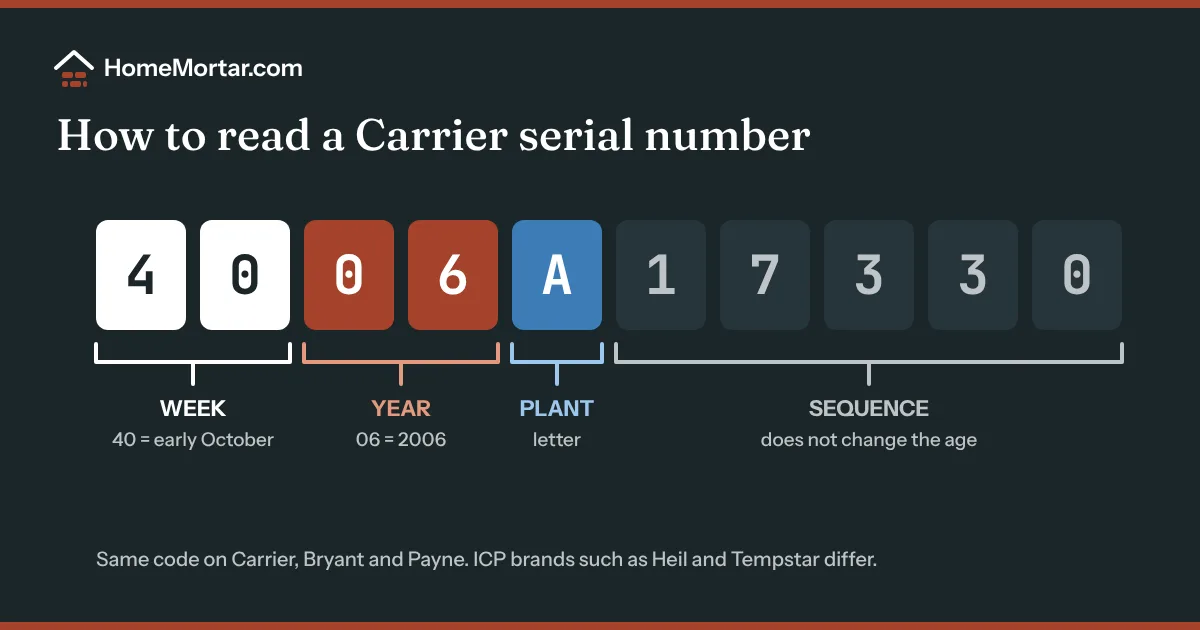
| Position | Example: 4006A17330 | Meaning |
|---|---|---|
| 1 and 2 | 40 | Week of manufacture |
| 3 and 4 | 06 | Year of manufacture, 2006 |
| 5 | A | Plant letter |
| 6 to 10 | 17330 | Sequence number |
Carrier’s factory-authorized dealers describe the same rule. Carrier Colorado, for example, reads a serial starting 1618 as the 16th week of 2018, in April. The Building Intelligence Center calls this style the one in exclusive use since 1980.
Turning the week into a month
The week is precise, but most people think in months. This table converts it for a typical year. A week near the edge can fall in either month.
| Weeks | Month | Weeks | Month |
|---|---|---|---|
| 01 to 05 | January | 27 to 31 | July |
| 06 to 09 | February | 32 to 35 | August |
| 10 to 13 | March | 36 to 39 | September |
| 14 to 18 | April | 40 to 44 | October |
| 19 to 22 | May | 45 to 48 | November |
| 23 to 26 | June | 49 to 53 | December |
A quick shortcut works too: divide the week by 4.3 and round up. Week 21 gives about 4.9, so late May.
Which century?
The two year digits do not say 19 or 20. Use common sense: a modern-looking unit with 06 is from 2006, not 1906. Year digits from 80 to 99 point to the 1980s and 1990s, and 00 onward to the 2000s.
Older Carrier Serial Numbers by Era
Basements still hold Carrier equipment from the 1960s, 1970s and 1980s. These styles come from inspection sources, not a current Carrier document, so treat them as good estimates.
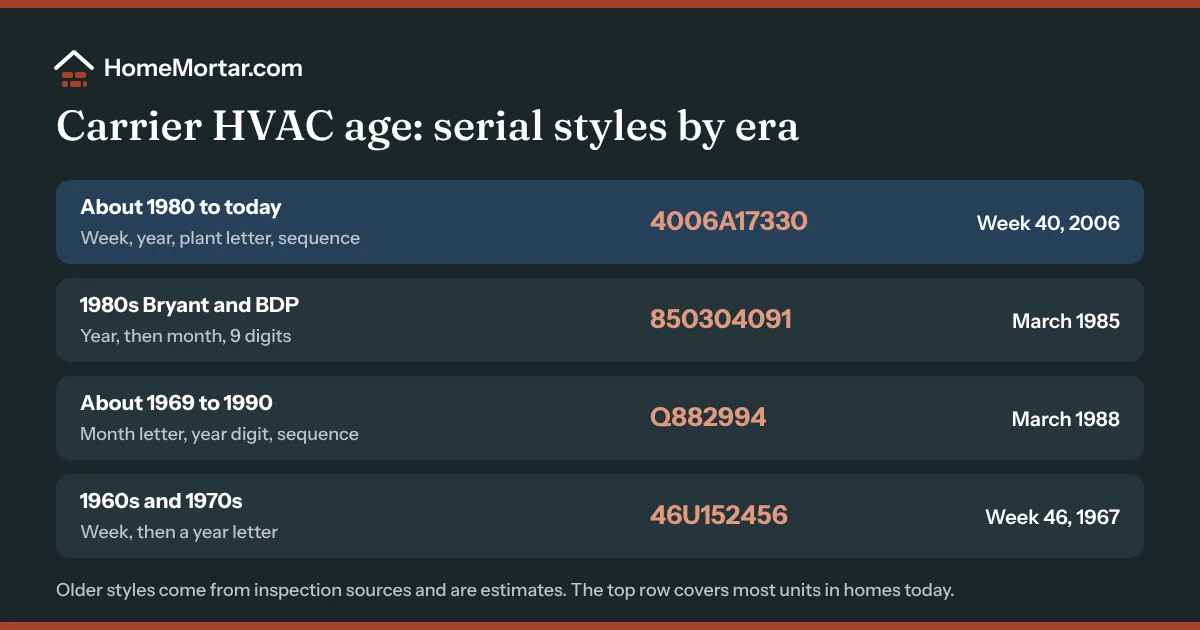
1980s Bryant and BDP: nine digits, year then month
The Building Intelligence Center describes a nine-digit style used mostly on Bryant and BDP units in the 1980s. Here the first two digits are the year and the next two the month. Its example, 850304091, reads as March 1985.
About 1969 to 1990: a month letter, then a year digit
This style has seven characters, such as Q882994. An InterNACHI forum post from 2006 explains it: the letter gives the month, and the digit after it gives the year.
- Letters A to M mean January to December in 1969 to 1979.
- Letters N to Z mean January to December in 1980 to 1990.
- Carrier skipped I and O, which another InterNACHI thread says Carrier confirmed to an inspector.
So Q882994 is March 1988: N is January, P is February and Q is March. Because the year is a single digit, a zero after a late letter could mean 1980 or 1990. The house’s age usually settles it.
Sources disagree on a few of these letters. One inspection site reads R as May, while the skip-O rule makes R April. When a letter sits near the edge, assume the date could be a month off.
1960s and 1970s: week first, then a year letter
The Building Intelligence Center lists an even older style used by Bryant and Carrier from 1960 to 1979. It starts with a one or two-digit week, followed by a letter for the year. In its example, 46U152456 is week 46 of 1967.
Canadian units from 1980 to 1984
The same source says some early-1980s serials had eight characters. U.S. and Canadian versions put the month letter and year digit in opposite order. If you have a short code like that, compare both readings with the age of the house.
Worked Examples, Decoded
These ages are counted to October 2026. Serials marked hypothetical are made up to show the method.
| Serial | Style | Built | Age in October 2026 |
|---|---|---|---|
| 4006A17330 (Building Intelligence Center example) | Week, year | Week 40 of 2006, early October | About 20 years |
| 1618E12345 (hypothetical) | Week, year | Week 16 of 2018, April | 8 years, 6 months |
| 2111Q76606 (example on a pricing guide) | Week, year | Week 21 of 2011, May | 15 years, 5 months |
| 5220A54321 (hypothetical) | Week, year | Week 52 of 2020, late December | 5 years, 10 months |
| 2526C10001 (hypothetical) | Week, year | Week 25 of 2026, June | 4 months |
| 4186A25463 (a reader’s heat pump on a home inspection blog) | Week, year | Week 41 of 1986, October | 40 years |
| 850304091 (Building Intelligence Center example) | Year, month | March 1985 | 41 years, 7 months |
| Q882994 (InterNACHI forum example) | Month letter, year digit | March 1988 | 38 years, 7 months |
| 46U152456 (Building Intelligence Center example) | Week, year letter | Week 46 of 1967, November | 58 years, 11 months |
The 4186A row matters. A reader asked whether that heat pump was from 1986, and the blog never answered. It is: week 41 of 1986, about 40 years old.
Bryant, Payne and the Rest of the Carrier Family
Carrier owns a long list of brands, and they do not all share one code.
| Brand group | Serial code | Notes |
|---|---|---|
| Carrier, Bryant, Payne | Same week and year code | Inspectors and dealers treat them as one system |
| Day and Night (older units) | Same as Bryant and Payne on older equipment | Part of the 1974 Bryant, Day and Night, Payne group |
| ICP brands: Heil, Tempstar, Comfortmaker, Arcoaire, KeepRight and others | Different codes | Carrier bought Inter-City Products in 1999 and renamed it ICP |
The Building Intelligence Center also warns that Carrier’s current style is easy to confuse with Lennox serials. Check the brand on the plate before decoding.
Carrier Model Number: Size, Not Age
The model number never gives the build date. It does tell you the size, which matters when you price a replacement.
- Air conditioners and heat pumps. The Building Intelligence Center says Carrier shows size in the 7th and 8th characters. In 24ACC636A003, that pair is 36, meaning 36,000 BTU per hour.
- Converting to tons. One ton of cooling equals 12,000 BTU per hour. So 36 means 3 tons, 24 means 2 tons and 60 means 5 tons.
- Gas furnaces. On furnaces such as the 59SC5B040, the three-digit group shows input in thousands of BTU per hour. Dealers list that model as 40,000 BTU per hour.
| Code in the model | BTU per hour | Tons |
|---|---|---|
| 18 | 18,000 | 1.5 |
| 24 | 24,000 | 2 |
| 30 | 30,000 | 2.5 |
| 36 | 36,000 | 3 |
| 42 | 42,000 | 3.5 |
| 48 | 48,000 | 4 |
| 60 | 60,000 | 5 |
Size on a new system should come from a load calculation, not from the old model number. The old unit may have been oversized from day one.
The model number shows your furnace’s input size. To see if that size fits your house, try our furnace size calculator.
The same plate tells you the system type. Carrier heat pump models start with 25 or 27, and our guide on how to tell if you have a heat pump covers the other clues.
Carrier’s 59TP6 Performance furnace runs low fire at 65% of its rated input. Our two stage furnace guide explains the trade-offs.
What Your Carrier’s Age Means
Carrier publishes its own lifespan guide. The figures are general guidelines, and its page gives two ranges for furnaces and heat pumps.
| Equipment | Carrier’s table | Elsewhere on the same page |
|---|---|---|
| Furnace | 15 to 20 years | 15 to 30 years |
| Air conditioner | 15 to 20 years | 15 to 20 years |
| Heat pump | 10 to 15 years | 15 to 20 years |
| Ductless mini split | 10 to 15 years | Not stated |
| Boiler | 15 to 20 years | Not stated |
Heat pumps run in both seasons, so it makes sense that they wear sooner than an air conditioner. Plan with the shorter range, and treat anything beyond it as a bonus.
Furnaces
A furnace in its late teens is not doomed, but its safety parts deserve attention. A cracked heat exchanger, a failing inducer or rust in the burner area changes the repair math fast. Carbon monoxide alarms on every level are cheap insurance at any age.
Air conditioners and heat pumps
For cooling equipment, the build year has a second meaning: the refrigerant. That is the next section.
The R-22 Line for Air Conditioners and Heat Pumps
Older Carrier air conditioners and heat pumps often use R-22. The EPA says no new R-22 has been made or imported in the United States since January 1, 2020. Only reclaimed refrigerant is left, and you can no longer buy a new central system that uses it.
The EPA does not require you to replace a working R-22 system, and it can still be serviced. But a refrigerant leak on an R-22 unit is often the moment owners decide to replace instead of recharge. If your serial points to the 2000s, ask your technician which refrigerant the label lists.
Your Serial Unlocks the Warranty
Carrier’s warranty lookup needs only the serial number. It returns the parts coverage, its length and the end date for that unit. If the serial matches more than one model, it asks you to pick one.
Carrier’s warranty page explains how coverage depends on registration.
| Situation | Parts coverage, per Carrier |
|---|---|
| Registered within 90 days of installation | Choice of 10-year parts, or 5-year parts plus 3-year labor through a participating dealer |
| Not registered within 90 days | 5-year parts only, no labor |
| Places where warranty cannot depend on registration | 10-year parts automatically |
| New home construction | Not eligible for the Consumer Choice warranty |
Coverage normally follows the install date, which can be months after the build date. So a unit built in week 40 of 2006 may have been installed in 2007. For an exact answer, use the lookup instead of the serial date alone.
Repair or Replace? A Plan by Age
Use this as a rule of thumb. A technician who sees the equipment can judge its condition better than a chart.
| Age | What usually makes sense |
|---|---|
| Under 10 years | Repair. Check the warranty first; many parts may still be covered. |
| 10 to 15 years | Repair small items, but price a replacement before peak season. |
| 15 to 20 years | Inside Carrier’s range for furnaces and air conditioners. Weigh any big repair against replacement. |
| Over 20 years | Plan a replacement on your schedule, not during a heat wave or cold snap. |
| Any age with an R-22 leak or a cracked heat exchanger | Usually replace. Get a second opinion on a cracked heat exchanger. |
Money for upgrades has changed too. ENERGY STAR lists a federal tax credit for qualifying central air conditioners of 30 percent, up to $600. It covers equipment purchased and installed from January 1, 2023 to December 31, 2025. Check with the IRS or a tax professional before you count on any credit for a 2026 install.
Have a quote in hand? Our free repair or replace calculator compares it with a new unit and with Carrier’s lifespan ranges.
Where People Get Stuck
Inspector forums, Reddit threads and comment sections keep raising the same problems.
- “Is 4086 week 40 of 1986?” Yes. A top answer in an r/HVAC thread, shown in Google’s results, says the same. The first two digits are the week and the next two the year.
- “Is that an O or a Q?” An InterNACHI thread argued over a serial that started with an O. Carrier did not use I or O in older codes, so it was a Q, and the unit was from March 1988.
- “The number does not decode.” Often the model number went into the decoder. Model codes like 24ACC636A003 also start with digits.
- “Carrier’s phone line was closed.” One inspector hit that wall in 2006. Today the online warranty lookup works with just the serial.
- “My Heil does not fit.” ICP brands use their own codes.
- “The furnace and AC have different years.” Normal. Outdoor units are often replaced alone, so decode each piece separately.
- “What SEER is my unit?” A reader on a pricing site asked this about 4623E04629. That serial is week 46 of 2023. The rating comes from the model number and the AHRI listing, not the serial.
- “How old is too old?” See Carrier’s ranges above, and plan rather than panic.
Write Down These Five Things Before You Call
A dealer or Carrier support can help much faster when you have the details ready. Take a photo of each rating plate, then note:
- The full serial number, exactly as printed, including the letter in the middle.
- The full model number, including any dash numbers at the end.
- The build date you decoded, and whether it was a week code or an older letter code.
- The install date, if you have receipts, permits or a registration email.
- The symptom, such as no heat, short cycling, ice on the lines or a tripped breaker.
With those five items, a technician can pull the right manual, check the warranty and bring the likely parts on the first visit.
Add Years With Basic Care
The serial tells you how old a system is. Care decides how long it keeps going.
- Change filters on schedule. A clogged filter strains the blower and can make a furnace overheat and shut off on its limit switch.
- Book a yearly tune-up. A technician checks the burners, flame sensor, heat exchanger and refrigerant pressures. Our guide to furnace tune-up costs shows what that usually costs.
- Keep the outdoor unit clear. Leave the clearance your installation manual lists, and rinse dirt off the coil fins gently.
- Watch the condensate drain on high-efficiency furnaces and air handlers. A blocked drain can shut the system down or leak into the ceiling.
- Listen for changes. New rattles, squeals or a burning smell are early warnings, not background noise.
Knowing your carrier age by serial number also tells you when to start budgeting. A unit at 12 years with a good maintenance record is in a very different place from one at 12 years with none.
Buying, Selling or Inspecting a Home
Home inspection reports nearly always list HVAC ages. If yours says “unknown”, the serial usually fixes it in a minute.
- Buyers: decode every unit: furnace, condenser, heat pump and air handler. Ask the seller for maintenance records and the warranty registration.
- Sellers: a recent install with receipts and a registered warranty answers questions before they become repair requests.
- Inspectors: note which serial style you read. Older letter codes deserve an “estimated” label.
Search Interest Keeps Climbing
Google Trends data for “carrier serial number” in the U.S. has risen every year since 2022. On Google’s 0 to 100 scale, the yearly average went from about 40 in 2022 to about 51 in 2025. So far in 2026, it is about 63.
Interest peaks in summer. In 2026 it reached about 80 in June and July, when air conditioners fail and people check the age before paying for a repair. Rising related searches include “carrier age by serial number” and “carrier serial number lookup”.
Delaware, Arizona, Virginia, South Carolina and Texas showed the highest interest relative to their size over the last five years.
Carrier Equipment Outside the U.S.
Carrier equipment is sold well beyond the United States, but the details differ by country. The Building Intelligence Center notes that some early-1980s Canadian serials reversed the month and year order. Warranty terms, registration rules and refrigerants also vary by market, so check the warranty documents for your country.
Other Brands Use Different Codes
If your house has a mix of brands, each one needs its own method. Goodman starts with the year and month. Our guide to Goodman age by serial number covers that. Lennox uses a two digit year and a month letter, which our Lennox furnace age guide decodes. To see how your furnace compares with its expected life, read how long a furnace should last. For a winter question about Carrier heat pumps, see what EM heat on a thermostat means. For more heating help, browse our heating guides.
The Bottom Line
Read the first two digits as the week and the next two as the year. That rule covers most Carrier, Bryant and Payne equipment in homes today. If the serial starts with a letter, you have an older unit, and the letter gives the month and decade.
Once you know the age, compare it with Carrier’s ranges and check the warranty with the serial. That is the whole job of carrier age by serial number. For the coverage itself, use Carrier’s warranty lookup.
Frequently Asked Questions
How old is my Carrier by serial number?
Read the first four digits. The first two are the week and the next two are the year. A serial starting 2111 was built in week 21 of 2011, around late May.
How do I use a Carrier serial number lookup?
For the date, decode the first four digits yourself or use the decoder above. For coverage, Carrier’s warranty lookup takes the serial number and shows the parts warranty and its end date.
What is the Carrier serial number age code for older units?
Units from roughly 1969 to 1990 often start with a letter and a digit. The letter gives the month, A to M for 1969 to 1979 and N to Z for 1980 to 1990, skipping I and O. The digit gives the year.
How do I find Carrier furnace age by serial number?
Find the rating plate inside the furnace door, with the power switched off first. Then read the first two digits as the week and the next two as the year.
How do I check Carrier HVAC age without the serial?
Look for an install sticker, permit records, receipts or the original warranty registration. A dealer can also check service records by address.
How do I decode a Carrier model number?
The model number describes the product line, efficiency and size, not the date. On air conditioners and heat pumps, a pair of digits such as 36 shows the size in thousands of BTU per hour.
How long does a Carrier furnace last?
Carrier’s guide gives 15 to 20 years in its table and up to 30 years in the text. Maintenance, installation quality and climate decide where yours lands.
How long does a Carrier heat pump last?
Carrier’s table gives 10 to 15 years, while the same page also mentions 15 to 20. Plan with the shorter range because heat pumps run year-round.
Do Bryant and Payne use the same serial code?
Yes. Inspectors and dealers read Carrier, Bryant and Payne serials the same way. ICP brands such as Heil and Tempstar use different codes.
My furnace is 25 years old. Should I replace it?
It is past both ranges on Carrier’s lifespan guide. Have it checked for heat exchanger cracks and carbon monoxide, and plan a replacement before it fails in winter.
Does the serial number show the install date?
No. It shows when the unit was built. The installation may be weeks or months later, and Carrier’s warranty runs from installation.
Why does my Carrier condenser have a different year than my furnace?
Outdoor units and furnaces are often replaced at different times. Decode each serial separately.