What Does a Heat Pump Look Like? 7 Easy Ways to Tell If You Have One
From the yard, a heat pump looks almost exactly like a central air conditioner. It’s a metal cabinet wrapped in thin fins, with a fan grille on top and two copper lines running into the house. Indoors, it usually connects to an air handler, a furnace, or a few white units high on the walls.
So the box alone won’t tell you much. If you searched what does a heat pump look like to figure out what you own, three clues answer it fast. Look for EM Heat or AUX on the thermostat, an HSPF rating on the yellow label, and an outdoor unit that runs while the house is heating.
The Outdoor Unit
Most central heat pumps in the U.S. share the AC shape. Picture a square or rounded cabinet with a wire fan guard on top. The sides are the outdoor coil, rows of thin aluminum fins. A large fan pulls air through them and blows it out the top. Near the base, two copper lines connect at small brass service valves; the thicker one usually wears black foam insulation.
Some units are tall and slim, with a round fan on the front that blows air sideways. Many ductless mini split outdoor units look like this. A side-blowing cabinet doesn’t prove you have a heat pump, though. Cooling-only mini splits exist too.
You’ll find two labels on the cabinet. Carrier says its yellow EnergyGuide label is usually on the upper front area. Its silver rating plate is typically on the back, above the service valves. Both matter for the checks below.

What it looks like in winter
Winter is when a heat pump gives itself away. An AC sits idle in the cold, while a heat pump keeps running and defrosts itself now and then. Lennox calls two sights and sounds normal during defrost:
- Steam rising from the unit, which is vapor from melting frost
- A whooshing sound as the system switches modes
Lennox says most systems check for frost every 30 to 90 minutes in heat mode, and a full defrost usually takes 5 to 15 minutes. Mini splits often show a code during this time; our guide to what DF means on a mini split explains it. A coil that stays caked in thick ice is not normal, so call a technician if it never clears.
The Indoor Side: Five Setups
Inside is where the answer to “what does a heat pump look like?” changes most. The outdoor box barely changes from house to house, so the indoor side often tells you more.
| What you see indoors | What it usually is |
|---|---|
| Slim cabinet with ducts, no flue pipe or gas line | Heat pump with an air handler |
| Gas furnace with a metal coil box on top | Furnace plus AC, or a dual fuel heat pump |
| White units high on walls, low consoles, or ceiling grilles | Ductless mini split |
| No indoor unit; ducts run from one big outdoor cabinet | Packaged unit |
| Furnace-like cabinet, but no outdoor fan box | Possibly a geothermal heat pump |
Air handler. In an all-electric home, the indoor part is an air handler. That’s a coil and a blower in one cabinet, standing in a closet or lying on its side in an attic. Look for refrigerant lines, ducts, a heavy electrical cable, and a plastic drain line, but no flue pipe and no gas line. Many hold electric heat strips, which are the backup behind the AUX light.
Furnace with a coil on top. Some homes pair a heat pump with a gas furnace for backup. From the basement, this dual fuel setup looks exactly like an ordinary furnace and AC. Only the outdoor unit and the thermostat tell them apart.
Ductless heads. These are the easiest to spot. You’ll see wall units, floor consoles, or ceiling cassettes, each linked to an outdoor unit through a small hole in the wall. Our heat pump vs mini split guide compares them with central systems. Some homes hide the indoor unit above the ceiling as a ducted mini split.
Packaged unit. Everything sits in one outdoor cabinet, with supply and return ducts running from it into the house. It can be a heat pump or an AC with gas heat, so the label check settles it.
Geothermal. A ground-source heat pump trades the outdoor fan box for buried or submerged pipe loops. Indoors, you’ll see a cabinet that looks like a furnace or air handler, fed by those pipes.
How to Tell If You Have a Heat Pump: 7 Checks
Here’s how to tell if you have a heat pump, quickest first. Two strong matches usually settle it.
1. Read the thermostat modes
Look for EM Heat, EMER, Emergency Heat, or AUX on the mode switch or menu. Carrier says a furnace and AC setup usually won’t have these settings. AUX turns on by itself when the heat pump needs help; EM Heat is a manual switch for when the heat pump can’t run. Our guide to EM heat on a thermostat explains when to use it.
2. Check the wire letters behind the thermostat
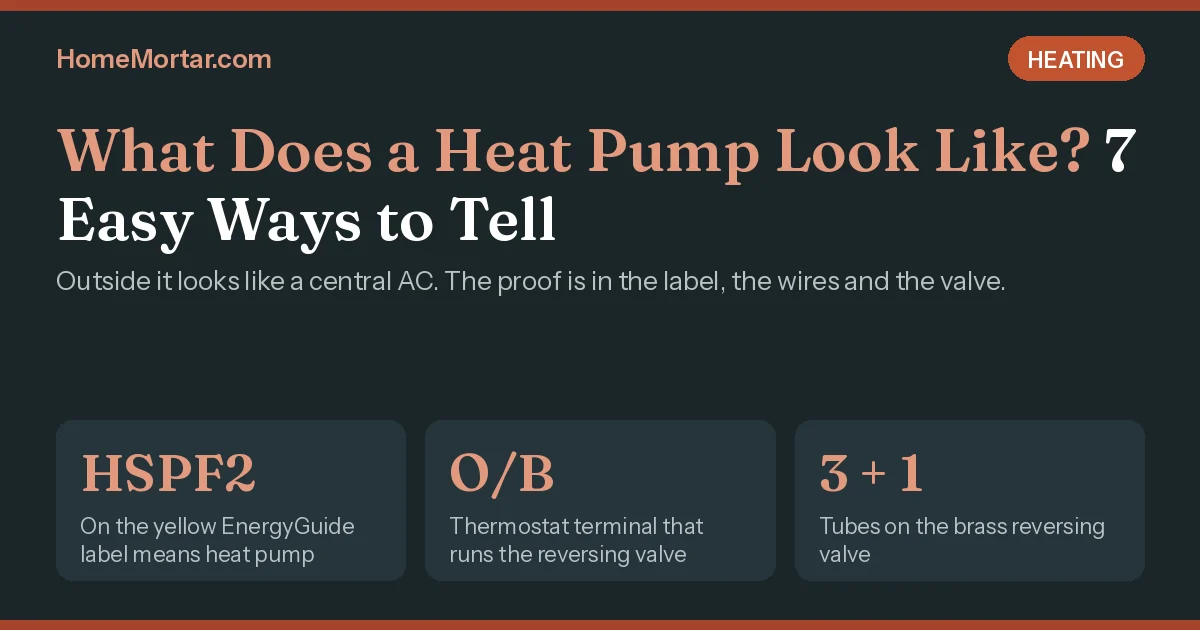
Turn the system off at the thermostat, then gently pull the faceplate off its base. Honeywell’s thermostat wiring guide describes the O/B terminal as the reversing valve for heat pump systems. A wire on O, B, or O/B is a strong heat pump sign. Don’t disconnect anything, and skip this check if the base doesn’t come off easily.
3. Run the heat mode test
Set the thermostat to Heat and raise it a few degrees. After a few minutes, go outside. Carrier says that if the outdoor fan is running and blowing cold air out the top, you have a heat pump. If the outdoor unit stays silent while warm air flows inside, the heat comes from a furnace, boiler, or electric strips.
Dual fuel is the catch. Those systems hand off to the furnace in cold weather. Trane says the switch point depends on the heat pump. It could be around freezing with a standard model and much lower with a cold-climate one. If the outdoor unit is idle on a frigid day, test again on a milder afternoon.
4. Read the yellow EnergyGuide label
Every central AC and heat pump lists a cooling rating, SEER or SEER2. According to Carrier, a label that also lists a heating rating, HSPF or HSPF2, means a heat pump. Older labels use the original SEER and HSPF names.
5. Check the model number
Write down the brand, model, and serial from the rating plate. Carrier says its R-410A heat pumps start with 25 and its R-454B heat pumps start with 27. Other brands use their own codes. Search the full model number on the maker’s site. Don’t trust a rule like “HP means heat pump.” The same plate dates the unit; see Carrier age by serial number or Goodman age by serial number.
6. Look for the reversing valve, without opening anything
The reversing valve is what lets a heat pump heat. A cooling-only AC doesn’t have one. With the system off, shine a flashlight down through the top grille. Carrier describes the valve as brass, with three tubes on one side and one on the other. Look only. Don’t reach in or remove panels, because parts inside carry high voltage.
7. Follow the fuel
A gas furnace needs a gas line and a flue or vent pipe; a heat pump air handler needs neither. Walk around the house. A gas meter and a winter gas bill point to gas heat, which could still be dual fuel. No gas service at all, plus central air, points strongly toward a heat pump or electric strips.

Do I Have a Heat Pump or a Furnace?
Asking “do I have a heat pump” often turns into a second question: furnace, heat pump, or both?
| Setup | Outdoor unit in heat mode | Indoor cabinet | Thermostat |
|---|---|---|---|
| Heat pump only | Runs | Air handler, no flue | EM Heat or AUX |
| Dual fuel | Runs in milder weather | Furnace with coil on top | EM Heat or AUX |
| Furnace plus AC | Silent | Furnace with flue | Heat, Cool, Fan |
| Boiler or baseboard | No AC unit, or silent | Boiler or none | Heat only |
If you see a gas furnace indoors and EM Heat on the thermostat, you probably have dual fuel. The heat pump handles milder days, and the furnace takes over when it gets colder.
Don’t Confuse It With a Heat Pump Water Heater
A heat pump water heater is a storage tank with a small heat pump on top. You’ll usually see a fan grille and a control panel up there. It heats water, not the house, so owning one doesn’t mean your home is heated by a heat pump. Our guide to what a hybrid water heater is shows how to recognize one.
Once You Know
That covers “what does a heat pump look like?” inside and out. Once you know you have one, care is a little different because a heat pump runs all year. Carrier recommends service twice a year, in spring and fall. Keep snow, leaves, and grass clear of the outdoor unit. Leave EM Heat off unless the outdoor unit has failed, since backup heat costs more to run.
If a repair quote just arrived, our repair or replace calculator weighs it against the unit’s age.
Safety note: reading labels and the thermostat is safe for anyone. Opening the outdoor unit, touching wiring, or handling refrigerant is not. In the U.S., refrigerant work requires an EPA Section 608 certified technician.
Frequently Asked Questions
How do I know if I have a heat pump?
Check the thermostat for EM Heat or AUX, then look for HSPF on the yellow label. If both are missing, set the thermostat to Heat and see whether the outdoor unit starts.
How to tell if I have a heat pump or just an AC?
An AC lists only SEER on its label and stays silent in heat mode. A heat pump also lists HSPF and runs when the house calls for heat. If the label has faded, watch the outdoor unit in heat mode instead.
Is every mini split a heat pump?
Not always; some are cooling-only. If the remote has a Heat mode, it’s a heat pump.
Why is steam coming from my outdoor unit in winter?
It’s almost always defrost. Lennox calls steam from melting frost normal. Call a technician only if thick ice never clears.