Indirect Water Heater: How It Works, What It Costs, and Who Should Get One
Go stand next to your boiler. Is there a tall, insulated tank beside it, piped to the boiler? If it has no burner, no flue, and no electric elements of its own, it is almost certainly an indirect tank. Plenty of homeowners live with one for years before anyone tells them what it is.
An indirect water heater is a storage tank that makes hot water with heat borrowed from a boiler. Boiler water runs through a coil inside the tank, warms the water around it, and goes back to the boiler. The two waters never mix. This guide explains how the setup works, what it costs in 2026, how to size one, and the summer catch most sellers skip.
The Setup at a Glance
| Question | Short answer |
|---|---|
| What heats the water? | Your boiler, through a coil or an inner tank |
| Does it need its own fuel line or vent? | No. The boiler burns the fuel and vents through its own flue |
| Can a furnace run one? | No. A forced-air furnace heats air, not water. You need a hot-water or steam boiler (or solar thermal) |
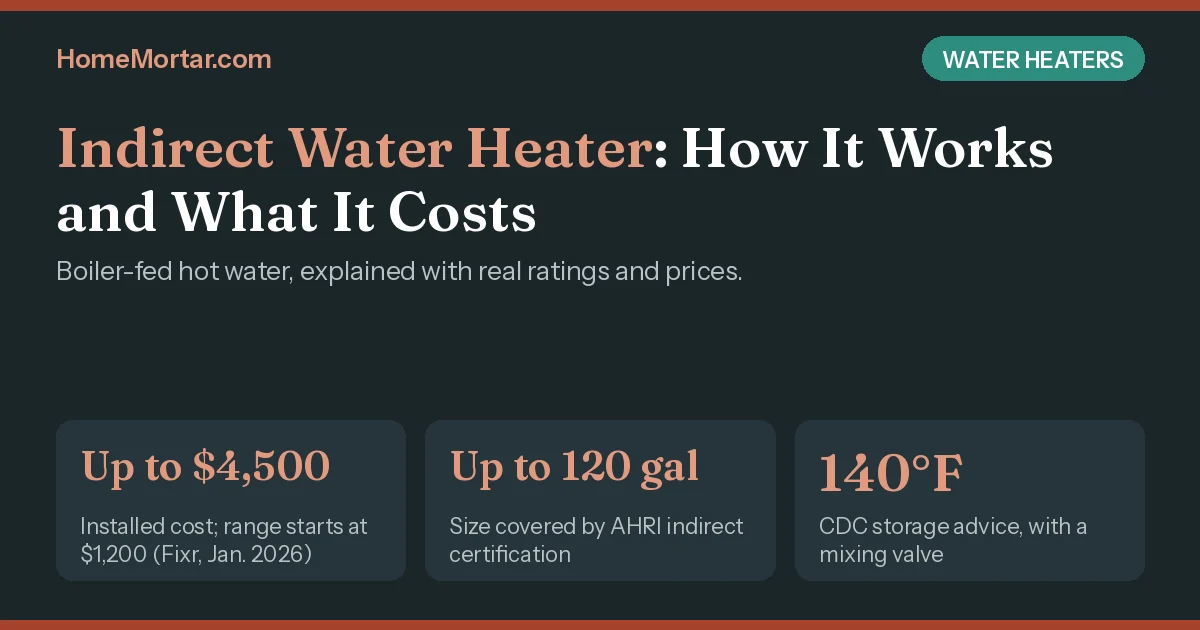
| Typical sizes | About 30 to 80 gallons in homes; AHRI certifies models up to 120 gallons |
| Installed cost | $1,200 to $4,500 (Fixr, January 2026 data) |
| Best fit | Homes that already heat with a boiler and use a lot of hot water |
| Weak spot | The boiler must fire in summer to keep the tank hot |
How Does an Indirect Water Heater Work?
Think of the tank as a thermos with a radiator inside it. The boiler supplies the heat, and the tank stores it. Here is the cycle, step by step:
- The tank cools. Someone showers, cold water refills the bottom, and the tank temperature drops.
- The aquastat calls. A tank thermostat, called an aquastat, signals the boiler and a pump or zone valve.
- Boiler water flows. Hot boiler water moves through the coil inside the tank. In most setups, the tank acts as one more heating zone.
- Heat moves through the coil wall. The domestic water around the coil warms up. Boiler water and drinking water stay in separate loops the whole time.
- The call ends. Once the tank reaches its set point, the pump stops and the boiler goes back to heating the house, or shuts off.
Many installers set the tank up with priority. On a hot water call, the control pauses the heating zones so the full boiler output goes to the tank. Installers on trade forums report that recovery usually takes well under half an hour, so the rooms barely notice. Without priority, the house and the tank share the boiler, and recovery takes longer.
Coil-in-tank vs tank-in-tank
Most models put a spiral coil near the bottom of the tank. A tank-in-tank design does the reverse: the domestic water sits in an inner tank, and boiler water surrounds it in an outer shell. Supplier PEX Universe notes that tank-in-tank units have more heat-transfer surface, so they recover faster. The trade-off is a little more standby loss because the hot boiler water sits on the outside.
Single wall vs double wall
Single-wall coils move heat faster. Double-wall heat exchangers add a second barrier between boiler fluid and drinking water. Bradford White makes a double-wall line called PowerStor2. It says the design gives “extra protection for systems using glycol or antifreeze in particularly cold areas.” If your boiler loop holds antifreeze, ask for a double-wall model, and check what your local code requires.
What Can Heat It: Oil, Gas, Propane, Steam, or Solar
An indirect tank does not care what fuel the boiler burns. Oil, natural gas, propane, and wood-fired boilers can all feed one. The setup is especially common in oil-heated homes. Fixr notes that most home systems that run on oil use an indirect tank linked to an oil-fired boiler.
Steam boilers can run one too. A pro pipes the tank as a hot-water loop taken from below the boiler’s waterline. Ask the installer how the boiler will be controlled in summer, since steam boilers handle this differently from hot-water boilers.
Solar thermal systems are the other big match. Dual-coil tanks take heat from two sources: solar collectors through one coil and the boiler through the other. On sunny days, the boiler has less to do.
What cannot heat it is a forced-air furnace. Several top-ranking pages say otherwise, but a furnace has no hot water loop to send through a coil.
How Much Hot Water Can It Make?
This is where the setup shines, and the reason is simple math. A boiler usually has far more heating power than a standard tank burner. U.S. Boiler compares a conventional direct-fired tank with a “34,000 BTU heat source” to a similar indirect drawing “over 100,000 BTUs of boiler power.”
Here is a hypothetical example. Warming water from 50°F to 120°F is a 70°F rise. One gallon of water weighs about 8.33 pounds, and one BTU raises one pound by 1°F. So, each gallon needs about 583 BTU (8.33 × 70).
| Heat going into the water | Gallons per hour at a 70°F rise |
|---|---|
| 34,000 BTU/hr | about 58 |
| 100,000 BTU/hr | about 172 |
These are upper limits, since no transfer is perfect. Still, the gap explains why boiler-fed tanks keep up so well in busy houses.

Comparing Hot Water Options in a Boiler Home
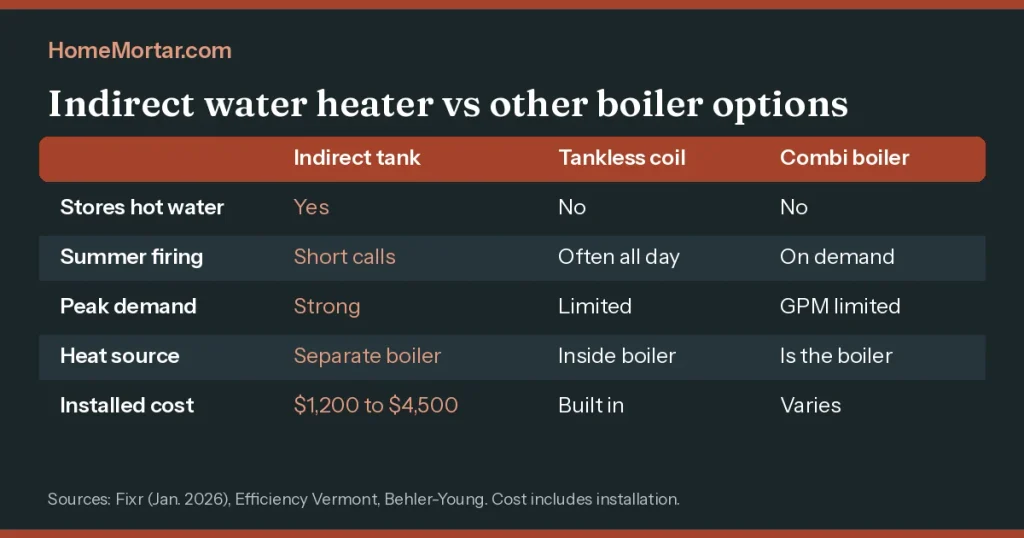
Boiler homes usually choose between four setups. The table below compares them on the points buyers ask about most.
| Setup | How it heats | Summer behavior | Hot water at peak | Main drawback |
|---|---|---|---|---|
| Indirect tank | Boiler heats a coil in a storage tank | Boiler fires briefly when the tank calls | Stored water plus fast recovery | Higher upfront cost; needs a boiler |
| Tankless coil | Coil inside the boiler heats water as it flows | Boiler often stays hot all day | Limited by coil output; temperature can swing | Efficiency Vermont says it can be one of the least efficient types |
| Combi boiler | Wall-hung boiler with built-in on-demand hot water | Fires only when a tap opens | Limited by GPM | May fall short with more than two showers at once in cold climates |
| Standard tank or gas tankless | Its own burner or elements | Independent of the boiler | Tank size or GPM | Second appliance, and gas units need their own vent |
Indirect water heater vs tankless
A gas tankless heater makes hot water on demand, so it has no tank losses. It also needs its own gas line, vent, and power. In a boiler home, that means two burners to service.
Michigan distributor Behler-Young puts it well for combi boilers. On-demand water is “an endless supply but not an endless amount.” With 40°F to 50°F ground water, it lists 2.5 to 5.2 GPM at a 70°F rise, depending on the model. A typical shower uses about 2 GPM.
An indirect tank stores a reserve and then refills fast. For houses with several bathrooms or a big soaking tub, that usually wins. For a house with a furnace instead of a boiler, a standard tank, a tankless unit, or a heat pump water heater makes more sense. Our tankless water heater pros and cons guide covers that choice in detail.
Upgrading from a tankless coil
Many owners first hear about indirects when a tankless coil stops keeping up. One homeowner on HVAC-Talk described exactly that. The post mentions “a lack of enough hot water (I have a tankless boiler with a coil).” Adding an indirect zone is usually simplest when the boiler is serviced or replaced. The installer adds a zone valve or circulator, a control, and supply and return piping.
Indirect Water Heater Pros and Cons
Pros
- Strong recovery. Boiler output is often several times a standard tank burner’s.
- One burner, one flue. Nothing extra to vent, and one less appliance to service.
- Long tank warranties. Some makers offer lifetime coverage on residential stainless or lined tanks (details below).
- Low standby loss. Some lined tanks are rated under 1°F per hour.
- Fuel flexible. Works with oil, gas, propane, wood, steam, and solar heat sources.
Cons
- Needs a boiler. No boiler means a far bigger project.
- Summer firing. The boiler must start up to reheat the tank, even when the house needs no heat.
- Higher upfront cost. You pay for the tank plus piping, controls, and labor.
- Tied to the boiler. If the boiler fails, you lose heat and hot water together.
- Old boiler, weak results. An outdated boiler drags down the efficiency of the whole setup.
How Much Does an Indirect Water Heater Cost?
Fixr’s January 2026 data puts a full indirect installation at $1,200 to $4,500. That compares with $600 to $2,500 for a standard tank and $1,000 to $4,000 for a tankless unit. In November 2026, US supply stores listed most residential indirect tanks (30 to 80 gallons) between roughly $1,100 and $3,500 for the tank alone.
| Cost item | Typical range (Fixr) |
|---|---|
| Labor | $300 to $1,500 |
| Plumber hourly rate | $45 to $200 |
| Old unit removal | $75 to $500 |
| Permit | $25 to $1,500 |
Price rises with tank size, stainless steel, double-wall coils, and how much new piping the boiler room needs. Here is a hypothetical budget for a 40-gallon replacement in a boiler home: tank $1,700, labor $900, and permit $100. The total is $2,700, inside Fixr’s range. Ask for a written quote that lists the zone valve or pump, controls, mixing valve, and expansion tank separately.
Why are indirect water heaters so expensive?
You buy a well-insulated tank made to last many years, plus the parts that tie it to the boiler. The labor also takes longer than a like-for-like tank swap. You save money elsewhere, though: no extra burner, no new vent, and no second fuel line.
How to Size an Indirect Tank
Gallons alone tell you little. Two numbers matter more, and both appear in AHRI ratings:
- First Draw rating (gallons per hour): it works much like the first-hour rating on a standard tank. A higher number means more hot water when heavy use starts.
- Continuous Draw rating: how many gallons per hour it can keep making, at a stated boiler output.
The AHRI Indirect Water Heaters certification program tests these under the AHRI 1400-2025 standard. It also verifies standby loss and the coil’s friction loss. Compare these numbers between models, not just the gallon size.
A few rules of thumb from the trade:
- Match the boiler, not the brochure. Rated recovery assumes a certain boiler input. Behler-Young calls upsizing the boiler just to hit that rating “a common mistake.”
- Think about peak use. Count the showers, tubs, and machines that run at the same time.
- Replacing a tank that worked? Matching its size is a safe start.
- Big soaking tub? Its filler alone can outrun a small tank, so size up or plan on priority.
A pro should also check the boiler’s output against the home’s heat loss. Pros on heating forums ask the same question again and again: “Have you had a heat calculation done?”
Tank Materials and Warranties
The tank’s lining has a big say in how long it lasts in your water. Here is how the main types compare:
| Tank type | Anode rod? | Good to know |
|---|---|---|
| Glass-lined steel | Yes | Most common and lowest cost; the lining can chip with rough handling |
| Stainless steel (316L or 444) | Usually no | Strong corrosion resistance; high chloride levels in water can still attack it |
| Thermoplastic-lined | Usually no | U.S. Boiler calls its thermoplastic liner ideal for most water conditions |
| Stone-lined (such as Hydrastone) | Usually no | Aimed at acidic, hard, or otherwise aggressive water |
Warranties give a firmer number than lifespan claims. U.S. Boiler offers an 8-year leak-free warranty on its stainless Alliance SST, and it can be upgraded to lifetime at no charge. Its lined Alliance LT and SL models carry 10 years with an optional lifetime upgrade. HTP lists a limited lifetime tank warranty for residential use on its SuperStor Ultra EVO. Read the terms, since lifetime coverage can come with conditions such as residential use only.
How Long Does an Indirect Tank Last?
No lab test gives a fixed number. Contractors in this field commonly quote 15 to 20 years or more for a well-kept stainless tank. Fixr gives 8 to 12 years for a standard tank water heater. Water chemistry, oxygen entering the boiler loop, and the installation matter as much as the brand.
One real data point from a buyer-agent blog stands out. A commenter wrote: “Our STOREX water heater finally broke after 27 years!” That is one tank, not a promise.
The Summer Catch
Here is the part most sales pages skip. Efficiency Vermont says indirect tanks are most efficient in cold months. In warm months, they “can be very inefficient.” The boiler runs all year and often heats the room around it.
How big the penalty gets depends on the boiler. A cold-start boiler cools down between calls and fires only when the tank asks. That beats a tankless coil, which keeps the boiler hot all day. Forum pros compare it to highway driving: fewer, longer runs instead of constant short ones.
If summer losses bother you, there is another route. Some boiler owners add a heat pump water heater and shut the boiler off for the warm season.
Temperature, Legionella, and Scald Safety
Storage temperature is a real trade-off. The CDC’s Legionella guidance for building water systems says to store hot water above 140°F (60°C). Water that hot can scald, so the CDC also recommends thermostatic mixing valves near fixtures.
Many indirect setups do both. The tank stores water hot, and a mixing valve sends a safer temperature to the taps. PEX Universe notes that this pairing also gives you more usable hot water from the same tank.
Safety note: Boiler controls, gas and oil burners, and pressure relief valves are pro territory. If the relief valve on the tank or the boiler drips or spits, call a licensed plumber or heating tech. Never cap or plug a relief valve.
Maintenance Checklist
Indirect tanks need less care than a burner tank, but not zero:
- Test the temperature and pressure relief valve as the tank’s manual directs.
- Flush sediment from the bottom, more often if your water is hard. Our water heater flushing guide walks through the steps.
- Check the anode rod on glass-lined tanks. Many stainless and plastic-lined tanks have none, so check your manual.
- Check the domestic expansion tank, if you have one, since a failed one stresses the whole system.
- Service the boiler every year because the tank is only as good as its heat source.
- Confirm the aquastat setting after any boiler work.
Signs Your Indirect Tank Has a Problem
| What you notice | Common cause |
|---|---|
| Water pooling under the tank | A fitting or valve leak, or a tank leak; a leaking tank usually needs replacing |
| Lukewarm water but the boiler runs | Aquastat, zone valve, pump, or priority control fault |
| Hot water runs out fast | Undersized tank, low boiler output, or sediment |
| Boiler pressure keeps creeping up | Possible coil leak letting house water into the boiler loop; call a pro |
| Rusty or smelly hot water | Anode wear in a glass-lined tank, or water chemistry |
Brands You Will See
US supply stores in November 2026 listed indirect tanks from many makers. Common names include Amtrol (BoilerMate), Bradford White (PowerStor), Burnham and U.S. Boiler (Alliance), HTP (SuperStor), Lochinvar (Squire), Triangle Tube, Weil-McLain (Aqua Plus and Aqua Pro), Dunkirk, Utica, IBC, and Laars.
Many boiler makers sell a matching tank, so your installer may suggest the brand that fits your boiler and controls. Compare the AHRI ratings, tank material, and warranty rather than the logo.
Is an Indirect Tank Worth It?
It usually is if three things are true. You heat with a boiler, your household uses a lot of hot water, and the boiler is in good shape. The best time to add one is when you replace the boiler or add radiant floors.
It is harder to justify if your boiler is old, your house uses a furnace, or you plan to move soon. A homeowner who expects to sell in a few years may get more value from a standard tank. If you are weighing gas tanks instead, our power vent vs direct vent water heater guide explains the venting side.
What It Is Called in Canada and the UK
Canada: Natural Resources Canada groups boiler-fed hot water under combination systems. It notes that some of these systems “use boilers in place of water heaters.” Canada’s CSA P.9 test standard rates combination systems on space and water heating together.
United Kingdom: The same idea is an “indirect cylinder.” Baxi, a boiler maker, says it “uses an external source, such as a boiler.” A direct cylinder has its own immersion heater instead. UK cylinders also come vented, fed from a loft tank, or unvented, running at mains pressure.
What Changed in 2025 and 2026
- Current rating standard. AHRI certifies indirect tanks under AHRI 1400-2025.
- Federal tax credit is gone. The 25C home improvement credit, which covered some water heaters, ended for equipment placed in service after December 31, 2025. Check state and utility rebates instead.
- Older DOE pages are gone. Many sites still quote DOE Energy Saver pages on indirect and tankless coil heaters. When we checked in November 2026, those pages returned “page not found.” Treat any quote from them with care.
- More people are searching. US search interest for the term rose about 40% year over year, per Semrush.
The Bottom Line
For a home that already heats with a healthy boiler, an indirect water heater is one of the strongest hot water choices you can make. You get fast recovery, no extra burner, and a tank built to last. Weigh the summer firing and the upfront price, size it on its first draw and continuous ratings, and store the water hot behind a mixing valve. Without a boiler, look at other options first.
Frequently Asked Questions
What is an indirect-fired water heater?
It is the same appliance under another name. “Indirect-fired” means the tank has no fire of its own. A boiler fires instead, and its hot water heats the tank through a coil.
What are the disadvantages of an indirect water heater?
You need a boiler, the upfront cost is higher, and the boiler must fire in summer. If the boiler fails, you lose heat and hot water at the same time.
Do you need to flush an indirect tank?
Yes, now and then. Sediment still settles at the bottom, especially with hard water. Flushing on a schedule from the tank’s manual keeps the bottom clean and the drain valve working.
Do you need an expansion tank on an indirect tank?
A hot-water boiler loop has its own expansion tank. The domestic side may need a separate one if your water line has a check valve or pressure-reducing valve. Local code decides, so ask your plumber or inspector.
Can a furnace run an indirect tank?
No. A forced-air furnace heats air and has no hot water loop. You need a hot-water or steam boiler, or a solar thermal system.
Can an indirect tank have electric backup?
Only if the model is built for it. Dual-coil tanks accept a second heat source, such as solar. Check the spec sheet before you count on an electric element.
How long does an indirect tank take to heat up?
With a hot boiler and priority control, installers often report recovery in well under half an hour. A full cold start takes longer and depends on boiler output.
Is an indirect water heater the same as a tankless coil?
No. A tankless coil sits inside the boiler and heats water only as it flows. An indirect water heater is a separate storage tank, which lets the boiler rest between calls.