Pros and Cons of Tankless Water Heaters: What Owners Wish They Knew

Your old tank is leaking, or it is simply getting old, and somebody has told you to go tankless. Endless hot water, lower bills and a unit the size of a carry-on bag sound hard to argue with. Then a plumber quotes three times the price of a new tank, and a neighbor says theirs runs cold in January.
Both stories can be true. This guide lays out the pros and cons of tankless water heater systems with the numbers most articles leave out. You will see how much hot water a unit really makes in winter and what the electrical and gas upgrades cost. You will also see who comes out ahead and who is better off with a tank.
The Short Verdict
| Tankless | Standard tank | |
|---|---|---|
| Hot water supply | Continuous, up to the unit’s flow limit | Runs out when the stored water is used |
| Energy use | 8% to 34% more efficient (DOE) | Loses heat from stored water all day |
| Typical life | 15 to 20+ years | 8 to 12 years |
| Upfront cost | Higher, often much higher | Lower |
| Space | Wall mounted, small | Floor space for a 40 to 80 gallon tank |
| Best fit | Gas homes, long stays, small to mid households | Tight budgets, very hard water, short stays |
Most tankless water heater pros and cons lists stop at a table like this. Tankless wins on life span, space and steady supply for most homes. It loses on upfront cost, and it can disappoint in cold climates if it is sized for summer water. The rest of this guide explains each line of that table.
How a Tankless Water Heater Works
A tankless unit, also called an on-demand or instantaneous water heater, stores no hot water. When you open a hot tap, a flow sensor detects moving water. The unit then fires a gas burner or switches on electric elements, and water heats as it passes through a heat exchanger.
Gas models come in two styles. Non-condensing units send hot exhaust out through stainless steel venting. Condensing units capture extra heat from the exhaust with a second heat exchanger, so the exhaust is cooler and can often run through PVC pipe. A. O. Smith describes both designs in its own pros and cons guide.
Electric models need no venting at all. They do need a lot of electrical current, which we cover below.
Every tankless unit also has a minimum flow before it switches on. Stiebel Eltron’s spec sheet lists 0.37 gallons per minute for its smallest whole house model and 0.77 gpm for its largest ones. A trickle below that line stays cold.
The Advantages
Lower energy use, but by less than many sites claim
A tank keeps 40 or 50 gallons hot around the clock and loses some of that heat into the room. A tankless unit avoids that standby loss because it only heats water while you use it.
The U.S. Department of Energy puts real numbers on this in its Energy Saver Guide. Take a home that uses 41 gallons of hot water a day or less. There, a tankless unit can run 24% to 34% more efficiently than a storage tank. Homes that use about 86 gallons a day see a smaller gain of 8% to 14%.
Some contractor pages say tankless units use 30% to 50% less energy. That range does not match the DOE figures above. The more hot water your household uses, the smaller the percentage gain.
Hot water that does not run out
A tank gives you its stored volume, then makes you wait while it reheats. A tankless unit keeps going as long as the demand stays within its flow rating. Back to back showers are no longer a scheduling problem.
The honest limit is the word “within.” Run two showers, the dishwasher and the washing machine at once, and an undersized unit will drop temperature. That is a sizing question, and it is the biggest single complaint owners raise.
A longer service life
The DOE guide says tankless water heaters can last more than 20 years. A. O. Smith gives about 15 to 20 years against roughly 10 for a tank. Rheem puts tank life at 8 to 12 years and says a well maintained tankless unit can reach 25 to 30.
The reason is simple. A tank fails when its steel shell corrodes from the inside. A tankless unit has no tank to rust through, and many of its parts can be replaced one at a time.
More floor space and no tank to burst
Noble Plumbing describes a typical 50 gallon tank as about 2 feet wide and 5 feet tall. A tankless unit hangs on a wall and is roughly the size of a suitcase. That frees a closet or a corner of the garage.
There is also no reservoir of 40 to 80 gallons waiting to flood the floor. A tankless unit can still leak at a fitting, but not dump a full tank.
Flexible installation
Many gas tankless units vent through a side wall instead of the roof. Some models are built for outdoor mounting in mild climates. Several smaller units can also be placed close to distant bathrooms to cut the wait for hot water.
The Disadvantages
A much higher upfront cost
Angi’s cost guide puts a tank water heater at about $600 to $2,500 installed and a tankless unit at about $1,400 to $3,900. It also notes that installation alone can range from about $600 to more than $7,000 once upgrades are involved.
The upgrades are where budgets break. A Seattle area plumbing company, Noble Plumbing, lists these typical add-ons from its own installs:
| Upgrade | Why it may be needed | Typical cost (Noble Plumbing) |
|---|---|---|
| Larger gas line | Tankless gas units need far more gas than a tank | $500 to $1,500 |
| New venting | Category III stainless or PVC, depending on the model | $300 to $800 |
| Electrical work | Even gas units need a 120V outlet; electric units need large circuits | $200 to $1,000 |
| Panel upgrade | Older homes may lack spare capacity for electric tankless | $2,000 to $4,000 |
Those are one contractor’s local figures, not national averages. Angi separately lists $1,000 to $3,500 for venting on non-condensing models. Get at least two written quotes that list each upgrade on its own line.
Flow limits, especially in winter
A tankless unit cannot heat water faster than its burner or elements allow. The colder the water coming in, the less hot water comes out. That is why a unit that felt fine in July can struggle in January.
Gas units are usually rated somewhere around 5 to 10 gallons per minute and electric units around 2 to 5. A. O. Smith and SlashGear both cite those ranges. Those ratings assume a certain temperature rise, so read the fine print on the spec sheet. Eccotemp, for example, rates its 6.5 gpm unit at a 45°F rise.
Electric units need a lot of power
Whole house electric tankless heaters draw far more current than a tank. Stiebel Eltron’s spec sheet for its 36 kW Tempra model calls for three separate 50 amp double pole breakers, or 150 amps of breaker capacity. Its 24 kW model needs two 50 amp breakers.
| Stiebel Eltron Tempra model | Power at 240V | Breakers required |
|---|---|---|
| Tempra 12 | 12 kW | 1 x 50 A |
| Tempra 20 | 19.2 kW | 2 x 40 A |
| Tempra 24 | 24 kW | 2 x 50 A |
| Tempra 29 | 28.8 kW | 3 x 40 A |
| Tempra 36 | 36 kW | 3 x 50 A |
Some older homes have only a 100 amp electrical service. A licensed electrician has to run a load calculation before you buy, because a panel upgrade can cost more than the heater.
Gas units need more gas and new venting
Noble Plumbing cites 40 gallon gas tanks from Rheem and A. O. Smith rated at about 40,000 BTU per hour. Rinnai’s RU199iN tankless unit can fire at up to 199,000 BTU per hour. Noble Plumbing notes that many homes then need a larger gas line, often going from 1/2 inch to 3/4 inch.
Gas units also need the right venting, and the old tank vent usually cannot be reused. This is licensed work. Poor venting can let carbon monoxide into the house.
Staying with a gas tank instead? Our guide to power vent vs direct vent water heaters compares the two most common ways to vent one through a wall.
A short wait and the cold water sandwich
Hot water still has to travel through the pipes, so a far bathroom still waits. Tankless units add a few seconds of their own while the burner lights. Some owners also notice a “cold water sandwich.” You shut the tap briefly and turn it back on. Then a slug of cool water arrives between two hot ones.
A recirculation pump can shorten the wait. Some models include a small buffer tank to smooth out the sandwich effect. Both add cost, and a pump adds some energy use.
Low flow fixtures may not trigger it
If a fixture draws less than the unit’s minimum activation flow, the burner never fires. Owners on older forum threads describe showers going cold mid-rinse with a very low flow head. Check the minimum flow on the spec sheet against your lowest flow fixture.
No hot water in a power outage
Electric tankless units stop when the power goes out. Gas units do too, because their igniter, fan and controls need a 120V supply. A gas tank with a standing pilot can keep a reservoir of hot water during an outage. That matters in storm prone areas.
Scale and yearly maintenance
Minerals in hard water coat the heat exchanger and cut performance. Rheem and other makers call for descaling about once a year, more often with very hard water. It means circulating a cleaning solution through the unit with a small pump. Our guide to flushing a water heater covers the descaling steps and what a plumber charges.
Some owners report warranties that exclude damage caused by scale. Read yours before you skip a year.
Freezing outdoors
Most outdoor models use built-in freeze protection heaters, and those need power. A long outage in a hard freeze can damage the heat exchanger. In cold regions an indoor unit is the safer choice.
How Much Hot Water Will You Actually Get?
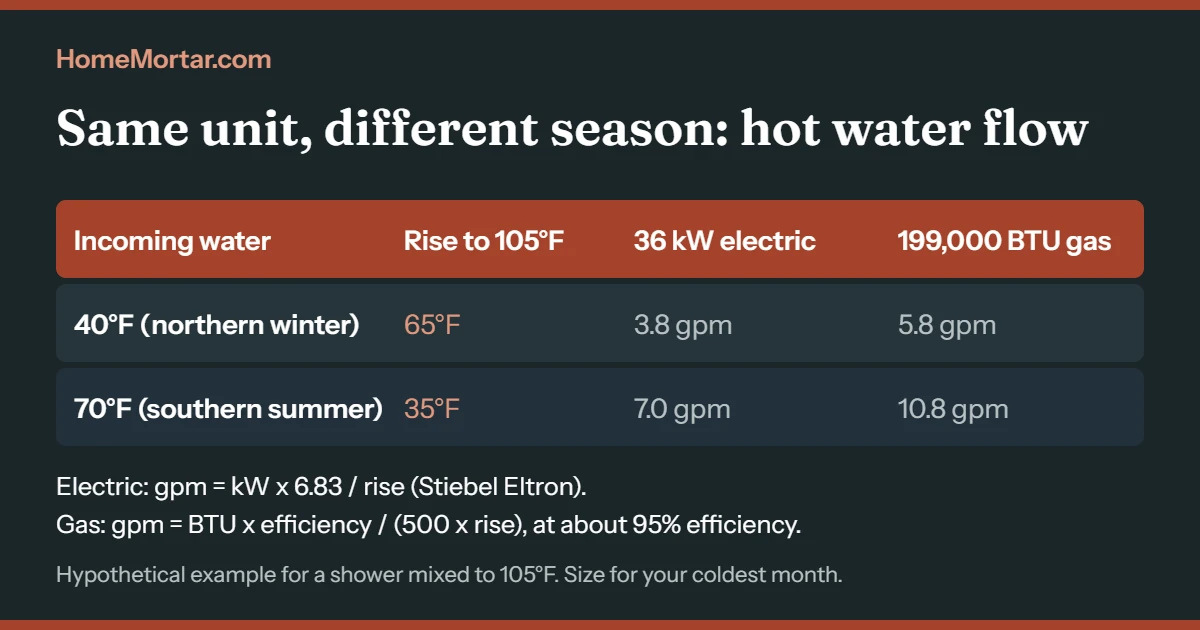
This is the math almost no competitor shows. The flow you get depends on the temperature rise: the gap between the water coming in and the water you want out.
For electric units, Stiebel Eltron’s own formula is gallons per minute = kW x 6.83 / temperature rise. For gas units, a standard engineering estimate is gallons per minute = input BTU x efficiency / (500 x temperature rise). The 500 comes from the weight of a gallon of water times 60 minutes.
Here is a hypothetical example for a shower mixed to 105°F. It compares a 36 kW electric unit with a 199,000 BTU gas unit at about 95% efficiency.
| Incoming water | Temperature rise | 36 kW electric | 199,000 BTU gas | 2.5 gpm showers at once (electric / gas) |
|---|---|---|---|---|
| 40°F (northern winter) | 65°F | 3.8 gpm | 5.8 gpm | 1.5 / 2.3 |
| 70°F (southern summer) | 35°F | 7.0 gpm | 10.8 gpm | 2.8 / 4.3 |
The same equipment delivers almost twice the flow in summer. A unit sold as “up to 11 gpm” reaches that number only at a small rise. With the same math, 11 gpm from a 199,000 BTU unit works out to roughly a 34°F rise.
To size your own unit, list the fixtures you run together, add their flow rates and size for your coldest month. EPA WaterSense notes that standard showerheads use 2.5 gpm and labeled models use no more than 2.0. A low flow head lets the same unit run more showers at once.
Does a Tankless Water Heater Save Money?
It saves energy for almost everyone, but the payback can be long. Here is a hypothetical example using the DOE percentages and an extra $1,500 upfront cost over a tank.
| Household (hypothetical) | Yearly water heating bill | DOE savings range | Yearly savings | Years to recover $1,500 |
|---|---|---|---|---|
| Light use, about 41 gal/day | $350 | 24% to 34% | $84 to $119 | about 13 to 18 |
| Heavy use, about 86 gal/day | $700 | 8% to 14% | $56 to $98 | about 15 to 27 |
That is slower than the 3 to 7 years HomeGuide quotes, or the 7 to 10 years Angi gives. Those estimates assume lower premiums or rebates. Your result depends on your fuel price, your hot water use and how much the upgrades cost.
There is a second side to the math. A tankless unit that lasts 20 years may outlive two tanks, and the replacement you skip has real value. If you plan to stay put, that often tips the decision. If you plan to sell in a few years, it usually does not.
To compare a repair quote on your current tank with replacement, try our repair or replace calculator.
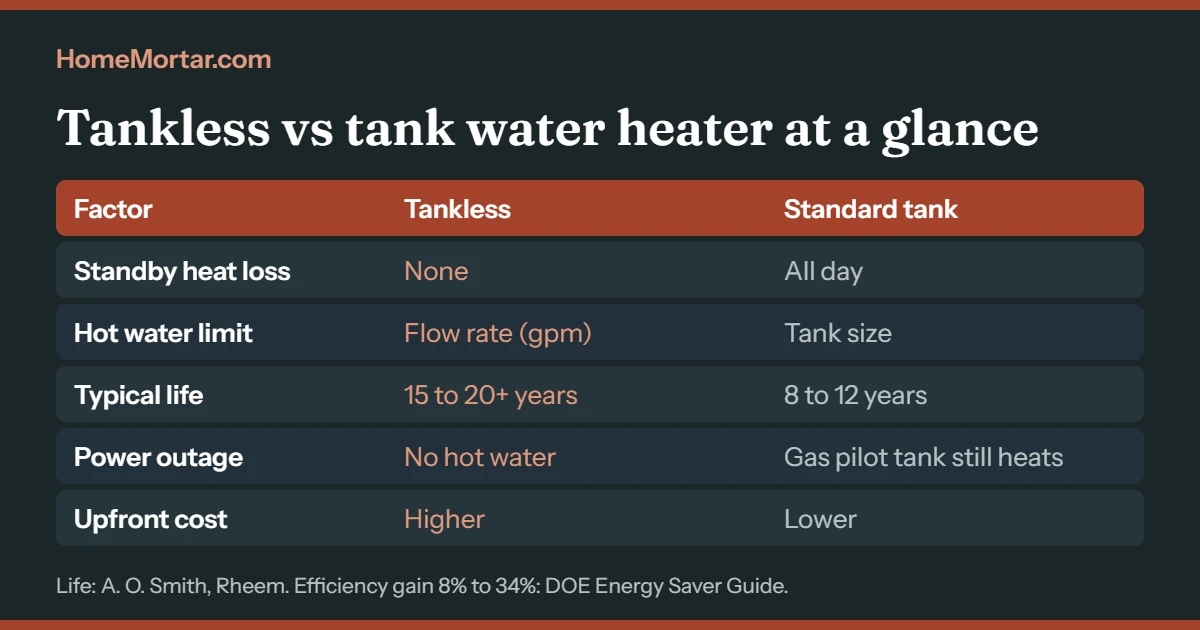
Tankless vs Tank Water Heater at a Glance
| Factor | Tankless | Tank |
|---|---|---|
| How it heats | On demand as water flows | Keeps a full tank hot |
| Standby loss | None | Yes, all day |
| Hot water limit | Flow rate (gpm) | Tank size and recovery |
| Gas input (typical) | Up to about 199,000 BTU/h | About 40,000 BTU/h |
| Electric needs | Up to 150 A of breakers on large models | A single 240V circuit is common |
| Outage | No hot water (gas and electric) | Gas tank with standing pilot still heats |
| Maintenance | Yearly descaling in hard water | Yearly flush and anode checks |
| Life | 15 to 20+ years | 8 to 12 years |
If you are weighing the tankless vs tank water heater choice for an older home, the upgrade line items usually decide it. Get those priced before you compare units.
Who Should Go Tankless, and Who Should Not
Tankless usually makes sense when:
- You have natural gas and room for a larger gas line and new venting.
- You plan to stay in the home for many years.
- Your household runs out of hot water with a tank now.
- Floor space matters, or the tank sits in a living area where a leak would do real damage.
- You are already remodeling, so walls are open for gas, vent or wiring work.
A tank is often the better call when:
- Budget is the main concern and your current setup works.
- You would need a panel upgrade to support electric tankless.
- You have very hard water and do not want yearly descaling.
- You live where power outages are common and hot water during one matters.
- You expect to sell within a few years.
If your current tank is near the end of its life, check its age first. Our guides to Rheem water heater age and Bradford White water heater age show how to read the serial number. Plan the switch before the old tank fails, not during an emergency.
Heat your home with a boiler? An indirect water heater uses the boiler to heat a storage tank, and it often handles several showers at once better than a tankless unit.
Gas or Electric Tankless?
Gas tankless units deliver higher flow rates, so they suit whole house use in most climates. They cost more to install because of the gas line and venting. ENERGY STAR now asks gas tankless models for a Uniform Energy Factor of at least 0.95, up from 0.87. Noritz summarizes the change in its guide to the criteria.
Electric tankless units are simpler to plumb and need no vent. They are often the best fit for one sink, one bathroom or an addition. As whole house heaters, they demand large circuits, and the flow drops fast with cold incoming water.
The cheap online electric units now trending in searches are mostly small models. Check the kW rating and the breaker list against your panel before you order one.
Questions to Ask Before You Buy
- What flow will this unit give at our coldest incoming water temperature?
- Which fixtures did you assume we run at the same time?
- Does our gas line need upsizing, and is that in the quote?
- What venting does this model need, and where will it exit?
- For electric models, what does the load calculation show for our panel?
- What is the minimum activation flow, and will our lowest flow fixture trigger it?
- Do you recommend a recirculation pump or a model with a buffer tank?
- What does the warranty say about scale damage and descaling?
- Who pulls the permits for gas and electrical work?
Safety note: gas piping, venting and high amperage electrical work need licensed professionals and usually a permit. Keep working carbon monoxide alarms on every level of a home with gas appliances. If you smell gas, leave and call your gas utility from outside.
What Changed in 2025 and 2026
- The federal tax credit ended. The IRS says the 25C energy efficient home improvement credit is not allowed for property placed in service after December 31, 2025. Several popular cost pages still list a $600 credit for tankless units. Check utility and state rebates instead.
- A stricter federal gas tankless standard was withdrawn. DOE finalized new standards for gas-fired instantaneous water heaters in December 2024. Congress disapproved that rule in May 2025, and DOE withdrew it.
- ENERGY STAR raised the bar. Gas tankless models now need a Uniform Energy Factor of at least 0.95 to earn the label.
- Budget electric brands are surging. Google Trends shows U.S. searches for several low cost electric tankless brands rising by thousands of percent over five years.
Tankless Water Heaters Outside the U.S.
Canada. Winter inlet water is very cold across much of the country, so size for the largest temperature rise you will see. Indoor installation is the norm for freeze protection.
United Kingdom. Many homes already heat water on demand with combination boilers. The same rule applies: a combi has a flow limit, and running two showers at once can stretch it.
Australia. Gas continuous flow units are common. In Victoria, new homes on planning permit applications lodged from January 1, 2024 cannot connect to mains gas. New homes there rely on electric hot water, such as heat pump systems, or on bottled LPG, which the rule does not cover.
The Bottom Line
The pros and cons of tankless water heater systems come down to three questions. Can your gas line, venting or electrical panel support one without huge upgrades? Will it deliver enough flow at your coldest water temperature? Will you stay long enough for the longer life and lower energy use to pay back the higher price?
If the answers are yes, a properly sized tankless unit gives you steady hot water, more space and a heater that can outlast two tanks. If not, a good tank, or a heat pump model if you are all electric, may serve you better. Our guide to what a hybrid water heater is explains that option.
Frequently Asked Questions
What are the pros and cons of tankless water heater systems in one sentence?
They save energy, last longer, save space and do not run out. On the other side, they cost more, have a flow limit and need power and yearly descaling.
What is the most common problem with tankless water heaters?
Scale buildup from hard water is the problem owners and manufacturers mention most. Undersizing is a close second, which shows up as lukewarm water when several fixtures run at once.
Are tankless water heaters worth it?
They are usually worth it for gas homes, long stays and households that run out of hot water now. They are less worth it when a panel upgrade is needed, when water is very hard or when you plan to move soon.
Can you run two showers with a tankless water heater?
Yes, if the unit is sized for it. In our hypothetical winter example, a 199,000 BTU gas unit supplies about 2.3 standard showers, while a 36 kW electric unit supplies about 1.5.
Do tankless water heaters make your electric bill go up?
A whole house electric unit draws very high power for short periods. Its yearly energy use is usually lower than an electric tank, because it avoids standby losses. Your bill goes up only if you also start using much more hot water.
Can I replace my 40 gallon water heater with a tankless water heater?
Usually, yes. Expect to check the gas line size, venting and electrical supply first. At full fire, a tankless unit needs far more fuel or current than a 40 gallon tank.
Why do some plumbers not like tankless water heaters?
The common reasons are complex installs, callbacks from undersized units and failures caused by skipped descaling in hard water. Many plumbers like them when they are sized and maintained properly.
How long does a tankless water heater last?
Manufacturers give 15 to 20 years or more, and the DOE says they can last more than 20 years. Yearly descaling in hard water areas helps a unit reach the top of that range.
What are the main disadvantages of tankless water heater systems?
The higher upfront cost, possible gas or electrical upgrades, flow limits in cold weather, no hot water in a power outage and yearly descaling. Each one is manageable if you plan for it before you buy.