Power Vent vs Direct Vent Water Heater: Which One Fits Your Home?
Your plumber says the old chimney can’t be used anymore, and now you have two new words to decode. Both sound modern, both cost more than the tank you have, and several top-ranking articles describe one of them incorrectly.
Here is the core of the power vent vs direct vent water heater choice in plain terms. A power vent unit uses an electric fan to push exhaust through a long plastic pipe. A direct vent unit pulls outside air in and sends exhaust out through a short, sealed vent with no fan at all. This guide covers how each works, what the spec sheets allow, what each costs, and which one suits your house.
The Short Answer
- Pick a power vent if the tank sits far from an outside wall and has an outlet nearby. A little fan noise is part of the deal.
- Pick a direct vent if the tank can sit against an outside wall. It also suits outage-prone areas, closets, and tight, well-sealed rooms.
- Pick a power direct vent if you need sealed combustion and a long vent run at the same time.
- Keep an atmospheric unit only if your existing chimney or metal vent is sound, properly sized, and approved for it.
Here is how the four common gas tank types compare at a glance.
| Type | Combustion air from | How exhaust leaves | Needs electricity? | Typical vent route |
|---|---|---|---|---|
| Atmospheric | The room | Rises on its own up a metal vent or chimney | No | Vertical only |
| Power vent | The room | A blower pushes it out | Yes, 120 volts | Long plastic pipe, wall or roof |
| Direct vent | Outdoors, through a sealed vent | Natural draft through the same sealed vent | No (standard models) | Short run through an outside wall or roof |
| Power direct vent | Outdoors, through a pipe | A blower moves intake air and exhaust | Yes | Long two-pipe or concentric run |
Why the Names Confuse People
You may have read that a direct vent sends exhaust “up a chimney.” Several top-ranking pages say exactly that. That description fits an atmospheric water heater, not a direct vent one.
Manufacturers use the terms differently. Rheem calls a direct vent unit “a sealed combustion system.” It draws “fresh combustion air from outside the home” and vents “exhaust gases directly outdoors through a dedicated vent assembly.” American Water Heaters, an A. O. Smith brand, adds that the vent “runs from the water heater through the side of your home.”
So, when a quote says “direct vent,” ask one question: does the unit take its combustion air from outdoors? If the answer is no, you are looking at an atmospheric or power vent model under a loose label.
How a Power Vent Water Heater Works
A power vent water heater is a standard gas tank with a blower mounted on top. When the burner fires, the blower pushes exhaust through a plastic vent pipe to the outside. American Water Heaters notes the fan “requires an electrical outlet to be close to the water heater.”
The burner still uses air from the room. Rheem’s Performance Power Vent spec sheet says it plainly. The unit “uses indoor air for combustion; blower exhausts the flue gases.” That matters in small, tight rooms, as the safety section explains.
What it needs
- A 120-volt outlet near the tank. Rheem lists a “standard 120 VAC electrical connection.”
- Plastic vent pipe. Rheem allows PVC, ABS, or CPVC. American Water Heaters explains that “lower exhaust temperatures” are what make plastic pipe possible.
- Enough room air for combustion, sized to the manual and local code.
How far it can vent
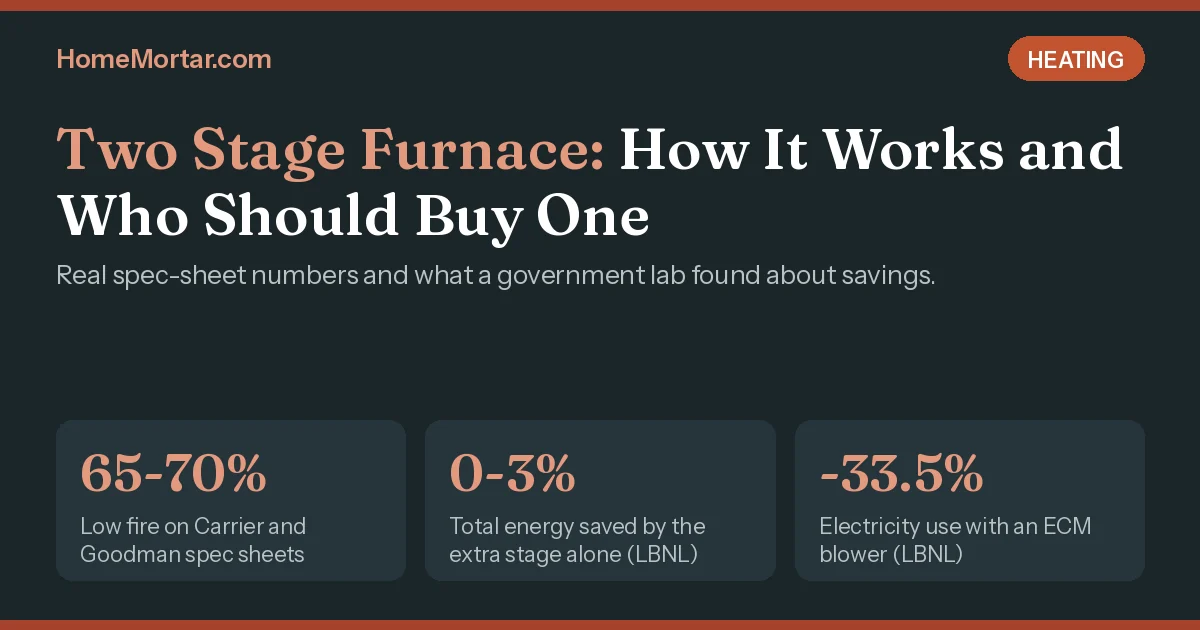
This is the big advantage. Below 2,000 feet of altitude, Rheem’s Performance power vent models allow up to 150 equivalent feet on a 3-inch vent. On a 2-inch vent, the limit is 55 feet, and the minimum is 7 feet. Rheem counts each 90° elbow as roughly 5 feet of pipe and each 45° elbow as about 2.5 feet.
Limits vary by model and age, though. An older Rheem PVG power vent manual allows a maximum of 40 feet with three long-sweep elbows. Always size the vent from the manual for your exact model.
How a Direct Vent Water Heater Works
A direct vent water heater has a sealed combustion chamber. Air for the burner comes from outdoors through the vent, and exhaust goes back out through the same assembly. Most use a coaxial vent, which American Water Heaters describes as “separate chambers for intake air and exhaust in a single assembled vent piece.”
Because the burner never touches room air, the house and the flame stay separate. American Water Heaters says this design helps “negate any backdrafting” inside the home.
No electricity needed
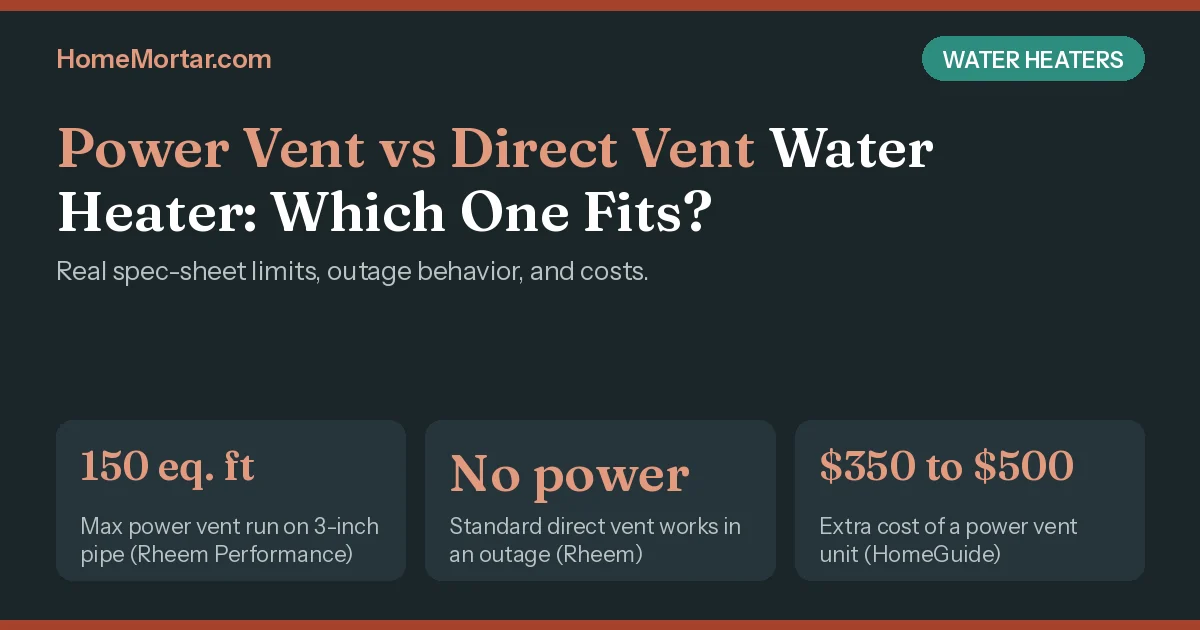
Standard direct vent models run without power. Rheem’s Professional Classic direct vent spec sheet states the unit “requires no electrical power” and uses piezo ignition. In Ontario, Enercare says its direct vent units work “without electricity so it provides hot water even during power outages.”
Short vent runs only
The trade-off is distance. Rheem’s direct vent models ship with a side-vent kit that reaches about 8 to 19 inches, depending on the model. Optional kits extend that to 48 inches. A. O. Smith’s ProMax direct vent allows up to 80 inches horizontally and 68 inches vertically before the turn through the wall.
In practice, the tank sits on or near an outside wall. One GreenBuildingAdvisor member summed it up: “the water heater needs to be near an exterior wall.”
What About Power Direct Vent?
A power direct vent water heater combines both ideas. It uses sealed combustion like a direct vent unit and a blower like a power vent unit. American Water Heaters explains that the blower pulls in outdoor air for combustion and pushes exhaust back outside, usually through PVC pipe.
Rheem says this design “allows venting over longer distances than many standard direct vent systems.” As an example, Rheem’s older power direct vent specs list runs up to 100 feet per pipe on a 4-inch vent for one model. You get placement freedom and sealed combustion, but you also need an outlet, and you lose hot water when the power goes out.
Power Vent vs Direct Vent Water Heater: Side-by-Side
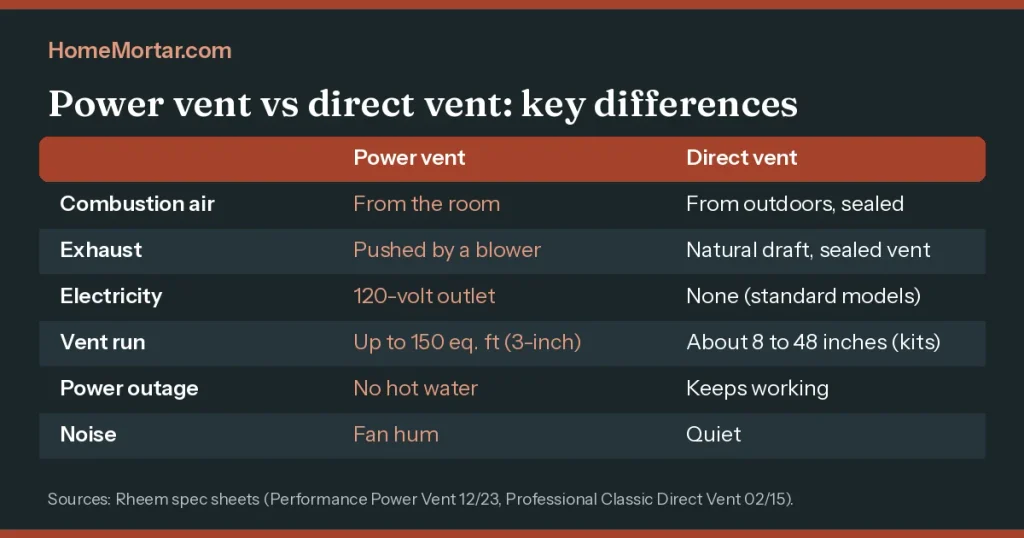
This table sets the two main choices next to each other, using the manufacturer documents above wherever a number is involved.
| Factor | Power vent water heater | Direct vent water heater |
|---|---|---|
| Combustion air | From the room | From outdoors, sealed |
| Exhaust | Pushed by a blower | Natural draft through a sealed vent |
| Electricity | Needs a 120-volt outlet | None for standard models |
| Vent pipe | PVC, ABS, or CPVC | Manufacturer’s coaxial vent kit |
| Maximum run (examples) | Up to 150 equivalent feet on 3-inch pipe (Rheem Performance) | About 8 to 48 inches (Rheem kits); 80 inches horizontal (A. O. Smith) |
| Placement | Almost anywhere a pipe can reach | On or near an outside wall |
| Power outage | No hot water | Keeps working |
| Noise | Fan hum when firing | Quiet |
| Moving parts | Blower, pressure switch | Few |
| Upfront cost | Higher (HomeGuide: $350 to $500 more) | Lower unit price |
| Best for | Basements far from walls, long routes | Closets, tight homes, outage-prone areas |
Safety: Backdrafting, CO, and Combustion Air
The main reason homeowners move away from atmospheric units is backdrafting. The U.S. Department of Energy’s Building America Solution Center explains the risk clearly. With an open flue, exhaust fans and dryers can reverse the draft. In the DOE’s words, they “can potentially overcome the upward flow of exhaust” and “draw combustion gases into the home.”
Both alternatives solve that problem, but in different ways.
- Power vent: the blower pushes exhaust out under pressure, so it can’t spill into the room the way an open flue can. However, it still uses room air for the burner, so the room needs a proper air supply.
- Direct vent and power direct vent: combustion air and exhaust never mix with house air. The DOE calls systems with “a dedicated source of outside air for combustion” the safest option.
Neither type removes every risk. A Minnesota home inspector at Structure Tech describes finding a power vent pipe section that “simply hadn’t been glued” on new construction. He also warns about vents ending too close to an air intake. Joints, slope, and termination spots still need a careful installer.
Don’t rely on a CO alarm alone to catch a bad vent. GreenBuildingAdvisor editor Martin Holladay made a key point. “A clean-burning gas appliance may not emit any carbon monoxide,” he wrote. In other words, a quiet alarm doesn’t prove the vent is drafting correctly. Keep CO alarms anyway, and have the draft checked after any vent change.
Power Outages: Which One Still Makes Hot Water?
This is the question homeowners ask most in forums, and the answer is simple.
- Direct vent (standard): keeps heating. Rheem’s direct vent models need no electrical power.
- Power vent: stops. The burner won’t light without the blower, so you get only what is already hot in the tank.
- Power direct vent: also stops, for the same reason.
If you live where winter storms knock out power for days, that difference matters. A GreenBuildingAdvisor reader in Alberta, where nights can drop to minus 30 degrees Celsius, said exactly that. If you choose a power vent anyway, ask your installer whether the unit can run on your backup generator. Also, know which outlet it plugs into. Structure Tech notes that a tripped GFCI device stops the water heater, too.
Efficiency and Running Costs
Here is where many articles get it backward. Pulling cold outdoor air into a sealed burner does not make a direct vent unit “less efficient” in any meaningful way. A GreenBuildingAdvisor expert put the effect of combustion air temperature at close to zero.
The bigger differences come from design.
- Standard power vent units are non-condensing. Rheem’s Professional Classic power vent line is rated at 0.65 to 0.70 UEF.
- ENERGY STAR gas storage tanks of 20 to 55 gallons need a UEF of at least 0.81 for a medium draw pattern. That level usually means a condensing, high-efficiency model, which is typically power vented or power direct vented.
- The blower uses some electricity. A power direct vent owner on GreenBuildingAdvisor called his electricity use “almost unnoticeable.”
So, if efficiency is your top goal, compare the UEF on the yellow EnergyGuide label, not the vent type alone. Weighing gas against other options entirely? Our guides to what a hybrid water heater is and the pros and cons of a tankless water heater cover those paths.
Cost to Buy and Install
Venting changes the bill more than the tank does. These are the published ranges we found.
| Cost item | Typical range | Source |
|---|---|---|
| Tank water heater, installed | $600 to $3,100 | HomeGuide |
| Power vent vs direct vent unit price | Power vent costs $350 to $500 more | HomeGuide |
| Adding a power vent and its electrical connection | $300 to $1,000 extra | Fixr, updated January 2026 |
| Installing vents for the first time | $500 to $1,500 | HomeGuide |
| Replacing existing vents | $100 to $600 | HomeGuide |
| Gas or electrical permit | $50 to $200 | HomeGuide |
| Standard tank labor | $200 to $1,000 | HomeGuide |
Two extra costs catch people off guard. First, a power vent needs an outlet, and adding one is a separate electrical job if there isn’t one nearby. Second, moving the tank to an outside wall for a direct vent can mean longer gas and water lines. Ask for both items to be listed in the quote.
Prices for specific models change often, so compare quotes from at least two licensed installers in your area.
Power Vent Water Heater Pros and Cons
These are the power vent water heater pros and cons that come up again and again in manufacturer guides, inspector reports, and forums.
Pros
- Places the tank almost anywhere, with vent runs up to 150 equivalent feet on some models
- Uses low-cost plastic vent pipe instead of a metal chimney
- Can’t backdraft while the blower runs, according to the DOE and home inspectors
- Solves the problem when a chimney is unsafe or missing
Cons
- No hot water during a power outage
- Fan noise, which a Structure Tech inspector says doesn’t get better with age
- Needs a nearby outlet and adds a blower and pressure switch that can fail
- Still uses room air for combustion
- Costs more upfront than an atmospheric or direct vent unit
Direct Vent Water Heater Pros and Cons
Pros
- Works during power outages on standard models
- Sealed combustion keeps exhaust and house air apart
- Quiet, with no blower running
- Can go in spots like a closet, bathroom, or kitchen, according to Enercare
Cons
- Must sit on or close to an outside wall
- Needs a larger wall opening for the coaxial vent
- The vent cap often sits low on an outside wall, so plan around walkways, windows, and snow
Which One Should You Choose?
Use your home’s layout first, then your priorities. This checklist settles most cases.
| Your situation | Best fit |
|---|---|
| Tank against an outside wall, frequent outages | Direct vent |
| Tank in the middle of a basement, far from any wall | Power vent or power direct vent |
| Small closet or tight, well-sealed house | Direct vent or power direct vent |
| Old chimney is unsafe or no longer approved | Power vent, direct vent, or power direct vent |
| Lowest upfront cost and the chimney is fine | Atmospheric |
| Highest efficiency (ENERGY STAR) | A condensing power vent or power direct vent model |

Switching from power vent to direct vent (or back)
You can switch, but the vent decides it. Going from a power vent to a direct vent usually means moving the tank to an outside wall and adding a new wall opening. Going the other way means adding an outlet and running a new plastic vent. In both cases, the old vent opening has to be sealed or reused exactly as the new manual allows.
When your chimney is no longer an option
Many switches start with a failed chimney check. One common case happens when a furnace is replaced with a high-efficiency model that vents through the wall. The water heater is then left alone in a chimney sized for two appliances. Building science writers call this the “orphaned water heater” problem because the small flow can lead to condensation and poor draft.
If an inspector flags your chimney, a sidewall vent is often simpler than relining it. That is exactly the situation where power vent and direct vent units earn their price.
If your home heats with a boiler, you may not need a vented gas tank at all. See how an indirect water heater works.
Canada Notes
In Google Trends, relative search interest for power vent water heaters in Canada matches the U.S. The same choice comes up north of the border. The appliance types are the same, but two things differ in practice.
- Renting is common. Enercare, for example, lists direct vent rentals in Ontario starting at $46.97 a month, with installation and repairs covered under the rental agreement. Check your utility bill before you buy a tank outright.
- Outages hurt more in winter. A direct vent unit that runs without power is a real advantage in places with long cold snaps.
In Ontario, TSSA says fuel-fired appliances should be installed, serviced, and inspected by a TSSA-registered contractor. Other provinces have their own gas authorities, so use a licensed gas fitter. In the UK and Australia, search interest for these terms is close to zero, so this guide focuses on North America.
How to Tell Which Type You Have Now
Before you shop, check what is already in your basement or closet. Three quick clues settle it.
- A metal pipe rising from a hood on top of the tank means an atmospheric unit. There is no fan and no power cord.
- A fan housing on top, a power cord, and white or black plastic pipe means a power vent. You will hear the blower start before the burner lights.
- One wide vent, or two pipes, going straight through the outside wall with no cord means a direct vent. If it has two plastic pipes and a cord, it is a power direct vent.
The rating plate on the side of the tank lists the model number, which you can look up on the maker’s site to confirm the vent type. Our guides to Rheem water heater age and Bradford White water heater age show where that plate sits and how old your tank is. Age matters here because Rheem says most conventional tanks last around 10 years.
Care and Maintenance for Each Type
Both types share the usual tank chores. The vent adds a few of its own.
| Task | Power vent | Direct vent |
|---|---|---|
| Flush sediment from the tank | Yes, per the manual | Yes, per the manual |
| Look at the outside vent cap for nests, snow, or ice | Yes | Yes, and it is often closer to the ground |
| Check plastic vent joints for gaps or sagging | Yes | Usually not needed (short kit) |
| Listen for new blower noise or rattles | Yes | No blower |
| Keep the outlet and cord in good shape | Yes | No cord on standard models |
Sediment care is the same for every gas tank, and our guide to flushing a water heater walks through it. Electric tanks work differently, since the heat comes from elements rather than a burner. Our water heater element guide explains how those work.
Venting Mistakes to Avoid
Most venting problems come from the install, not the water heater. These are the ones manuals and inspectors call out.
- Unglued or loose plastic joints. The Structure Tech inspector found a vent section on a new home that “simply hadn’t been glued.” Every joint should be joined exactly as the manual says.
- The wrong fittings. Rheem’s older PVG power vent manual allows only long-sweep fittings and says “vent diameter must not be reduced.” Short-radius elbows add resistance the blower wasn’t sized for.
- Too many elbows. Each 90° elbow counts as about 5 feet of pipe in Rheem’s charts, so a twisting route can exceed the limit fast.
- Poor support. The same Rheem manual calls for pipe hold-downs “at least every three feet.”
- A bad termination spot. A vent cap too close to a window, door, or air intake can let exhaust back in. Follow the clearance chart in the manual and your local code.
- Snow and ice at the cap. Low wall vents on direct vent units can get buried. Clear them after storms.
Questions to Ask Your Installer
A good quote answers these before any work starts.
- Is the unit you are quoting atmospheric, power vent, direct vent, or power direct vent?
- Where does it get its combustion air?
- What is the total equivalent vent length, and what does the manual allow for this model?
- Where will the vent end outside, and does that spot meet the clearance chart?
- Is a new outlet or circuit included in the price?
- Are permits and the gas and electrical inspections included?
- What warranty comes with the tank, and what covers the installation?
Conclusion
The power vent vs direct vent water heater decision comes down to where the tank sits and how you feel about losing power. A power vent goes almost anywhere but needs electricity and makes some noise. A direct vent stays quiet and keeps working in an outage, but it has to live near an outside wall.
If you need both a long vent run and sealed combustion, a power direct vent model bridges the gap. Whatever you choose, size the vent from the exact manual, get the termination spot right, and keep CO alarms in the house. If your current tank is aging, our repair or replace calculator can help you decide whether it is time to switch at all.
Frequently Asked Questions
What is better, a power vent or a direct vent?
In the power vent vs direct vent water heater debate, neither is better everywhere. A direct vent is quieter, needs no electricity, and keeps working during outages, but it must sit near an outside wall. A power vent fits more locations but needs an outlet and stops when the power goes out.
Why are power vent water heaters so much more expensive?
They add a blower, a pressure switch, and control parts, and they often need an outlet installed. HomeGuide reports power vent units cost $350 to $500 more than direct vent models. Fixr puts the added vent and electrical work at $300 to $1,000.
Does a direct vent water heater need electricity?
Standard direct vent models don’t. Rheem’s Professional Classic direct vent units use piezo ignition. The spec sheet says the unit “requires no electrical power.” Power direct vent models are different and do need an outlet.
Can I replace a power vent water heater with a direct vent?
Yes, if the tank can move to an outside wall and the wall can take the coaxial vent. Otherwise, a power vent or power direct vent unit is the practical choice. A licensed installer should confirm the vent route and clearances first.
How far can a power vent water heater be vented?
It depends on the model and pipe size. Rheem’s Performance power vent models allow up to 150 equivalent feet on 3-inch pipe and 55 feet on 2-inch pipe. An older Rheem model allows only 40 feet. Each elbow reduces the allowed length.
Is a power vent water heater noisy?
You will hear the blower when the burner fires. Most people notice it more when the tank sits under a bedroom or living room. Some installers can reduce noise with careful mounting, but the fan sound doesn’t go away completely.
What is a power direct vent water heater?
It is a sealed-combustion unit with a blower. It takes combustion air from outdoors through one pipe and pushes exhaust out through another, or through a concentric vent. It allows longer runs than a standard direct vent but needs electricity.
Can a power vent use my old chimney?
No. A power vent is built to vent through its own plastic pipe to the outdoors, as the manual specifies. An old masonry chimney isn’t part of that system.
Can a direct vent water heater go in a closet?
Often, yes. Enercare says its direct vent units can go in spots such as a kitchen, bathroom, or closet because they take combustion air from outdoors. Your model’s manual and local code still set the clearances and access space.