What Is a Hybrid Water Heater? How It Works, Costs and Who Should Get One
A hybrid water heater is an electric tank water heater with a small heat pump on top. The heat pump pulls warmth from the surrounding air and moves it into the water. Regular electric elements inside the tank take over when demand is high or the room gets too cold.
That is the short answer to what is a hybrid water heater, and it explains the big claim behind it. Moving heat takes far less electricity than making heat. ENERGY STAR says that can cut a family’s water heating bill by hundreds of dollars a year.
The catch is that these units need the right room, the right wiring and a little more care than a plain tank. This guide covers all of it, with current costs and the rules that changed in 2026.
What Is a Hybrid Water Heater?
The product goes by several names, and the mix of labels confuses many shoppers. They all describe the same appliance.
| Name you may see | What it means |
|---|---|
| Hybrid water heater | Heat pump plus backup electric elements in one tank |
| Heat pump water heater (HPWH) | The technical name used by DOE and ENERGY STAR |
| Hybrid electric heat pump water heater | Brand wording, for example at A. O. Smith and Rheem |
| Plug-in heat pump water heater | A 120V version meant to replace gas tanks with little rewiring |
| Split heat pump water heater | Tank indoors, compressor outdoors |
ENERGY STAR says plainly that heat pump water heaters are also called hybrid electric water heaters. It is an electric appliance. It does not burn gas, and it has nothing to do with hybrid cars, although Google Trends shows plenty of shoppers mixing the two up.
A heat pump water heater is separate from a heat pump that heats the house. Our guide to what a heat pump looks like shows how to tell the two apart.
How Does a Hybrid Water Heater Work?
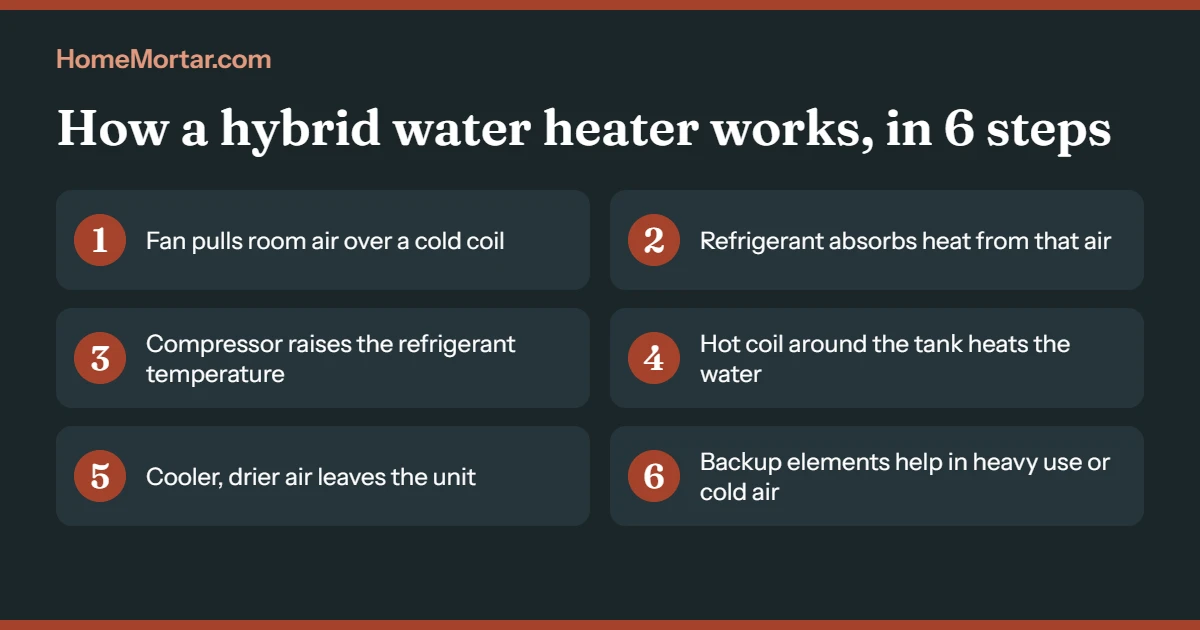
ENERGY STAR compares it to a refrigerator running in reverse. A fridge pulls heat out of a box and dumps it into the kitchen. A hybrid water heater pulls heat out of the room and dumps it into the water.
- A fan draws room air across a cold coil called the evaporator.
- Refrigerant in the coil absorbs heat from that air and turns to vapor.
- A compressor squeezes the vapor, which raises its temperature.
- The hot refrigerant flows through a coil wrapped around the tank and gives its heat to the water.
- The cooled air leaves the unit, a little drier than before.
- When the heat pump alone cannot keep up, the backup electric elements switch on.
Rheem describes the same cycle for its ProTerra models. It notes that the electric elements step in as the room air nears 37°F.
The operating modes
Most units let you pick a mode on the control panel. ENERGY STAR lists these:
| Mode | What it does | When to use it |
|---|---|---|
| Efficiency or Economy | Heat pump only | Lowest bills, normal demand |
| Auto or Hybrid | Heat pump first, elements when needed | Default for daily use |
| Electric or Heater | Elements only | Short spells of very high demand |
| Vacation or Timer | Sleep mode while you are away | Trips and empty homes |
Leaving a unit in Electric mode turns it back into an ordinary electric tank, with ordinary bills. That is an easy way to lose most of the savings.
When the backup elements take over
Sources give slightly different temperature points, so here they are side by side.
| Source | What it says |
|---|---|
| ENERGY STAR (cold climate article) | Works best in spaces at or above 40°F; keeps making hot water below that |
| ENERGY STAR (myths article) | Runs efficiently from 35°F to 120°F; below 35°F switches to electric resistance |
| A. O. Smith | Backup elements run outside a 37°F to 120°F range |
| Rheem | Elements help when air nears 37°F |
The practical reading is simple. A basement or garage that stays above about 40°F lets the heat pump do most of the work. A space that drops near freezing pushes the unit onto its elements and erases most of the savings.
How Efficient Is a Hybrid Water Heater?
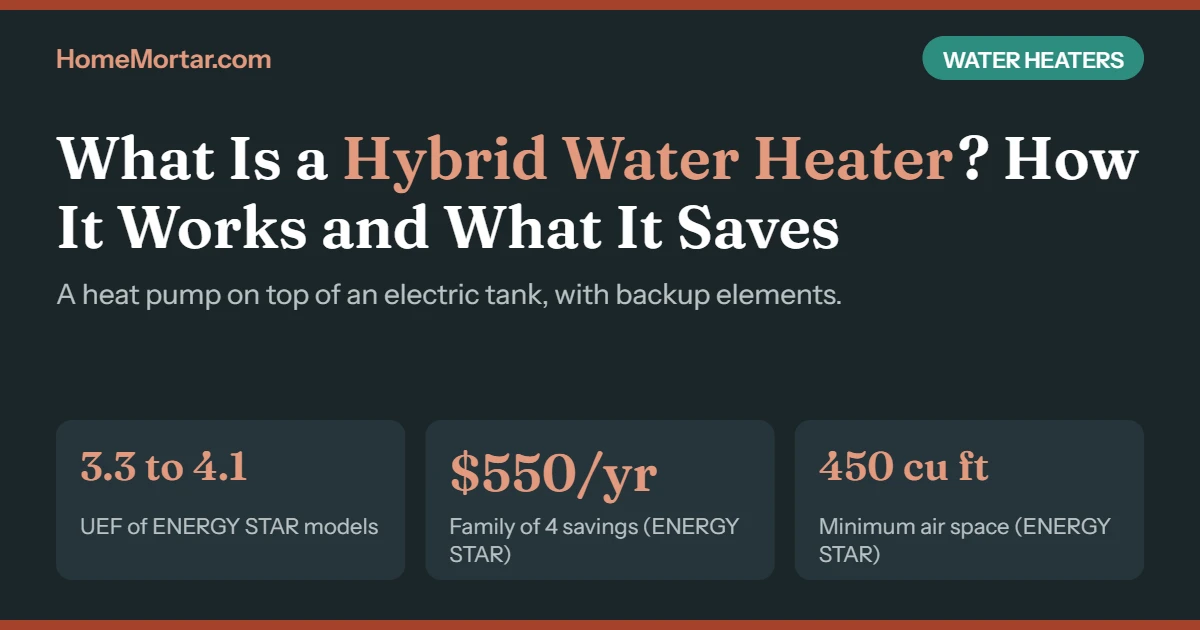
Water heater efficiency is rated as a Uniform Energy Factor, or UEF. ENERGY STAR explains that most traditional water heaters fall between 0.63 and 0.95. A standard electric tank sits around 0.93. Certified heat pump water heaters typically rate 3.3 to 4.1.
| Water heater type | Typical UEF (ENERGY STAR) | Heat delivered per 1 kWh used |
|---|---|---|
| Standard electric tank | About 0.93 | About 0.93 kWh |
| ENERGY STAR heat pump (hybrid) | 3.3 to 4.1 | 3.3 to 4.1 kWh |
A UEF above 1 is possible because the unit moves heat that already exists in the room instead of creating it. On these figures, a hybrid delivers roughly 3.5 to 4.4 times as much hot water heat per kWh as a standard electric tank. The DOE Energy Saver Guide gives a more cautious “two to three times,” which is a fair real world floor.
What a Hybrid Water Heater Saves in 2026
ENERGY STAR publishes a savings table for certified heat pump water heaters compared with a standard electric water heater. Its math assumes electricity at 14.6 cents per kWh, an extra $1,503 upfront and a 13 year life.
| Household size | Yearly kWh saved | Yearly savings (ENERGY STAR) | Payback (ENERGY STAR) |
|---|---|---|---|
| 2 people | 1,880 | $270 | 5.5 years |
| 3 people | 2,820 | $410 | 3.7 years |
| 4 people | 3,760 | $550 | 2.7 years |
Electricity costs more now. The U.S. Energy Information Administration projects the 2026 residential average at about 18.2 cents per kWh. Here is the same table rerun at that price, as a hypothetical example.
| Household size | Yearly kWh saved | Yearly savings at 18.2 cents | Payback on $1,503 extra |
|---|---|---|---|
| 2 people | 1,880 | about $342 | about 4.4 years |
| 3 people | 2,820 | about $513 | about 2.9 years |
| 4 people | 3,760 | about $684 | about 2.2 years |
Higher power prices make the hybrid look better, not worse. Your own numbers depend on your rate, your hot water use and the room the unit sits in. These savings compare against an electric tank. Against a gas tank, the result depends on your local gas and electric prices.
What It Costs to Buy and Install
ENERGY STAR says a heat pump water heater unit typically costs $1,500 to $3,000 before incentives. An informal survey of contractors it cites put labor and materials at another $1,000 to $3,000. Its rule of thumb is that installation can cost about as much as the unit.
| Cost item | Typical range | Source |
|---|---|---|
| Hybrid unit | $1,500 to $3,000 | ENERGY STAR |
| Installation, labor and materials | $1,000 to $3,000 | ENERGY STAR contractor survey |
| Hybrid unit (contractor view) | $1,800 to $3,500 | Barnett Plumbing, California |
| Standard electric tank unit | $500 to $1,200 | Barnett Plumbing, California |
| Utility rebate example | $750 | Atlantic City Electric customers |
Several extras push the price up. Common ones are a new 240V circuit, a condensate pump and a louvered door or ducting kit. Some areas also require a thermostatic mixing valve. Ask every installer to list these separately.
Where a Hybrid Water Heater Works, and Where It Struggles
Placement decides most of the savings. These are the checks to make before you buy.
How much air space it needs
This is where sources disagree the most.
| Source | Minimum surrounding air space | Room example given |
|---|---|---|
| ENERGY STAR | At least 450 cubic feet | About an 8 x 8 foot utility closet |
| Energy Trust of Oregon | 700 cubic feet or more | 7 x 10 x 10 feet |
| Barnett Plumbing | 750 to 1,000 cubic feet | Not given |
| Atlantic City Electric | More than 1,000 cubic feet | About a 12 x 12 foot room |
The manufacturer’s installation manual for your exact model is the rule that counts. To check a room, multiply length by width by ceiling height. An 8 by 8 foot room with a 7 foot ceiling holds 448 cubic feet. A 12 by 12 foot room with the same ceiling holds 1,008. A smaller space can work with a louvered door or a duct kit that pulls air from next door.
The temperature of the room
The best spots stay above 40°F all year and do not get extremely hot. Atlantic City Electric suggests 40°F to 90°F, and the DOE guide names the same range for the biggest savings. A basement near a furnace is ideal. An unheated garage in Minnesota is not, at least in January.
Split models solve the cold room problem by putting the compressor outdoors. ENERGY STAR says many split units keep heating water down to -25°F outside.
Noise
The compressor and fan make a steady hum. ENERGY STAR puts most new models at 45 to 60 decibels, about the range between a quiet refrigerator and a window air conditioner. Keep the unit away from bedrooms and home offices, or ask about a sound kit.
Cool, drier air
Because it pulls heat out of the room, the unit cools and dehumidifies the space around it. That is a bonus in a damp summer basement. ENERGY STAR cites a 2022 Slipstream study of 81 basement installs. It found an average room temperature drop of only 2.3°F, which returned to normal within four hours.
A Canadian study cited by ENERGY STAR found the extra winter heating load was offset by the water heating savings.
Condensate drainage
The coil pulls water out of the air, so the unit needs a drain line to a floor drain or a condensate pump. ENERGY STAR notes this water is clean and can go into existing drains. A blocked or poorly pitched line can overflow, so check it a few times a year.
Height and access
The heat pump sits on top of the tank, so a hybrid is taller than a standard tank of the same size. Measure the ceiling height and leave room to reach the air filter.
Hybrid Water Heater Pros and Cons
Pros
- Uses a fraction of the electricity of a standard electric tank.
- Saves an estimated $270 to $550 a year for 2 to 4 people, per ENERGY STAR, and more at 2026 power prices.
- Cools and dehumidifies the space around it.
- No combustion, no flue and no carbon monoxide from the water heater.
- Many models offer 10 year warranties, according to ENERGY STAR.
- Smart controls and modes on many models.
Cons
- Costs more upfront than a standard tank, often double or more installed.
- Needs space, a moderate room temperature and a drain.
- Makes a constant hum while running.
- Taller than a standard tank.
- Recovers more slowly in heat pump only mode, so many homes size up.
- Needs more upkeep: air filter cleaning and condensate checks on top of normal tank care.
These hybrid water heater pros and cons point to one pattern. The unit rewards homes with a good spot for it and penalizes homes without one.
Hybrid Water Heater vs Tankless vs Standard Tank
| Factor | Hybrid (heat pump) | Tankless | Standard electric tank |
|---|---|---|---|
| Fuel | Electricity | Gas or electricity | Electricity |
| Efficiency (UEF) | About 3.3 to 4.1 | 0.95 or higher for ENERGY STAR gas models | About 0.93 |
| Hot water supply | Stored tank, slower recovery in heat pump mode | Continuous up to a flow limit | Stored tank |
| Space needs | Large room or ducting | Small, wall mounted | Floor space only |
| Electrical | Usually one 240V circuit; some 120V plug-in models | Large circuits for whole house electric | One 240V circuit |
| Life | About 13 to 15 years (ENERGY STAR) | 15 to 20+ years | 10 to 12 years (ENERGY STAR) |
The hybrid water heater vs tankless choice usually follows your fuel. All electric homes with a basement or garage often do best with a hybrid. Gas homes that run out of hot water may lean tankless. Our guide to the pros and cons of tankless water heaters covers that side in detail.
Boiler owners have one more option: an indirect water heater. It stores hot water heated by the boiler instead of its own burner or elements.
Switching From a Gas Tank to a Hybrid
ENERGY STAR lists extra steps when a hybrid replaces a gas or propane tank:
- Electrical capacity. Most hybrids need a 240V circuit, and your panel must have room for it. An electrician should confirm this before you buy.
- Size up. Heat pumps recover more slowly than gas burners. ENERGY STAR suggests moving from 40 to 50 gallons, or from 50 to 65.
- Seal the old vent. The gas flue is no longer needed, and the opening should be sealed.
- Cap the gas line. A licensed installer caps the line that fed the old tank.
Rheem also sells 120V plug-in heat pump models built for gas replacements. They can often use an existing outlet instead of a new 240V circuit, but they recover more slowly. Ask whether one fits your household before paying for new wiring.
Safety note: 240V wiring, gas line capping and the temperature and pressure relief valve are jobs for licensed pros, and most areas require a permit. If you smell gas during removal, leave and call your gas utility from outside.
If you decide to keep gas, the vent type matters too. Our power vent vs direct vent water heater guide explains which one fits your space.
Sizing: Pick the Right Tank
Hybrids come in roughly 40, 50, 65 or 66 and 80 gallon sizes, depending on the brand. A. O. Smith suggests 50 gallons for smaller families, 66 for busy households and 80 for large tubs or several bathrooms.
Look at the first hour rating on the label, not just the gallons. ENERGY STAR explains that this figure shows how much hot water the heater can supply in its first hour of heavy use. Compare it with your busiest morning hour, with showers, a dishwasher or a washer running back to back.
Maintenance Checklist
- Air filter: clean it on the schedule in your manual. Barnett Plumbing suggests every 3 to 6 months, more often in dusty garages.
- Condensate drain: check that it flows and that the pump, if any, works.
- Anode rod: inspect it as you would on any tank water heater.
- Flush the tank: sediment still collects at the bottom. Our guide to flushing a water heater walks through the steps.
- Elements: if hot water runs short in Hybrid mode, a failed element may be the cause. Our guide on how to test a water heater thermostat covers the electric parts.
- Professional check: many manufacturers recommend a yearly service visit.
ENERGY STAR cites a typical life of 13 to 15 years for heat pump water heaters, and A. O. Smith gives 12 to 15. Good care helps you reach the top of that range. To read the age of an existing tank, see our guide to Rheem water heater age.
What Changed in 2025 and 2026
- The federal tax credit ended. The 25C credit covered up to $2,000 for heat pump water heaters. The IRS says it is not allowed for property placed in service after December 31, 2025. Some brand pages still advertise it. Utility rebates continue in many areas.
- A federal standard is on the way. DOE finalized new water heater efficiency standards in April 2024, with compliance on and after May 6, 2029. DOE says the rule will push more than half of new electric storage water heaters to use heat pump technology, compared with about 3% before.
- Search interest jumped. Google Trends shows U.S. searches for “hybrid water heater” peaking in April and May 2026. That was the highest level in five years, and interest settled back by fall.
- Savings estimates moved. ENERGY STAR’s savings page now shows about $550 a year for a family of four. Its 2024 cold climate article used $425.
Hybrid Water Heaters Outside the U.S.
Canada. A heated basement makes an ideal location. A Canadian study by the Canadian Centre for Housing Technology and the National Research Council found no rise in total home heating costs. ENERGY STAR cites it in its myths article.
United Kingdom. British homes often heat water through a boiler or an air-to-water heat pump feeding a hot water cylinder. A standalone hybrid tank is a less common choice there, so check what local installers offer before planning around one.
Australia. Air source heat pump water heaters are eligible for small-scale technology certificates under the Clean Energy Regulator’s scheme. The model must be on the regulator’s register and hold less than 425 liters. In Victoria, new homes on planning permit applications lodged from January 1, 2024 cannot connect to mains gas. Those homes need electric hot water, such as a heat pump system, or bottled LPG.

The Bottom Line
So, what is a hybrid water heater in practice? It is an electric tank that heats water mostly by moving heat from the air, with backup elements for heavy use. In the right room, it cuts water heating electricity sharply and pays back its higher price in a few years.
The right room matters. Give it enough air space, keep that space above about 40°F, plan for a drain and keep it out of earshot. If your home cannot offer that, a standard tank or a tankless unit may serve you better.
Frequently Asked Questions
What is a hybrid water heater and how does it work?
It is a heat pump water heater with backup electric elements. A fan and compressor move heat from the room air into the tank, and the elements help during heavy use or cold weather.
What is the life expectancy of a hybrid water heater?
ENERGY STAR cites 13 to 15 years, and A. O. Smith gives 12 to 15 years with regular maintenance. Standard electric tanks usually last 10 to 12 years, per ENERGY STAR.
Is it worth getting a hybrid water heater?
For most all electric homes with a suitable basement or garage, yes. ENERGY STAR estimates a 2.7 year payback for a family of four, and higher 2026 power prices shorten that further.
What is the difference between a regular water heater and a hybrid water heater?
A regular electric tank heats water directly with elements. A hybrid uses a heat pump to move heat from the air, and only uses its elements as backup. That makes it about three to four times as efficient.
How much does a hybrid water heater cost?
ENERGY STAR puts the unit at about $1,500 to $3,000, plus $1,000 to $3,000 for installation in many cases. Utility rebates can cut that; Atlantic City Electric, for example, offers $750.
Do you need to vent a hybrid water heater?
It needs no flue, because nothing burns. It does need enough surrounding air, or a duct kit that brings air from another room, plus a drain for condensate.
Does a hybrid water heater use gas?
No. It runs on electricity only. Some 120V plug-in models are designed to replace gas tanks with little electrical work.
Do hybrid water heaters need to be drained?
Yes, like any tank water heater, it benefits from a periodic flush to clear sediment. The condensate line also needs a regular check.
Which is better, a tankless or a hybrid water heater?
It depends on fuel and space. A hybrid usually wins in all electric homes with a good location. Tankless gas often wins where space is tight or hot water demand is continuous.