How to Test Water Heater Thermostat Parts With a Multimeter
Before you order a new part, spend 30 minutes with a multimeter. A failed heating element, a tripped reset button and a bad thermostat can all leave you with a cold shower. Each one has a different fix. Testing tells you which part has actually failed.
This guide shows how to test water heater thermostat controls on a standard electric tank. That covers the upper thermostat, the lower thermostat, the high-limit reset and both elements, with the readings you should expect at each step. Gas, tankless and heat pump models work differently, so they get their own section near the end.
Match the Symptom to the Likely Part
Start with what the water is doing. The pattern usually points to the upper or lower half of the tank before you open a single panel.
| What you notice | Most likely cause | What to test first |
|---|---|---|
| No hot water at all | Tripped high-limit reset, failed upper element or upper thermostat | Reset button, then upper element and upper thermostat |
| Water warm for a minute, then cold | Failed lower element or lower thermostat | Lower element, then lower thermostat |
| Hot water runs out much sooner than before | Lower element or lower thermostat, or heavy sediment | Lower element and lower thermostat |
| Water far too hot, or steam at the tap | Thermostat stuck closed | Turn the power off now, then test both thermostats |
| Reset button trips again and again | Thermostat stuck closed, grounded element or loose wire | Both thermostats and both elements |
| Breaker trips when the heater starts | Shorted element or damaged wiring | Elements first; call an electrician if wiring is burned |
Elements are a frequent culprit too. On Google Trends for the past five years, U.S. searches for “water heater element” have run well ahead of “water heater thermostat”. Check both parts in the same visit, and you will rarely have to open the panels twice.
How an Electric Water Heater Thermostat Works
Most residential electric tanks have two thermostats and two elements. Each thermostat is a temperature-operated switch clamped to the outside of the tank. It never touches the water. It senses the steel tank wall through a gap in the insulation.
The two thermostats do not share the work equally. Interplay Learning, a trade-training company, puts it simply: the upper thermostat is in charge, and it decides when the lower thermostat may run.
- When you use hot water, cold water enters at the bottom of the tank through the dip tube.
- The lower thermostat feels the cooler water and turns on the lower element, as long as the top of the tank is still hot.
- If the top of the tank cools, the upper thermostat switches power to the upper element instead.
- Only one element runs at a time on a standard home heater.
The upper thermostat also carries the high-limit switch, often called the ECO (energy cut-off). This is the red reset button. It cuts power to both elements if the water gets dangerously hot. White-Rodgers lists a fixed 170°F limit with manual reset for its 750-series controls, and that figure is common across residential heaters.
That design explains the symptoms in the table. A dead upper circuit stops all heating. A dead lower circuit leaves only the top of the tank hot, so the hot water runs out early.

Safety First: Read This Before You Open the Panels
An electric water heater runs on 240 volts in North America. That voltage can kill. Work only with the power off, and confirm it is off.
- Switch off the breaker for the water heater. Many are labeled “WH” or “water heater”. If yours has a separate disconnect switch near the tank, turn that off too.
- Test for voltage at the thermostat terminals with a non-contact tester or a multimeter set to AC volts. Do not trust the breaker label alone.
- Watch for hot water and hot metal. The tank, pipes and element bolts can stay hot for a long time.
- Stop if you see damage. Melted wire insulation, scorch marks or a burned terminal block need a licensed electrician or plumber.
- Never bypass the reset button. A tripped high-limit is protecting you from scalding water and tank pressure.
Some guides describe testing with the power on. Live testing at 240 volts is for trained technicians with proper meters and gloves. Everything below is done with the power off.
Tools You Need
- A digital multimeter that reads ohms (resistance) and AC volts
- A non-contact voltage tester
- A flathead and a Phillips screwdriver, and a 1/4 inch nut driver on some models
- Work gloves and safety glasses
- A phone to photograph the wiring before you disconnect anything
- An infrared or kitchen thermometer, for the tap check at the end
A basic multimeter is enough. You are looking for near-zero ohms (continuity) or an open circuit, not precise lab readings.
How to Test Water Heater Thermostat Parts, Step by Step
These steps follow the method used by appliance parts suppliers and HVAC trainers, written in the order a careful homeowner can follow. Terminal layouts vary by brand, so match each step to the diagram printed on your thermostat or in your manual.
Step 1: Turn off the power and confirm it
Switch off the breaker. Remove the upper access panel and fold back the insulation. Leave the plastic safety cover in place for now, and touch the voltage tester to the wires above it. No signal means you can continue.
Step 2: Check the reset button
Press the red reset button above the upper thermostat. A click means it had tripped. That alone can explain a sudden loss of hot water, but it rarely trips without a reason. Test the parts below anyway, because a thermostat stuck closed or a grounded element is a common cause.
Step 3: Photograph and disconnect the wires
Take a clear photo of every wire and terminal. Then disconnect the wires from the thermostat you are testing. Testing a thermostat while it is still wired to the elements can give false readings through the rest of the circuit.
Step 4: Set the multimeter
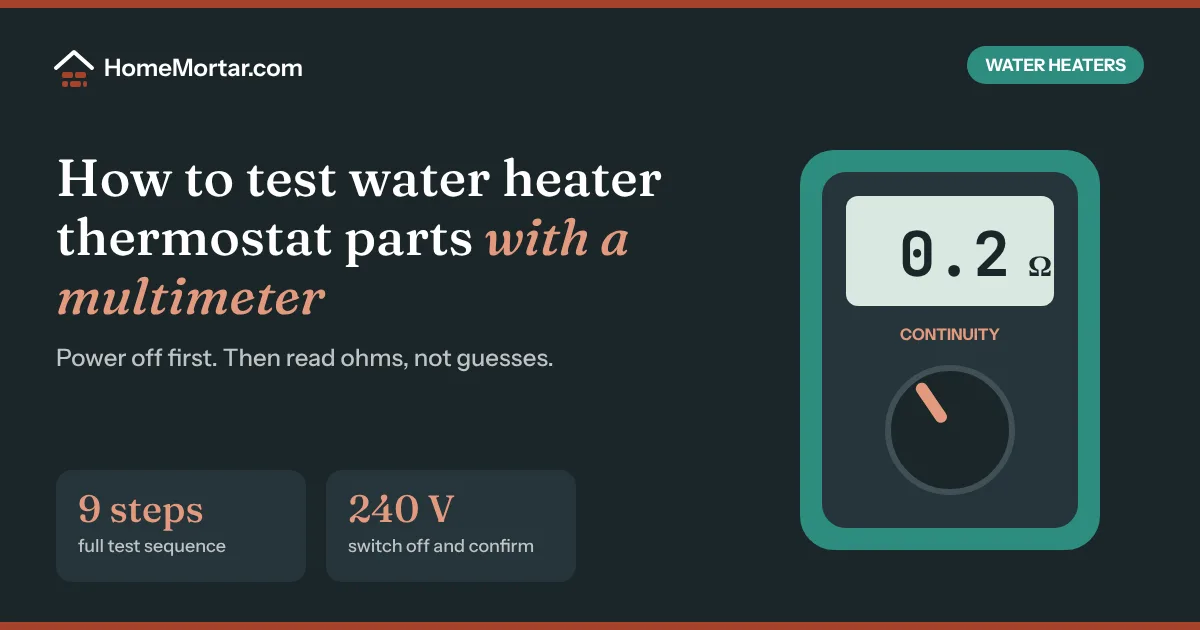
Turn the meter to its lowest ohms range. Touch the two probes together. It should read close to zero. That is what a closed, working circuit looks like.
Step 5: Test the high-limit (ECO) switch
Find the pair of terminals that run through the reset switch. On most upper thermostats, they sit at the top with the incoming power wires. With the reset pushed in, each pair should read near zero ohms. An open reading on a reset switch that is pushed in means the upper thermostat assembly has failed.
Step 6: Test the upper thermostat
Turn the dial all the way up, so the thermostat calls for heat. Probe from the common terminal to the terminal that feeds the upper element. You should see near zero ohms. Now probe from the common terminal to the terminal that feeds the lower thermostat. That path should be open.
Turn the dial all the way down. The results should swap: open to the upper element, near zero to the lower circuit. If a path stays open or closed no matter where the dial is, the upper thermostat is bad.
Step 7: Test the lower thermostat
Remove the lower panel and insulation, confirm there is no voltage and disconnect the wires. Turn the dial all the way up and probe across the two terminals. You should read near zero. Turn the dial all the way down, below the water temperature, and the reading should go open.
If the reading never changes, the lower thermostat has failed. Because water temperature affects the result, a tank that is already cold may read closed at both settings. In that case, judge it by the high setting and the element tests.
Step 8: Test both elements while you are there
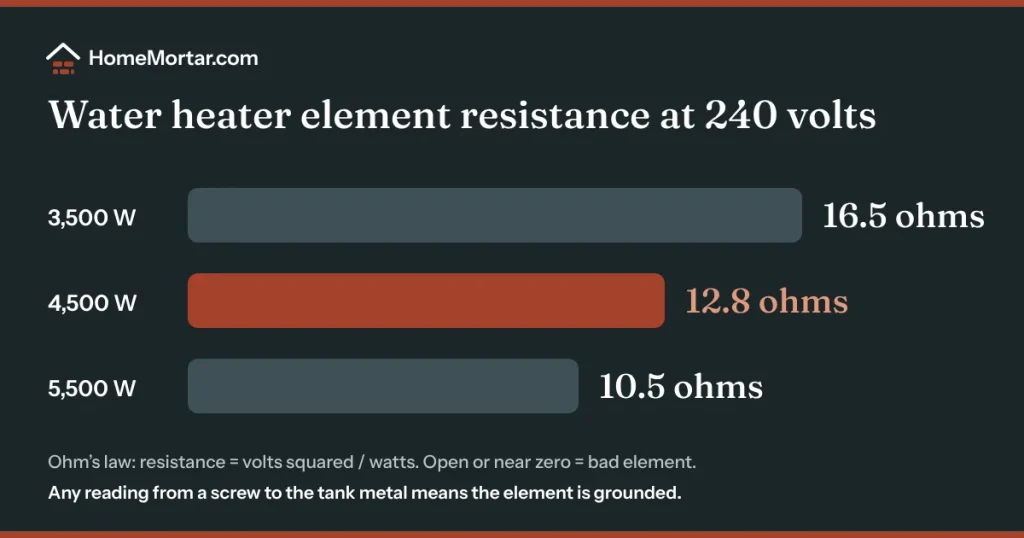
Disconnect one wire from each element. Probe across the two element screws. A good element reads a fixed resistance that depends on its wattage, shown in the table below. A reading of open, or close to zero, means the element is bad.
Then put one probe on an element screw and the other on the bare metal of the tank or the element’s mounting flange. Any reading at all means the element is grounded. A grounded element is a common reason a reset button keeps tripping.
| Element wattage | Expected resistance at 240 volts | Expected resistance at 208 volts |
|---|---|---|
| 3,500 W | About 16.5 ohms | About 12.4 ohms |
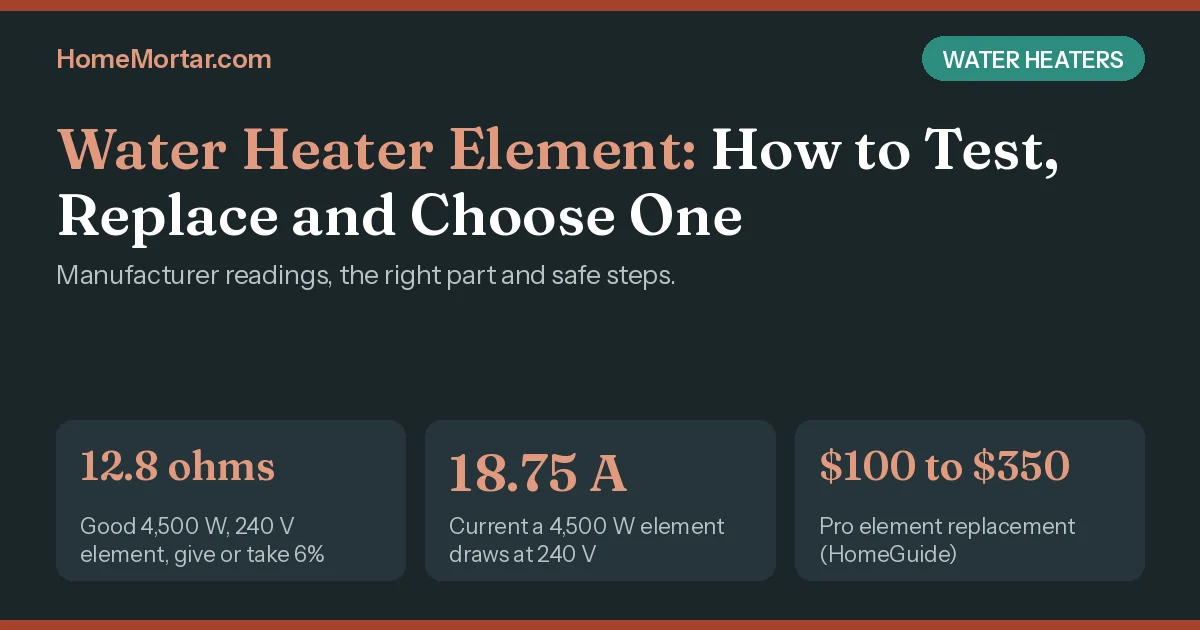
| 4,500 W | About 12.8 ohms | About 9.6 ohms |
| 5,500 W | About 10.5 ohms | About 7.9 ohms |
These values come from Ohm’s law: resistance equals voltage squared divided by wattage. Use the voltage and wattage stamped on the element or the rating plate. Expect a reading within a few percent, since meters and cold elements vary slightly.
Need the full element guide? Our water heater element article adds 120-volt readings, a plain-English ground test, and step-by-step replacement.
Step 9: Reconnect and restore power
Reconnect every wire exactly as it was in your photo. Tighten each screw firmly, because a loose terminal can overheat. Refit the safety covers, insulation and panels before you turn the breaker back on. Never run an electric tank with no water in it, as a dry element burns out within seconds.
Reading the Results
| What you found | What it means | Next step |
|---|---|---|
| All tests pass, reset had tripped | Possibly a one-off trip, or an early fault | Watch it; test again if the reset trips a second time |
| Upper thermostat paths do not switch | Upper thermostat failed | Replace the upper thermostat |
| Lower thermostat reads the same at both settings | Lower thermostat failed | Replace the lower thermostat |
| Element reads open or near zero | Element burned out | Replace the element (the tank must be drained) |
| Element reads to the tank metal | Element grounded | Replace the element |
| Everything tests good but water is still cold | Wiring, breaker or supply problem | Call a licensed electrician or plumber |
Replace thermostats with the same type. Single-element and dual-element heaters use different upper thermostats, and the wrong part may not fit the wiring.
How to Check Thermostat on Water Heater Units Without a Multimeter
You cannot fully test a thermostat without a meter, but you can narrow the problem down. Searchers ask this often, so here is what a simple check can and cannot tell you.
- Measure the tap temperature. Run the hot tap closest to the heater for a minute and hold a thermometer in the stream. Compare it with the dial setting.
- Use the run-out test. If hot water lasts only a few minutes, the lower circuit is the likely suspect.
- Feel the pipe. The hot outlet pipe should warm up within an hour of the water heater recovering. This only tells you that something is heating.
- Watch the reset button. If it trips again soon after you press it, stop pressing it and test or call a pro.
None of these checks proves which part failed. They tell you where to look. A multimeter costs less than most replacement parts, so it usually pays for itself on the first job.
Gas, Tankless and Heat Pump Models
The steps above are for standard electric tanks. Other types use different controls.
- Gas tank water heaters. The thermostat sits inside the gas control valve on the front of the tank. Homeowners can check the dial setting and measure tap temperature. Testing or replacing the gas valve, thermocouple or burner parts is a job for a licensed gas technician. If you smell gas, leave the house and call your gas utility from outside. Many homeowners have the gas water heater looked at during the yearly heating visit; our furnace tune-up cost guide explains what that visit should cover.
- Tankless water heaters. These use electronic temperature sensors and a control board. They show error codes. Look up the code in the manual before you touch anything.
- Heat pump water heaters. These also use electronic controls and sensors, plus backup elements. They report faults on a display. Most problems need the manual’s error code table or a qualified technician.
Heat pump models still use electric elements as backup. See what a hybrid water heater is for how the two work together.
Safe Temperature Settings in the U.S., Canada, UK and Australia
Once the thermostat works, set it correctly. The advice differs by country, mostly because of the balance between scald risk and Legionella bacteria.
| Country | What the authority recommends | Source |
|---|---|---|
| United States | Lower the water heater to 120°F | U.S. Consumer Product Safety Commission |
| Canada | Set the tank to 60°C (140°F), with mixing valves set to 49°C (120°F) at the tap | Public Health Agency of Canada |
| United Kingdom | Store hot water at 60°C or more, reaching 50°C at outlets within one minute | Health and Safety Executive |
| Australia | Store above 60°C; deliver no hotter than 50°C to bathroom fixtures | Government of South Australia |
The U.S. figure is a scald-prevention target. The CPSC warns that most adults suffer third-degree burns after two seconds in 150°F water, and burns also occur after six seconds at 140°F. The Department of Energy says turning the temperature down to 120°F can save $36 to $61 a year.
Canada, the UK and Australia favor storing water hotter and limiting the temperature at the tap with a mixing or tempering valve. If someone in your home is very young, elderly or has reduced sensation, a mixing valve fitted by a licensed plumber gives you both protections.
Homes in the UK and Australia also use different names and voltages. An electric tank is often called an immersion heater or an electric hot water system, and supply voltage is around 230 volts. The resistance math still works: a 3,000 W element at 230 volts should read about 17.6 ohms.
What Replacement Costs, and When to Replace the Heater Instead
A replacement thermostat for an electric tank is an inexpensive part. HVAC and plumbing company guides we reviewed put the part at roughly $15 to $50. They put a professional repair at roughly $100 to $350 with labor. One home services site lists higher figures, so get a local quote before you decide. These are published estimates, not quotes.
| Situation | Usually the better choice |
|---|---|
| Heater under about 8 years old, one bad thermostat or element | Repair it |
| Heater near or past 10 years, first repair | Repair is reasonable, but start budgeting for a new heater |
| Heater past 10 years with a leak, rust at the base or repeated failures | Replace the water heater |
| Any gas valve, venting or burner problem | Call a licensed gas technician |
Thermostats do not need the tank drained, because they mount on the outside of the tank. Elements do, since they sit in the water. If you are not comfortable with 240-volt wiring, a pro can usually test and replace both in a single visit.
Not sure how old the tank is? Our guides decode Rheem and Bradford White water heater age from the serial number.
Keep Your Thermostats Working Longer
- Flush sediment once a year. Hard water leaves scale at the bottom of the tank, which buries the lower element and makes it run hot. Our guide to flushing a water heater shows how to do it safely.
- Keep the setting moderate. Constantly running at the top of the dial adds wear and scald risk.
- Tighten connections during each check. Loose terminals heat up, scorch and ruin thermostats.
- Keep the insulation and covers in place. They help each thermostat read the tank wall accurately and protect the wiring.
- Test the relief valve as your manual directs. It protects the tank if a thermostat and the high-limit both fail.
Finding the Fault and Fixing It
Knowing how to test water heater thermostat controls saves you from guessing. Start with the symptom, check the reset button, then test the high-limit, the upper thermostat, the lower thermostat and both elements in one visit. Most no-hot-water problems are solved with a single inexpensive part.
If anything looks scorched, the readings make no sense or the heater is gas, hand it to a licensed pro. You can find more guides in our water heater section and our free HVAC tools. The Department of Energy compares tank, tankless and heat pump models in its guide to choosing a water heater.
Frequently Asked Questions
How do I know if my water heater thermostat is bad?
Common signs are no hot water, water that runs out quickly, water that is far too hot, or a reset button that keeps tripping. A multimeter test that shows a thermostat path that never switches confirms it.
How do you test a hot water heater thermostat with a multimeter?
Turn off the power and confirm it is off. Disconnect the wires, set the meter to ohms and check that each thermostat switches between near zero and open as you turn the dial. Test the reset switch and both elements too.
Which thermostat is bad on my water heater, upper or lower?
No hot water at all points to the upper circuit. Hot water that runs out fast points to the lower circuit. Testing both thermostats and both elements tells you for certain.
Why are there two thermostats on a hot water heater thermostat setup?
Two thermostats let a tank heat its top half first, so you get hot water sooner. The upper thermostat controls the sequence and passes power to the lower thermostat when the top is hot.
Can I replace the water heater thermostat myself?
On an electric tank, many handy homeowners can, with the power off and confirmed off. Use the same type of part and follow your photo when reconnecting the wires. Gas controls should be left to a licensed technician.
Do I need to drain the tank to replace an electric water heater thermostat?
No. Thermostats clamp to the outside of the tank. You only need to drain the tank to replace an element.
Why does my water heater reset button keep tripping?
A thermostat stuck closed, a grounded element or a loose, overheating wire are the usual causes. Stop resetting it and test those parts, or call a pro.
What should a water heater thermostat read on a multimeter?
A closed path should read close to zero ohms, and an open path should show no continuity. Which paths are closed depends on the dial setting and the water temperature.
Can a bad thermostat make water too hot?
Yes. A thermostat stuck closed keeps the element running. The high-limit should cut power around 170°F, but treat very hot water as urgent and turn the heater off.
What temperature should a water heater be set to?
In the U.S., the CPSC recommends 120°F. Canada, the UK and Australia favor storing water at 60°C and limiting tap temperature with a mixing valve.
How long does a water heater thermostat last?
There is no official lifespan. Thermostats often last as long as the tank, but heat, loose wiring and sediment shorten their life. If the heater is over 10 years old, weigh a repair against a new heater.