What Is EM Heat on Thermostat Screens, and When Should You Use It?

It is the coldest morning of the year, the house feels chilly, and a setting on the wall reads EM HEAT. Some thermostats show EMER, EM HT or a small red E instead. Press it at the wrong moment and your electric bill can jump. Ignore it at the right moment and you may sit in a cold house waiting for a repair.
So what is EM heat on thermostat controls? It is emergency heat, a manual mode that shuts off your heat pump’s compressor. Only the backup heat runs, usually electric heating strips in the indoor unit. It exists for one job, keeping you warm when the heat pump cannot run. It is not a stronger or faster heat setting.
EM Heat in One Minute
- EM heat appears only on thermostats wired to a heat pump. A gas furnace on its own has no emergency heat mode.
- Choosing it turns the outdoor heat pump off and runs the backup heat by itself, until you switch it back.
- Auxiliary heat uses the same backup source, but the system turns it on and off automatically.
- Electric resistance backup turns one unit of electricity into one unit of heat. A heat pump can move up to three times that, so EM heat costs far more per hour.
- Use it when the heat pump has failed, is buried in ice or was damaged. Do not use it just because it is cold outside.
What Does EM Heat Mean on Your Thermostat Display?
The label changes by brand, but the em heat meaning is the same everywhere: backup heat only, heat pump off. Thermostat makers describe it in their own support pages, which helps when the wording on your screen looks unfamiliar.
| What you see | Where it is common | What the maker says it does |
|---|---|---|
| EM HEAT or EM HT switch position | Honeywell heat pump thermostats | Locks out the heat pump compressor so only backup heat runs |
| Emergency Heat in Settings | Google Nest thermostats | Runs only backup heat until you manually turn it off |
| Modes, then Emergency heat | Lennox thermostats | Uses the second-stage supplemental heat by itself |
| Red E next to the system mode | Trane Home thermostats | Shows that Emergency Heat is switched on |
| EMER, E or a red light | Many other brands and older models | Usually the same backup-only mode; check the manual |
If the setting is missing on your thermostat, your home probably does not have a heat pump. Trane and Lennox both note that emergency heat is only offered on heat pump systems.
How a Heat Pump Heats, and Where Backup Heat Fits
A heat pump does not burn fuel. It pulls heat from outdoor air and moves it inside, which is why it can deliver more heat than the electricity it uses. The U.S. Department of Energy says a properly installed unit can deliver up to three times more heat energy than the electrical energy it consumes. As the outdoor air gets colder, there is less heat to collect, and the system works harder.
That is where the backup comes in. Most homes with heat pumps have electric resistance strips in the air handler, the indoor cabinet with the blower. Some dual-fuel homes use a gas or oil furnace as the backup instead. Your thermostat can call on that backup in two very different ways.
Normal heat mode
The heat pump does the work on its own. On mild winter days this is the cheapest way to heat a home with electricity.
Auxiliary heat, automatic
If you have ever wondered what is auxiliary heat, it is the same backup source working as a helper. Aux heat runs alongside the heat pump when the thermostat decides the heat pump needs help. Common triggers include a big jump in the setpoint, very cold outdoor air and the defrost cycle. Once the house catches up, the thermostat shuts the backup off again on its own.
Emergency heat, manual
EM heat is the one you choose. The heat pump stays off, the backup carries the whole load, and nothing changes until you switch the mode back. That is the key difference between em heat vs heat mode: one uses your most efficient heat source, and the other skips it completely.

Not sure your system is a heat pump at all? Our guide to what a heat pump looks like walks through seven quick checks, from the thermostat wires to the yellow label.
EM Heat vs Heat vs Aux Heat at a Glance
| Heat (normal) | Aux heat | EM heat | |
|---|---|---|---|
| Who turns it on | You select Heat | The thermostat, automatically | You, manually |
| Heat pump compressor | Running | Running | Locked out |
| Backup strips or furnace | Off | On for short periods | On for the whole call for heat |
| Typical reason | Everyday heating | Cold snap, defrost, big setpoint jump | Heat pump failure or damage |
| Running cost | Lowest | Higher while it runs | Highest |
| When it stops | When the room reaches the setpoint | When the heat pump catches up | Only when you switch modes |
Heat pump owners on forums often call the backup “strip heat”. Once you know that the strips are the same in both aux and EM modes, the confusion about the two labels usually clears up.
When You Should Switch to EM Heat
Think of emergency heat as a bridge to a repair, not a heating plan. These are the situations where it earns its place:
- The heat pump has stopped heating. The outdoor unit will not start, or the vents blow cool air in heat mode.
- The outdoor unit is encased in ice that will not clear. Light frost is normal in winter, and the defrost cycle handles it. A solid block of ice after an ice storm is not.
- The outdoor unit is damaged. A fallen branch, flooding or a broken fan blade are reasons to keep the compressor off.
- A technician tells you to use it. If a repair is scheduled for tomorrow, EM heat keeps the house warm without running a faulty compressor.
Honeywell’s support page describes the same idea in a sentence: the mode is typically used until a contractor can troubleshoot or fix the heat pump.
When You Should Not Use It
- Because it is cold outside. The heat pump and aux heat are designed to handle cold weather together. Forcing EM heat only removes your cheapest heat source.
- To warm the house faster. Backup heat does not make the air hotter than normal heat mode does in a way that saves time or money.
- All season, because the option exists. Google’s Nest support page warns that running emergency heat is usually expensive and inefficient.
- When you are not sure the heat pump has failed. Check the basics first, as shown later in this guide.
What EM Heat Costs to Run
Utilities and manufacturers agree that emergency heat raises bills, but few show the math. Here is a worked example with clearly stated assumptions. It is hypothetical; your strip size, run time and rate will differ.
The U.S. Energy Information Administration’s October 2026 outlook puts the average residential electricity price at 18.2 cents per kilowatt-hour for 2026. Assume a 10 kW strip heater runs 10 hours on a cold day. Compare it with a heat pump that delivers the same heat at an average efficiency of 2.5 units of heat per unit of electricity.
| Hypothetical cold day | Electricity used | Cost at 18.2 cents per kWh |
|---|---|---|
| EM heat: 10 kW strips for 10 hours | 100 kWh | $18.20 |
| Heat pump delivering the same heat (efficiency 2.5) | 40 kWh | $7.28 |
| Difference for one day | 60 kWh | $10.92 |
| Difference over a 7-day repair wait | 420 kWh | $76.44 |
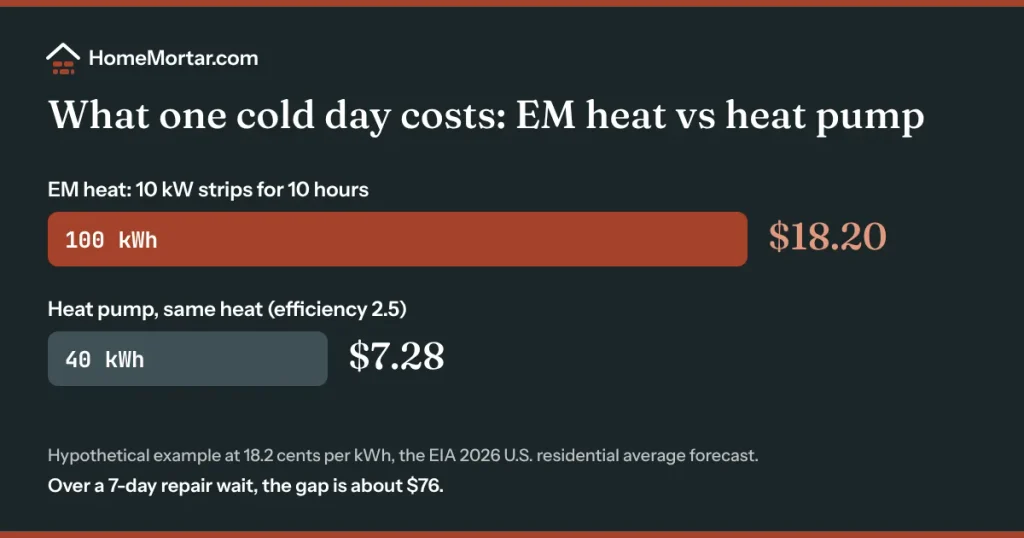
The point is not the exact dollars. It is the ratio. Electric resistance heat converts each kilowatt-hour into one kilowatt-hour of heat. A heat pump that moves two or three times as much heat will always be cheaper while it works.
Strip size matters too. Residential heat strips are commonly sold from about 5 kW to 20 kW, and each kilowatt equals about 3,412 BTU per hour. A 15 kW strip kit draws half again as much power as the 10 kW example above.
Why the EM or AUX Light Comes On by Itself
A light you never switched on can be alarming. Lennox lists two common reasons for an emergency heat indicator on its thermostats. Either the thermostat really is set to emergency heat, or the heat pump cannot keep up and the second stage, auxiliary heat, has kicked in. Many thermostats use similar lights for both.
Short bursts of backup heat are normal in three situations:
- Defrost. In winter, the outdoor coil collects frost, and the heat pump briefly reverses to melt it. North Georgia EMC notes that heat strips run during defrost, usually for no more than 30 minutes at a time.
- A big setpoint change. Raising the thermostat several degrees at once often brings on aux heat, because the heat pump alone would take a while to close the gap.
- Very cold outdoor air. Below a certain temperature, the heat pump cannot match the home’s heat loss, so the backup tops it up.
When the light stays on for hours on a mild day, treat it as a warning. Lennox and other makers point to refrigerant leaks, faulty sensors, compressor problems and frozen coils as typical causes. That is a job for a licensed technician.
Is It Bad If Auxiliary Heat Comes On?
Usually not. Searches like “why does my auxiliary heat keep kicking on” have climbed sharply on Google Trends. Most of those owners are seeing a system that works as designed. Aux heat is part of normal heat pump operation in cold weather.
Trane gives homeowners a few useful benchmarks in its guide to auxiliary heat:
- Aux heat commonly runs below about 40°F outside and during defrost. It also starts when you raise the setpoint more than 3 to 4 degrees at once.
- If aux heat keeps running above 40°F for more than an hour or two, something may be wrong.
- If a defrost cycle has not finished after an hour, the heat pump may need repair.
Those are guide figures, not universal rules. Your installer may have set a different outdoor lockout on your thermostat, so check its settings before you assume a fault.
How to Turn Emergency Heat On and Off
| Thermostat | To turn it on | To turn it off |
|---|---|---|
| Honeywell with a system switch | Move the switch to EM HEAT or EM HT | Move it back to HEAT |
| Google Nest | Settings, then Emergency Heat, then confirm | Choose Turn off in the same menu |
| Lennox | Modes, then Emergency heat | Select Heat or Auto |
| Trane Home app or portal | System Mode, System Options, Emergency Heat on | Same path, set Emergency Heat off |
| ecobee and other smart models | Look under the system or equipment mode menu | Return the mode to Heat or Auto |
Always switch back to Heat or Auto once the heat pump is repaired. Most thermostats will not do it for you, and Google notes that Nest keeps using emergency heat until you turn it off.
Accidentally Turned On Emergency Heat? Here Is What to Do
It happens often, especially in a new home or after someone presses buttons to “make it warmer”. The fix is quick, and nothing is damaged.
- Switch the mode back to Heat or Auto.
- Wait 10 to 15 minutes and check that the outdoor unit starts and the vents blow warm air.
- If you were on EM heat for days, expect a higher electric bill for that period.
- If the heat pump does not start after you switch back, it may have failed earlier. That could be why someone chose EM heat in the first place, so book a service call.
A home inspector or a previous owner may also have told you to “just use emergency heat”. Owners post this exact story on HVAC forums. Unless the heat pump is broken, that advice costs money every day it is followed.
Why the House Can Feel Cold on Emergency Heat
Many owners expect EM heat to feel hotter. Sometimes it feels weaker instead. Here is why:
- The strips may be sized as a helper. Backup strips are often chosen to support the heat pump, not to heat the whole house alone on the coldest night. On their own, they may fall behind.
- Some strips may be off. Larger kits are wired in stages or on separate breakers. If one breaker is off, only part of the backup runs.
- Airflow problems hurt any heat source. A clogged filter or closed vents reduce the warmth that reaches each room.
If the house will not stay warm on EM heat, keep interior doors open and call a technician. A licensed pro can check whether the strips, sequencers or breakers are working.
What to Check Before You Call a Technician
Some heat pump problems have simple causes. These checks are safe for most homeowners and need no tools.
- Confirm the thermostat is set to Heat or Auto, and that the setpoint is above room temperature.
- Replace a clogged air filter. A blocked filter starves the system of airflow.
- Look at the outdoor unit. Light frost that clears within a defrost cycle is normal. A thick shell of ice is not.
- Clear snow, leaves and debris from around the outdoor unit, keeping about two feet of open space if you can.
- Make sure supply and return vents inside are open and not blocked by furniture.
- Look for a tripped breaker labeled for the heat pump or air handler. If it trips again, leave it off and call for service.
Safety note: do not chip ice off the coil, open electrical panels or touch refrigerant lines. If your backup heat is a gas or oil furnace, keep a working carbon monoxide alarm on every level of the home. An old heat pump that keeps failing may simply be at the end of its life. Our guide to reading a Goodman serial number shows how to date one common brand. For a Lennox unit, use our Lennox age decoder.
At What Outdoor Temperature Should You Use EM Heat?
Advice online is all over the map. Some HVAC company blogs say the 20s. Others say below 30°F, 35°F or 40°F. Those numbers usually describe when a heat pump starts to need help, which is the job of aux heat, not EM heat.
The honest answer is that no outdoor temperature on its own calls for emergency heat. A working heat pump with automatic aux heat handles cold snaps without you touching the thermostat. Newer cold-climate heat pumps keep producing useful heat at much lower temperatures than older models, so the point where backup heat joins in keeps dropping.
Use EM heat because the heat pump has a problem, not because of the forecast.
Emergency Heat During a Power Outage
Emergency heat needs electricity like everything else in an all-electric home, so it will not help during a grid outage. It matters if you plan to use a generator. Strip heat draws a large load. A 10 kW strip kit needs about 10,000 watts on its own, which is more than many portable generators can supply.
If you rely on a generator in winter, ask an electrician which loads it can safely carry. Never run a generator indoors or in an attached garage, because its exhaust contains carbon monoxide.
Is a Space Heater Cheaper Than EM Heat?
A plug-in space heater is also electric resistance heat. It turns one kilowatt-hour into one kilowatt-hour of heat, exactly like heat strips. The difference is scale. A typical 1,500-watt heater warms one room, while a strip kit tries to warm the whole house.
So while you wait for a repair, heating only the rooms you use can cost less than running EM heat for every room. Follow the heater maker’s safety rules. Plug it straight into a wall outlet, keep it about three feet from anything that can burn and never leave it running unattended.
Thermostat Settings That Keep Backup Heat in Check
The best way to avoid big bills is to let the heat pump do as much of the work as it can.
- Change the setpoint in small steps. One or two degrees at a time keeps many thermostats from calling for aux heat.
- Go easy on deep night setbacks. Recovering from a large drop on a cold morning often brings on the strips. A smaller setback, or an earlier start time, helps.
- Use your smart thermostat’s outdoor limits. ecobee, for example, offers settings such as “compressor min outdoor temperature” and “aux heat max outdoor temperature”. A technician can set them so the strips stay off on milder days.
- Keep up maintenance. A clean filter, clear outdoor coil and correct refrigerant charge all reduce how often backup heat is needed. Our guide to furnace tune-up costs shows what a yearly heating check should include and what it costs.
Still choosing a winter setpoint? Our guide on whether 72 is a good temperature for heat in the winter compares comfort, cost and sleep.
When People Search for EM Heat, and Where
Interest in this question jumps with the weather. In Google Trends, U.S. searches for “emergency heat” peaked in late January 2026. That was the top week in five years, during a widespread cold snap. Earlier peaks line up with the December 2022 and January 2024 cold snaps. Between storms, interest falls back to a low, steady level.
Our keyword research from October 2026 showed U.S. searches for this exact question up 134 percent over the previous 12 months. Rising related searches on Google Trends tell the same story. People now ask “what does em heat stand for on a thermostat”, “em heat vs heat” and “is it bad if auxiliary heat comes on”.
| Country | What the data shows | What it means for you |
|---|---|---|
| United States | Highest interest; Florida, Nevada and Arizona lead for “em heat” | Heat pumps with strip backup are common, so the label is familiar |
| Canada | Rising searches for “honeywell em heat vs heat” and “em heat vs heat” | The same thermostats and the same advice apply |
| Australia | Almost no searches for “em heat” | The EM HEAT label is mainly a North American thermostat term |
| United Kingdom | Very few searches for “em heat” | The label is uncommon there; check your heat pump manual |
More homes now heat with heat pumps, so more owners meet the EM HEAT label for the first time on their first cold night. That is the gap this guide is built to fill.
The Bottom Line on Emergency Heat
If you were wondering what is EM heat on thermostat screens, the answer fits in one line. It is a manual, backup-only mode for when the heat pump cannot run. Use it to stay warm while you wait for a repair. Then switch back to Heat or Auto as soon as the heat pump works again.
Leave the day-to-day cold weather to the heat pump and its automatic aux heat. If the backup light keeps coming on by itself, or you find yourself reaching for EM heat often, book a licensed HVAC technician. You can find more help in our thermostat guides. The Department of Energy’s page on air-source heat pumps explains how the equipment works in more depth.
Frequently Asked Questions
What does EM heat mean on a thermostat?
EM heat stands for emergency heat. It turns off the heat pump and runs only the backup heat, usually electric strips. People searching what does em heat mean usually see it on a heat pump thermostat during cold weather.
What is emergency heat on a heat pump?
If you are asking what is emergency heat, think of it as the heat pump’s spare tire. It is the backup heat source running on its own, chosen by you when the heat pump has failed or is damaged.
Is EM heat the same as auxiliary heat?
They use the same backup source, but they are not the same mode. Aux heat turns on automatically and works with the heat pump. EM heat is manual and runs the backup without the heat pump.
Does emergency heat turn on automatically?
No. On most thermostats, emergency heat only runs when you select it. A light can still appear on its own when auxiliary heat runs, which is why the two are often confused.
Is it bad to run EM heat?
It will not usually harm the system, but it costs more to run. The bigger risk is leaving it on by mistake, which can hide a heat pump fault and raise your bill for weeks.
How long can you run emergency heat?
As long as you need to while you wait for a repair. It is meant to be temporary, so switch back to Heat or Auto as soon as the heat pump is fixed.
At what temperature should I use emergency heat?
There is no outdoor temperature at which you should switch to it. Cold weather alone is not a reason. Use it when the heat pump has stopped working or the outdoor unit is damaged or encased in ice.
Does EM heat use gas?
Usually not. Most homes with heat pumps have electric strip heat as the backup. In a dual-fuel system, the backup is a gas or oil furnace, and EM heat runs that furnace instead.
Why is my thermostat stuck on EM heat?
Most thermostats stay in emergency heat until you change the mode. Set it back to Heat or Auto. If the heat pump still does not run, call a technician.
Does a gas furnace have emergency heat?
No. The emergency heat setting only appears on heat pump systems. A furnace-only home has no heat pump to switch off, so there is no EM heat mode.
Why does my auxiliary heat keep kicking on?
Common reasons are cold outdoor air, defrost cycles and big setpoint changes. If it runs for hours on a mild day, a dirty filter, low refrigerant or a faulty sensor may be to blame. Call a technician.
Does emergency heat defrost the heat pump?
No. Defrost is an automatic heat pump cycle. Switching to EM heat simply turns the heat pump off. A coil that stays iced over needs a technician.
Is emergency heat dangerous?
Electric strip heat is generally safe when it is installed correctly. The main risk is cost. If your backup is a gas or oil furnace, keep carbon monoxide alarms working, as with any fuel-burning appliance.
What is EM heat on thermostat displays from Honeywell?
On Honeywell heat pump models, EM HEAT is a system switch position. It locks out the compressor and runs backup heat only, until you move the switch back to HEAT.
Em heat vs heat: which is cheaper?
Normal heat mode is cheaper whenever the heat pump works, because it moves heat instead of making it. EM heat costs more per hour, often two to three times more for the same warmth.
What does HEAT EMER mean on a thermostat?
EMER is short for emergency heat. On the Emerson 1F94-80, the system switch reads HEAT, EMER, OFF, COOL and AUTO. Its manual says EMER means the heat pump compressor is off while auxiliary heat holds the setpoint. Venstar’s T1700 uses an EMER HT button and shows EH on the display.
What is the emergency setting on my thermostat?
It is the emergency heat mode on a heat pump thermostat. Honeywell’s T6 Pro lists it as Em Heat in its system modes. It only appears when the thermostat is set up for a heat pump with a backup heat stage. Use it only when the heat pump has stopped heating, then call a technician.