Heat Pump vs Mini Split: Which System Fits Your Home?
The question sounds like a choice between two machines. In most cases it is not. A mini split is usually a heat pump too. The real decision is how the heat and cooling reach your rooms: through ducts, or straight from units on the wall and ceiling.
That shift matters because it changes cost, comfort and efficiency more than the brand on the box. Whether you search it as mini split vs heat pump or the other way around, the answer starts with your ducts.
This guide compares heat pump vs mini split setups the way a careful contractor would. You will see the three systems people actually choose between and what each costs in 2026. You will also see how efficient each one really is, and which one fits your house.
The Short Answer
| If your home has | The usual best fit |
|---|---|
| Good, sealed ductwork in most rooms | A central (ducted) heat pump |
| No ducts, such as radiators, baseboards or a boiler | Ductless mini splits |
| Ducts in part of the house plus an addition or ADU | A central heat pump plus one or two mini split zones |
| A few rooms that need conditioning without wall units | A ducted (concealed) mini split |
| Very leaky or undersized ducts | Ductless mini splits, or a duct repair before a central heat pump |
Both options heat and cool. Both use the same basic refrigerant cycle. The big differences are ducts, zoning, upfront cost and how the indoor units look.
Is a Mini Split a Heat Pump?
Usually, yes. Most mini splits sold today can reverse their refrigerant flow, which lets them heat in winter and cool in summer. That is exactly what a heat pump does. The U.S. Department of Energy calls them ductless mini-split heat pumps for that reason.
There is one exception people miss. Some mini splits are cooling only. They look the same on the wall but have no reversing valve, so they cannot heat. Check the spec sheet for a heating capacity and an HSPF2 rating. If both are listed, it is a heat pump.
So is a mini split a heat pump? Most are. Still, confirm it for the exact model you are quoted.
If you are not sure which system is already in your house, start with our guide to what a heat pump looks like, inside and out.
The Three Systems People Actually Compare
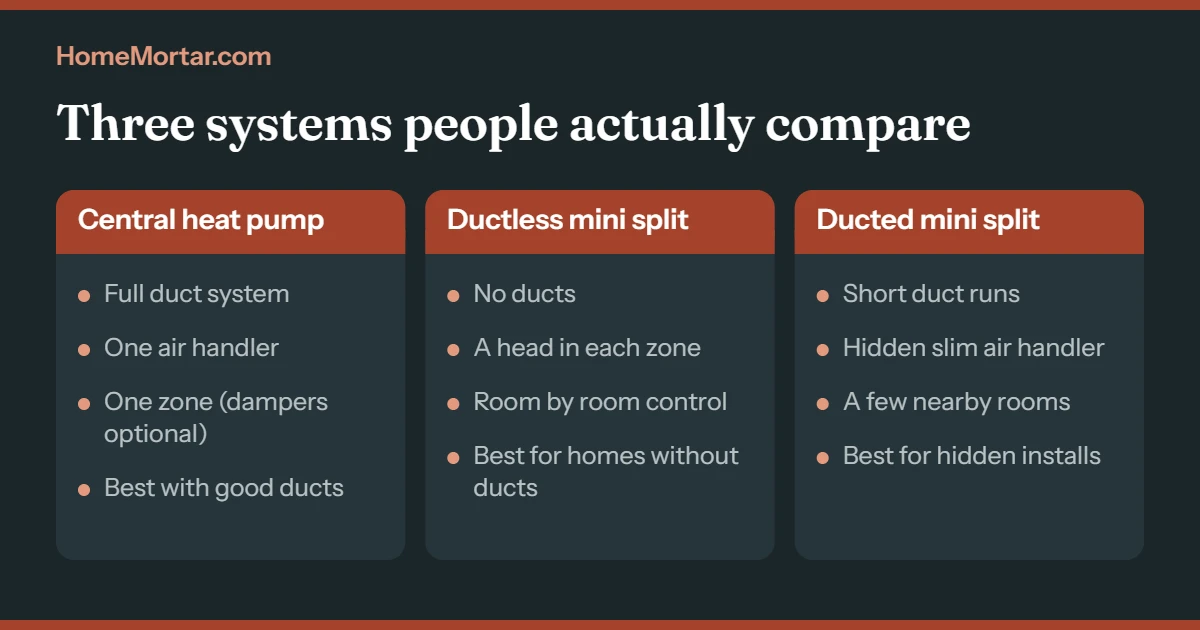
Most quotes fall into one of three setups. Knowing the names helps you compare bids that use different words.
| System | How air is delivered | Indoor equipment | Typical use |
|---|---|---|---|
| Central heat pump | Full duct system with supply and return vents | One air handler in a closet, attic or basement | Whole homes that already have ducts |
| Ductless mini split | No ducts, air blows straight into the room | One indoor head per zone on a wall, ceiling or floor | Homes without ducts, additions, single rooms |
| Ducted mini split | Short duct runs to a few nearby rooms | A slim concealed air handler | Small groups of rooms, hidden look |
The third option blurs the line. It uses mini split equipment with short ducts, so it hides the indoor unit but keeps the small, efficient outdoor unit. We cover it in depth in our guide to the ducted mini split.
The Two Systems Side by Side
| Factor | Central heat pump | Ductless mini split |
|---|---|---|
| Ductwork | Required, existing or new | Not needed |
| Zoning | One zone unless dampers are added | Each head is its own zone |
| Efficiency range (DOE) | About 15.2 to 25 SEER2 | About 15.2 to 35 SEER2 |
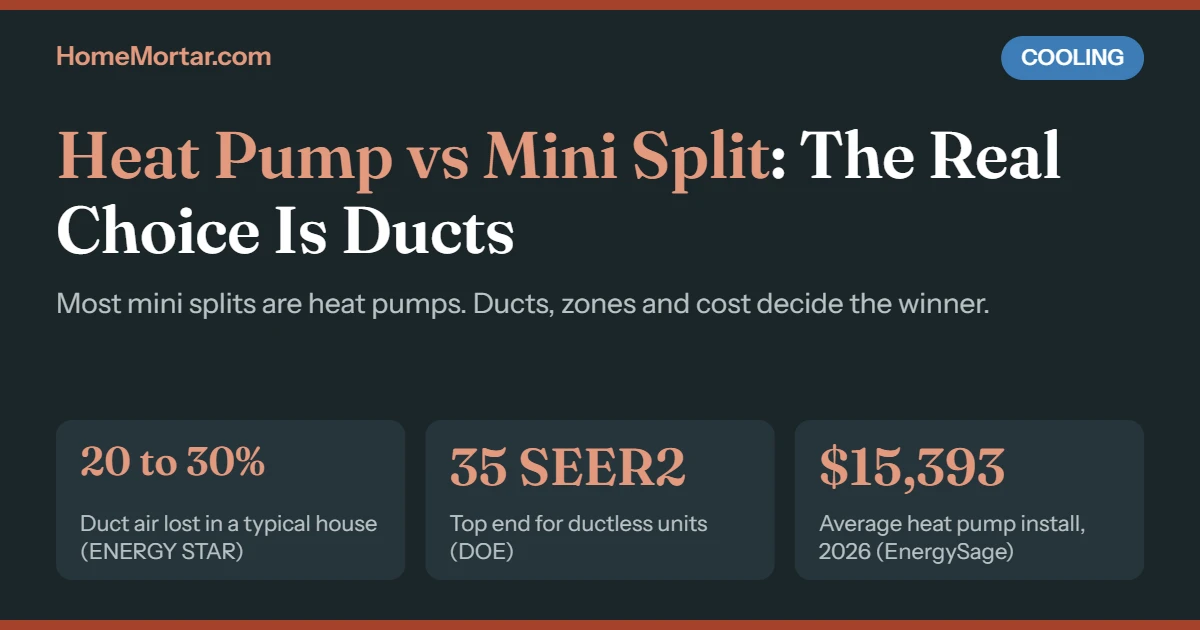
| Duct losses | Can be 20 to 30% of air in a typical house (ENERGY STAR) | None |
| Look indoors | Vents only | Visible head in each zone |
| Filtration | Larger filters at one air handler | Small washable filters in each head |
| Install | Simple if ducts are good | Line set and wiring to each head |
| Best for | Whole home with good ducts | Rooms or homes without ducts |
The efficiency numbers come from the DOE Energy Saver guide on ductless mini-split heat pumps. The duct loss figure comes from ENERGY STAR. It says a typical house loses about 20 to 30 percent of the air moving through its ducts to leaks, holes and poor connections.
Efficiency: Where the Real Gap Comes From
On paper, the best ductless units post higher SEER2 numbers than most ducted systems. In real homes, the bigger gap is usually the ducts.
A central heat pump with 18 SEER2 equipment can still waste energy if its ducts run through a hot attic and leak. A mini split with similar equipment avoids that loss because the air never leaves the room. That is why many energy programs push ductless units for homes that do not already have good ducts.
Some baseline numbers help when you read quotes:
- Federal minimum: since January 1, 2023, new split system heat pumps must reach at least 14.3 SEER2 and 7.5 HSPF2, according to AHRI.
- ENERGY STAR: split heat pumps need at least 15.2 SEER2, 7.8 HSPF2 and 11.0 EER2 to earn the label.
- Cold climate label: ENERGY STAR cold climate models must keep a COP of at least 1.75 at 5°F. They must also deliver at least 70% of their 47°F heating capacity.
If two quotes use the same efficiency class and your ducts are tight, running costs will often be close. If your ducts are leaky, the ductless option usually wins on the bill.
Why your electric bill can still be high
High bills with either system usually trace back to a few causes. The unit may be oversized and short cycling. Backup electric strips may be running too often. The house may leak air faster than any heat pump can keep up with. On a central system, the setting called emergency heat can run electric strips alone, which is costly. Our guide on what EM heat means on a thermostat explains when that happens.
Heat Pump vs Mini Split Cost
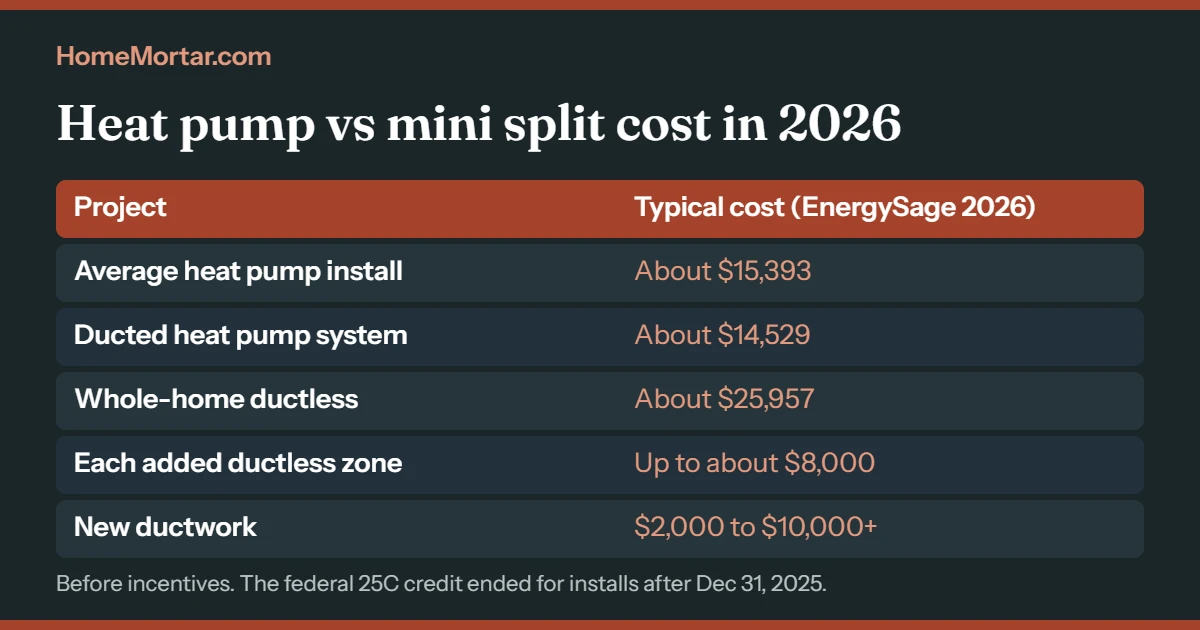
EnergySage marketplace data for 2026 gives a useful national picture, before any incentives:
| Project | Typical installed cost (EnergySage, 2026) |
|---|---|
| Average heat pump installation | About $15,393 |
| Ducted heat pump system | About $14,529 |
| Whole-home ductless system | About $25,957 |
| Each added ductless zone | Up to about $8,000 |
| New ductwork | About $2,000 for a small new home to more than $10,000 for a full retrofit |
Read these as ranges, not quotes. Prices swing with climate, brand, labor rates and how many zones you need.
The pattern is still clear. If you already have good ducts, a central heat pump is usually cheaper for a whole house. If you have no ducts, ductless often beats the cost of adding ducts plus central equipment, especially for a few rooms. Whole-home ductless gets expensive because every zone adds a head, a line set and labor.
One change matters for 2026 budgets. The federal 25C tax credit for heat pumps ended for equipment placed in service after December 31, 2025. Local utility and state rebates may still apply, so ask your installer what is open in your area.
What about a 2,000 square foot house?
There is no honest single price, because a 2,000 square foot house can need anything from two to five tons depending on climate and insulation. Use the EnergySage averages as a starting point, then get a room by room load calculation. For a single room, our mini split sizing calculator gives a quick BTU estimate based on ENERGY STAR guidance.
Running Cost: A Worked Example
Numbers make the duct question easier to see. This example is hypothetical, and your climate and rates will differ.
Say a house needs 30 million BTU of heat over a winter. Heating efficiency is rated in HSPF2, which is BTU of heat per watt hour of electricity. Electricity costs about 18.2 cents per kWh, the U.S. residential average EIA projects for 2026.
| Setup | Electricity used | Winter heating cost |
|---|---|---|
| Central heat pump, 8.0 HSPF2, tight ducts | 3,750 kWh | About $683 |
| Same unit, ducts losing 20% | 4,688 kWh | About $853 |
| Mini split, 10.0 HSPF2, no ducts | 3,000 kWh | About $546 |
The math is simple. Divide 30,000,000 BTU by the HSPF2 to get watt hours, then divide by 1,000 for kWh. For the leaky duct case, divide the kWh by 0.8 because only 80% of the heat reaches the rooms.
Two lessons stand out. Good ducts close most of the gap. And comparing efficiency ratings only works when you also account for where the air goes.
Comfort, Zoning and Air Quality
Zoning is the mini split’s strongest card. Each head has its own setpoint, so a cold basement office and a warm upstairs bedroom can run at different temperatures. A central heat pump treats the house as one zone unless you add motorized dampers.
Central systems have their own comfort strengths. Air spreads through many vents, so there are fewer hot or cold spots in small rooms like bathrooms and closets. A single central air handler can also hold a thicker, higher MERV filter than the small screens inside mini split heads.
Noise is close. Modern indoor heads are quiet, and so are well designed duct systems. The outdoor unit is usually the loudest part of either setup.
Cold Climate Performance
Both systems use the same outdoor technology, so cold weather performance depends on the model, not the category. Look for the ENERGY STAR cold climate label or published capacity at 5°F before you buy in a northern state or in Canada.
In freezing weather, every air source heat pump stops now and then to melt frost off its outdoor coil. On a mini split, a defrost light or a code on the display often shows when this happens. Our guide on what DF means on a mini split explains the normal pattern and when to worry.
Which One Fits Your House
Homes with good ductwork
A central heat pump usually makes the most sense. You reuse what you have, keep vents in every room and avoid visible indoor units. Ask the installer to test the ducts for leakage and seal them as part of the job.
Homes without ducts
Ductless mini splits shine here. Homes heated by radiators, baseboards or boilers can add cooling and efficient heat without tearing open walls for ductwork. Plan zones around how you live, not around one head per room.
Additions, garages and ADUs
A single mini split zone is often the cleanest answer for a new room or an accessory dwelling. It avoids overloading an existing central system that was never sized for the extra space.
Two story homes
Many two story homes have weak upstairs airflow. Options include a central heat pump with better ducts and zoning, or a central system downstairs with a mini split upstairs. New York’s Clean Heat program even publishes a guide for ductless setups in two story homes, which shows how common the question is.
A mixed setup
You do not have to pick one. Plenty of homes run a central heat pump for the main floors and a mini split for a bonus room. Some mini split outdoor units can serve both ductless heads and a ducted air handler on the same system.
Three Homes, Three Answers
These examples are hypothetical, but each one matches a situation homeowners describe all the time.
A 1990s two story house with ducts in the attic. The ducts are original and some joints have pulled apart. Swapping the old AC and furnace for a central heat pump makes sense here, but only if the ducts are tested and sealed first. Without that step, the new system pays for duct leaks every month. A mini split for a hot upstairs bonus room can fix the one zone the ducts never served well.
A 1920s house with a boiler and radiators. There are no ducts at all, and the walls are plaster. Ductless mini splits are the natural fit for cooling and for efficient shoulder season heat. The boiler can stay as backup for the coldest weeks. Four or five well placed heads usually cover the main rooms, and the zone plan matters more than the brand.
A new garage apartment. The main house has a central system that is already working hard. Running new ducts across the yard is not practical. A single zone mini split sized for the apartment keeps it comfortable without touching the main system. Our mini split sizing calculator gives a starting BTU figure for a space like this.
Can a Mini Split Heat a Whole House?
Yes, if the house is well insulated and the zones are planned well. Many efficient homes run entirely on ductless or ducted mini splits. The usual weak spots are small closed rooms such as bedrooms and bathrooms, which a head in the hallway cannot reach well.
Homeowners on Green Building Advisor describe this exact problem: ductless heads work great in open areas, but bedrooms with doors closed stay off target. A short ducted mini split for the bedroom wing is one way around it.
Central Heat Pump vs Mini Split: Pros and Cons
Here is the trade off in one place, written from the homeowner’s side. Most heat pump vs mini split decisions come down to these points.
Central heat pump pros
- Uses existing ducts, so no units on the walls
- Even airflow to small rooms, closets and bathrooms
- One filter location that can take a higher MERV filter
- Often cheaper for a whole house that already has good ducts
Central heat pump cons
- Duct leaks can waste 20 to 30% of the air, per ENERGY STAR
- One zone unless you add dampers and controls
- New ductwork in an older home is costly and disruptive
Mini split pros
- No duct losses and very high efficiency on the best models
- Room by room temperature control
- Easy to add to homes with radiators, baseboards or no ducts
- Small wall openings instead of new duct runs
Mini split cons
- Visible indoor heads in most rooms
- Cost climbs with every added zone
- Filters and drains to look after in each head
- Closed rooms far from a head may stay off target
Lifespan and Maintenance
Lennox puts the typical life of a heat pump at about 15 years. Mini splits use similar compressors and outdoor coils, so a similar range is a reasonable expectation with good care. Coastal air, poor drainage and skipped cleaning shorten that.
Maintenance differs. A central system needs a filter change at the air handler and a yearly service. A mini split needs each head’s filters washed, often monthly in heavy use. It also needs a periodic deep cleaning of the indoor coil and blower wheel by a pro. Refrigerant work on either system requires an EPA Section 608 certified technician.
Downsides to Know Before You Choose
Every option has trade offs. For central heat pumps, the main risks are poor ducts and one zone for the whole house. For mini splits, the common complaints are visible heads, higher cost per zone, condensate lines and filters to clean in every room.
We cover the mini split side in detail in our guide to the disadvantages of mini split systems. Read it before you sign a whole-home ductless quote.
Getting an Honest Quote
Homeowners often report that installers push whatever they install most. On Green Building Advisor, one homeowner described contractors who refused to quote a ducted mini split and steered him to ductless only. The fix is to ask the right questions.
- Ask for a room by room load calculation, often called Manual J, not a rule of thumb.
- Ask how the duct system will be tested and sealed if you go central.
- Ask for the exact model numbers and their SEER2, HSPF2 and 5°F capacity.
- Ask how many zones are planned for a mini split, and why.
- Ask what backup heat is included and when it runs.
- Ask which refrigerant the system uses and who handles service.
A good installer welcomes these questions. If the answers stay vague, get another bid.
What Changed in 2025 and 2026
- Tax credit gone: the federal 25C credit for heat pumps ended for systems placed in service after December 31, 2025.
- New refrigerants: since January 1, 2025, new residential split systems in the U.S. must use lower GWP refrigerants such as R-454B or R-32.
- R-410A install rule relaxed: a final EPA rule in May 2026 removed the January 1, 2026 installation deadline for R-410A equipment made before 2025. New York kept its own deadline.
- Search interest: Google Trends shows U.S. searches for this comparison running higher in 2026 than in 2025. Related searches such as “what is a heat pump” are rising too.
Outside the U.S.
United Kingdom. British guides split heat pumps into air-to-water and air-to-air. Air-to-water units feed radiators and hot water. Air-to-air units are what Americans call mini splits. Ofgem runs the Boiler Upgrade Scheme in England and Wales. It pays £7,500 toward air-to-water units and £2,500 toward air-to-air units. A temporary £9,000 grant covers eligible off-gas homes from July 21, 2026 to March 31, 2027.
Australia. A mini split is usually called a split system or a reverse cycle air conditioner. The comparison there is often split system versus ducted reverse cycle, which maps closely to this guide.
Canada. The same choices apply, but cold climate performance matters more. Look for published capacity at very low temperatures and plan backup heat for the coldest days.
Questions to Answer Before You Decide
Write down your answers to these before you call installers. They will steer every quote you get.
- Do I have ducts, and do they reach every room I care about?
- Have my ducts ever been tested for leakage, and where do they run?
- Which rooms are used most, and which sit empty most of the day?
- Do family members want different temperatures in different rooms?
- Am I comfortable with visible indoor units on the walls?
- How cold does it get here, and what backup heat do I have now?
- What is my budget before rebates, now that the federal 25C credit has ended?
If most answers point to good ducts and one shared comfort level, start with a central heat pump. If they point to missing ducts, separate rooms and different needs, start with mini splits.
The Bottom Line
The heat pump vs mini split choice is really a choice about ducts and zones. With good ducts, a central heat pump is usually the cheaper whole-home answer. Without ducts, or for rooms that need their own control, mini splits make more sense. Many homes do best with a mix.
Get a real load calculation, compare matched models on SEER2, HSPF2 and cold weather capacity, and budget without the old federal credit. Do that, and either system can keep your home comfortable for 15 years or more.
Frequently Asked Questions
Is a mini split cheaper to run than a central heat pump?
Often, yes, because a mini split has no duct losses and heats only the rooms you use. If your ducts are tight and inside the conditioned space, the gap shrinks. Compare the SEER2 and HSPF2 of the exact models.
What’s better, a heat pump or a mini split?
Neither is better in every home. A central heat pump suits homes with good ducts. A mini split suits homes without ducts, additions and rooms that need their own temperature. Many homes use both.
Can you heat and cool a whole house with a mini split?
Yes, in well insulated homes with well planned zones. Closed bedrooms and bathrooms are the usual weak spots. A ducted mini split or extra heads can solve that.
What are the disadvantages of a mini split heat pump?
Visible indoor heads, higher cost per zone, filters in every head and a condensate line for each one. Our full guide on mini split disadvantages covers each issue and how to manage it.
How much is a heat pump for a 2,000 square foot house?
EnergySage puts the average heat pump installation at about $15,393 before incentives in 2026. Your price depends on climate, ducts and size, so get a load calculation and at least two quotes.
What is the average lifespan of a mini split?
Expect roughly 15 years with good care, similar to the lifespan Lennox gives for heat pumps. Clean filters, clear drains and yearly checks help it last.
Is a ductless heat pump the same as a mini split?
In most cases, yes. A ductless heat pump is a mini split that can heat and cool. A cooling-only mini split is the exception.
Do I need backup heat with a heat pump or mini split?
In mild climates, often not. In cold climates, many homes keep electric strips, a furnace or a boiler as backup. Cold climate models reduce how often backup heat runs.