Ducted Mini Split: How It Works, Costs and When It Beats Ductless
Picture a mini split with no white box on the wall. The outdoor unit looks the same, but inside, the air comes out of a few small ceiling grilles. The equipment hides above a hallway ceiling or in an attic, and short ducts carry the air to the rooms around it.
That is a ducted mini split. It keeps the efficient inverter heat pump of a regular mini split and adds the clean look of central air. It also comes with a design catch that most store pages skip: the small blower inside can only push air so far. This guide explains how the system works and what static pressure means in plain words. It also shows where it fits best and what to ask before you buy one.
The Short Version
- It is a mini split heat pump with a concealed indoor air handler instead of a wall head.
- Short ducts carry air from that air handler to one room or a small group of nearby rooms.
- It heats and cools, just like a ductless mini split heat pump.
- Air handlers come in low, mid and higher static versions, which decides how much ductwork they can serve.
- It suits bedroom wings, additions, finished attics and homes where people do not want wall units.
- It needs careful duct design. A poor layout can make it noisy, weak or inefficient.
How a Ducted Mini Split System Works
This setup has the same core parts as any mini split. The difference is what happens inside the house.
- Outdoor unit. An inverter compressor and coil sit outside. The compressor speeds up and slows down to match the load instead of switching fully on and off.
- Line set and wiring. Two insulated copper refrigerant lines and a control cable run from the outdoor unit to the indoor unit.
- Concealed air handler. A slim indoor unit with a coil and a blower sits in a ceiling space, attic, crawlspace, soffit or closet.
- Short supply ducts. Ducts carry conditioned air to grilles in the ceiling, wall or floor of each room served.
- Return path. Air comes back through a return grille, often with the filter, or through a filter box at the air handler.
- Condensate drain. In cooling mode, the coil pulls water out of the air. A drain line or a small pump carries it away.
- Controller. A wall thermostat or a wireless controller runs the system, since there is no head with a built-in sensor in the room.
Carrier and Bryant both describe this layout on their product pages. Lennox sells its own multi-position mini split air handler for ducted use as well, which shows how mainstream the idea has become.
Ducted Mini Split vs Ductless vs Central Air
| Feature | Ductless mini split | Ducted (concealed) unit | Central system |
|---|---|---|---|
| Indoor unit | Visible head in each zone | Hidden air handler, one per zone | One large air handler or furnace |
| Ducts | None | Short runs to nearby rooms | Full duct system |
| Rooms per indoor unit | Usually one open area | Several nearby rooms | The whole house or a large zone |
| Look | Head on wall or ceiling | Grilles only | Grilles only |
| Duct losses | None | Small if ducts stay indoors | Can be 20 to 30% of air (ENERGY STAR) |
| Design sensitivity | Low | High, static pressure matters | Moderate |
| Typical fit | Single rooms, open plans | Bedroom wings, additions, hidden installs | Whole homes with ducts |
The ducted mini split vs ductless choice often comes down to two things. Will you accept a head on the wall, and are the rooms closed off? A ductless head in a hallway cannot heat three bedrooms with their doors shut. A small ducted unit above that hallway can.
Static Pressure, Explained Plainly
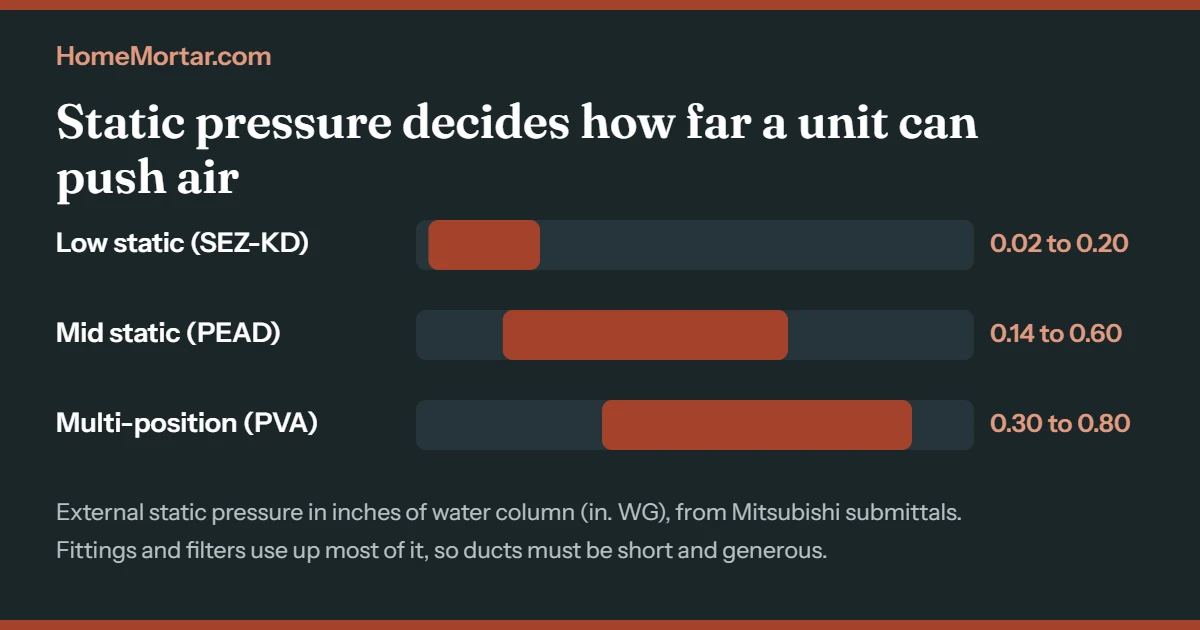
Static pressure is the resistance the blower has to push against. Every foot of duct, every elbow, every grille and the filter adds a little. Pros measure it in inches of water column, written “in. WG.”
Big furnace blowers can push hard. Many mini split air handlers cannot, because they use small, quiet, efficient fans. That is the single biggest design limit of a concealed duct mini split.
Manufacturer submittals show the range clearly. Here are Mitsubishi Electric’s published numbers for three common indoor unit types.
| Mitsubishi unit type | External static pressure range | Body height | What it suits |
|---|---|---|---|
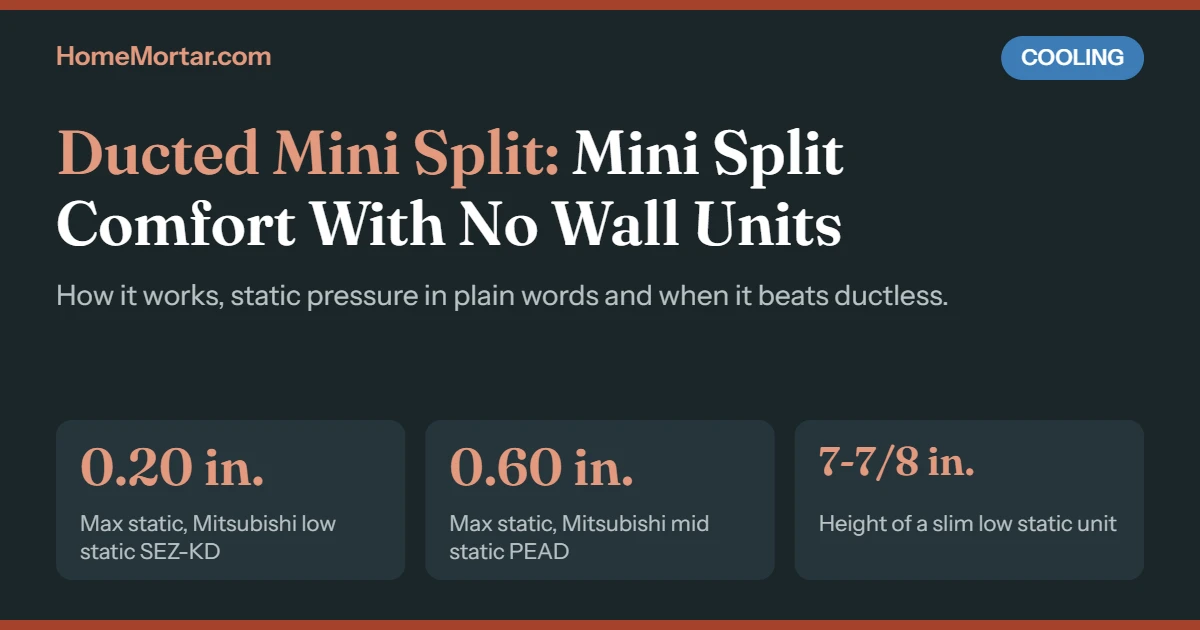
| SEZ-KD low static ducted | 0.02 to 0.20 in. WG | 7-7/8 in. | Very short runs to one or two rooms |
| PEAD mid static ducted | 0.14 to 0.60 in. WG | 9-7/8 in. | Several rooms with planned ductwork |
| PVA multi-position air handler | 0.3, 0.5 or 0.8 in. WG settings | Full size cabinet | Longer runs, some existing duct systems |
The numbers come from Mitsubishi submittal sheets and distributor spec pages. Other brands publish similar data. Always read the exact model’s sheet, because static ranges vary by size and fan setting.
Low static (slim duct) units
These are the thinnest and quietest. They work best when the air handler sits right next to the rooms it serves, with short, straight, generous ducts. Mitsubishi describes its SEZ-KD line as a concealed unit “for applications with short duct runs.”
Mid static units
Mid static units can push air through more duct, more fittings and more grilles. They are the usual choice for a bedroom wing or a finished basement with several rooms.
Multi-position air handlers
These look like small furnace air handlers and can mount upright, sideways or upside down. Higher static settings let them serve longer duct systems. They are the most likely candidates for reusing part of an existing duct system.
Why fittings matter more than length
Building scientist Allison Bailes has pointed out that duct fittings drive pressure loss far more than straight duct. He explains this in his article on a myth about low-static ducted mini-splits. Bigger ducts and smoother fittings let even a low static unit serve more ductwork than many people expect.
In practice, that means a good designer uses larger ducts, long radius elbows and fewer sharp turns. A careless install with tight flex duct and many bends can choke the same unit.
Can You Run a Mini Split Through Existing Ductwork?
Sometimes, but not by default. Old duct systems were sized for big furnace blowers. Hooking a low static mini split to them often means weak airflow, noise and poor comfort.
Here is how a careful contractor checks it:
- Measure the existing system’s static pressure with the current blower running.
- Check duct sizes against the airflow the new unit needs.
- Test the ducts for leakage, especially runs in attics and crawlspaces.
- Match the result to an air handler with enough static capacity, often a mid static or multi-position model.
On Green Building Advisor, one homeowner reported a measured 0.26 in. WG on a second floor system. That is beyond a typical low static unit but within reach of many mid static models. The lesson is to measure, not guess.
How Many Rooms and Square Feet Can It Serve?
There is no fixed number. It depends on the heating and cooling load of the rooms, not on square footage alone. A well insulated 600 square foot bedroom wing may need less capacity than a sunny 400 square foot room with big windows.
As a rough guide, small ducted units of 9,000 to 12,000 BTU often serve one to three rooms. Mid static units in the 18,000 to 30,000 BTU range can serve a floor or a wing. One Green Building Advisor contributor described serving about 2,000 square feet with one ducted unit when the ducts were sized properly. Treat that as one person’s experience, not a rule.
For a single room estimate, our mini split sizing calculator uses ENERGY STAR room AC guidance. For a full home or wing, ask for a Manual J load calculation.
Three Layouts That Usually Work
These hypothetical layouts match the situations where concealed units earn their keep. Each one keeps the air handler close to the rooms it serves.
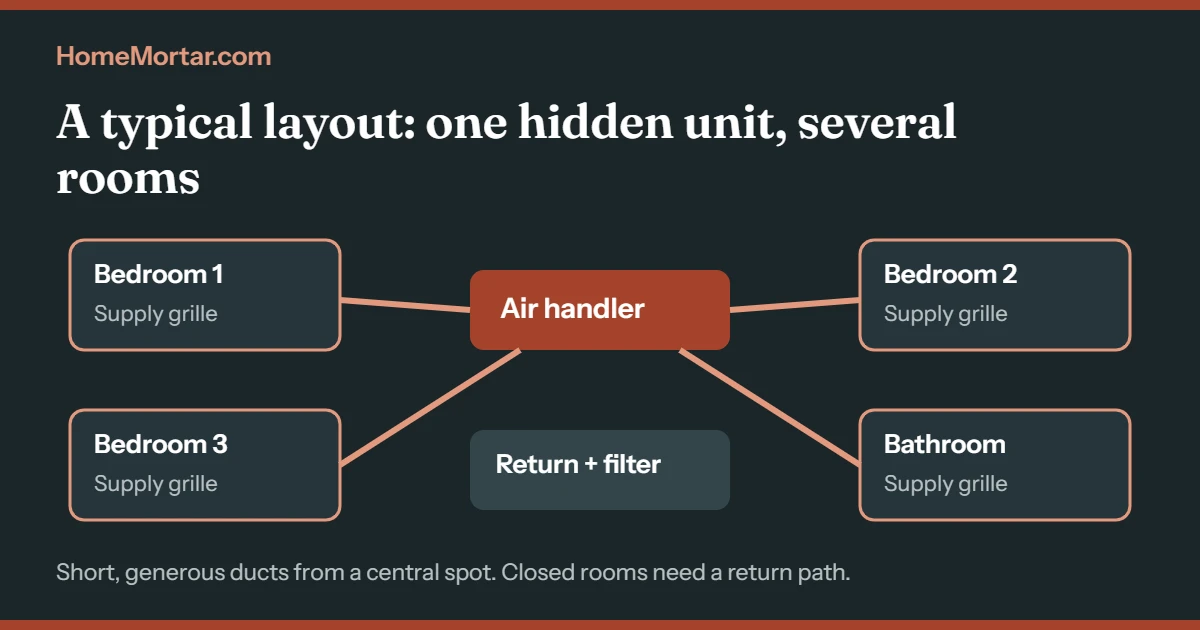
A bedroom wing off one hallway. Three bedrooms and a bathroom sit along a short hall. A slim mid static unit goes above a dropped section of the hallway ceiling. Short ducts feed a grille near the door of each bedroom, and a single return grille in the hall holds the filter. Each bedroom gets air even with the door shut. It just needs a return path, such as a door undercut or a transfer grille.
A finished attic or bonus room. Upstairs rooms under the roof often run hot in summer because the main system was never sized for them. A small concealed unit in the knee wall space serves two rooms through short runs. The ducts stay inside the insulated envelope, which protects efficiency.
A finished basement. A basement family room, office and guest room sit close together. A unit mounted between the joists sends air through short runs to each space, and a condensate pump carries water to the floor drain. The basement then runs on its own schedule instead of fighting the main floor thermostat.
In each case, the design rule is the same. Keep the unit central to its rooms, keep the ducts short and generous, and give the air a clear way back to the return.
Where the Air Handler Goes
| Location | Pros | Watch out for |
|---|---|---|
| Dropped hallway ceiling | Short runs to bedrooms, easy access panel | Needs a few inches below the joists |
| Attic | No interior space lost | Heat and cold reduce efficiency, needs a drain pan |
| Closet | Easy filter access, inside the home | Takes storage space, needs a return path |
| Crawlspace or basement | Good for floor registers | Moisture, access and drain routing |
| Soffit or bulkhead | Hidden in kitchens and bathrooms | Tight space, plan service access |
Mitsubishi’s slim units measure about 7-7/8 inches tall for the low static line and 9-7/8 inches for the mid static line. Carrier says its ducted units typically need about 10 to 14 inches of vertical clearance. Add room for the drain and service.
Plan these details before installation:
- An access panel large enough to remove the filter, clean the coil and reach the blower.
- A secondary drain pan with a float switch when the unit sits above finished ceilings.
- A condensate pump if gravity drainage is not possible. Many units include a built-in condensate lift.
- Insulated ducts if any duct runs through an attic, garage or crawlspace.
Benefits of a Ducted Mini Split
- No wall units. Rooms show only small grilles, which suits historic homes and modern interiors alike.
- Closed rooms get air. Bedrooms and bathrooms off a hallway can share one hidden unit.
- Quiet operation. The blower sits away from the room, and inverter compressors ramp gently.
- Better filtration than small heads. A return filter box can hold a larger filter than the screens inside wall units.
- Efficient equipment. Mini split heat pumps run at variable speed and avoid long duct losses when the ducts stay indoors.
- Mix and match. Many multi-zone outdoor units can run a ducted air handler and ductless heads together, as Carrier notes in its FAQ.
Drawbacks to Weigh
- Design sensitive. Static pressure limits mean the ductwork must be planned, not improvised.
- Fewer experienced installers. Homeowners on Green Building Advisor report contractors who refused to quote ducted units or tried to talk them out of it.
- Access for service. A hidden unit still needs filter changes and cleaning. A poor access panel turns a five minute job into a ceiling repair.
- Attic placement costs efficiency. An air handler and ducts in a hot attic lose some of the efficiency advantage.
- Condensate risk. A clogged drain above a ceiling can cause water damage if there is no secondary pan and safety switch.
- Cost. Concealed units and ductwork usually cost more than a simple wall head for the same room.
For the wider list of mini split trade offs, see our guide to the disadvantages of mini split systems.
Ducted Mini Split Cost
We did not find a reliable national average for concealed duct installations specifically. Quotes vary too much with ductwork, ceiling work and the number of rooms. Here is what we can say with sources behind it.
| Cost item | Reference point |
|---|---|
| Ducted heat pump system (all types) | About $14,529 average before incentives (EnergySage, 2026) |
| Each ductless zone | Up to about $8,000 (EnergySage, 2026) |
| New ductwork | About $2,000 to more than $10,000 (EnergySage, 2026) |
| Single zone equipment only | Retail listings for concealed duct kits run from about $1,100 to $1,800 for some brands, before installation |
The last row comes from one retailer’s listed prices in October 2026 and covers equipment only. Installation, ductwork, electrical work, permits and finish repairs often cost more than the equipment.
The federal 25C tax credit no longer applies to heat pumps placed in service after December 31, 2025. Check your utility and state programs for rebates.
Can You Install One Yourself?
Some brands sell pre-charged DIY mini split kits, and search interest in DIY brands has jumped in 2026. A few of those lines include ducted air handlers. They let a handy owner avoid opening the refrigerant circuit, but the rest of the job is still real work.
Safety and rules: the system runs on a dedicated 240 volt circuit in most cases, and local codes often require a permit and an inspection. Any work that opens the refrigerant circuit requires an EPA Section 608 certified technician in the U.S. Newer systems use A2L refrigerants that are mildly flammable, which adds handling rules. Check the warranty terms too, since some brands require professional installation for full coverage.
If you are unsure about electrical work, duct design or condensate drainage above a ceiling, hire a licensed contractor for those parts.
Questions to Ask Your Installer
- Which exact indoor unit will you use, and what static pressure range does it have?
- What static pressure do you expect from the planned ducts, filter and grilles?
- How will the ducts be sized, and will you use rigid duct or flex?
- Where will the filter go, and how will I reach it?
- Is there a secondary drain pan and a float switch?
- Did you run a Manual J load calculation for these rooms?
- Can the outdoor unit also run ductless heads later, if I add rooms?
A contractor who answers these clearly has done this kind of work before. Vague answers are a warning sign.
Maintenance Checklist
- Monthly in heavy use: check the return filter and clean or replace it.
- Each season: make sure the condensate drain flows and the pump, if any, runs.
- Each season: keep the outdoor unit clear of leaves, snow and plants.
- Yearly: have a technician clean the coil and blower, check refrigerant performance and inspect the drain pan and safety switch.
- As needed: look up the error code on the controller before calling for service. Our guide on what DF means on a mini split covers the defrost signal you may see in winter.
What Changed in 2025 and 2026
- Lower GWP refrigerants. New U.S. residential split systems made since January 1, 2025 use refrigerants such as R-454B or R-32. Lennox notes that its ducted air handler for mini split systems is compliant with the 2025 EPA rules.
- R-410A install deadline lifted. A May 2026 EPA rule removed the January 1, 2026 installation deadline for R-410A equipment built before 2025. New York kept its own deadline.
- Search interest is up. Google Trends shows U.S. searches for ducted mini splits peaking in spring 2026, well above 2025. Queries about DIY brands rose fastest.
- No federal 25C credit for heat pumps installed in 2026.
Ducted Mini Splits Outside the U.S.
United Kingdom. These systems count as air-to-air heat pumps. Under Ofgem’s Boiler Upgrade Scheme in England and Wales, residential air-to-air heat pumps can get a £2,500 grant, compared with £7,500 for air-to-water systems.
Australia and New Zealand. Ducted reverse cycle systems are common, and the same static pressure logic applies. Mitsubishi Electric New Zealand lists its PEAD ducted units with selectable static settings from 35 to 125 pascals. That is the metric way of writing the same limit.
Canada. Cold climate performance matters most. Check the published heating capacity at low outdoor temperatures and plan backup heat for the coldest days.
The Bottom Line
A ducted mini split gives you mini split efficiency with no units on the walls. It works best for a small group of nearby rooms, with the air handler close by and the ducts designed around its static pressure. Get that design right and it is quiet, hidden and comfortable. Get it wrong and no brand will fix it.
Compare the concealed option with ductless heads and a central system using the table above, then ask the installer the seven questions. If you are still deciding between system types, our guide to heat pump vs mini split walks through the whole choice.
Frequently Asked Questions
Is there such a thing as a ducted mini split?
Yes. Most major brands, including Mitsubishi Electric, Carrier, Bryant, Daikin and Lennox, sell concealed or ducted indoor units that connect to mini split outdoor units. They are also called slim duct, concealed duct or compact ducted units.
Is a ducted or ductless mini split better?
Neither wins everywhere. Ductless heads are simpler and cheaper for single open rooms. Ducted units are better for closed rooms off a hallway and for people who do not want wall units.
How much does a ducted system like this cost?
We found no reliable national average for this specific system. EnergySage puts ducted heat pump systems at about $14,529 on average in 2026, and new ductwork alone can run $2,000 to more than $10,000. Get at least two itemized quotes.
How many square feet can one ducted unit cool?
It depends on the load of the rooms. Small units often serve one to three rooms, and larger mid static units can serve a wing or floor. A Manual J load calculation gives the real answer.
Can you run a mini split through existing ductwork?
Sometimes. The ducts must be tested for static pressure, size and leakage first. Mid static or multi-position air handlers are the most likely to work with older ducts.
Are ducted mini splits efficient?
Yes, when the ducts are short, well sealed and inside the home. They use the same inverter technology as ductless units. Long runs through a hot attic or poor duct design reduce the advantage.
Is a hidden ductless mini split the same thing?
People use that phrase for a concealed duct mini split. The air handler is hidden and connected to short ducts, so strictly speaking it is not ductless, but the idea is the same.
Can I mix ducted and ductless units on one outdoor unit?
Often, yes. Many multi-zone outdoor units accept both ducted air handlers and ductless heads. Check the brand’s approved combinations before you buy.